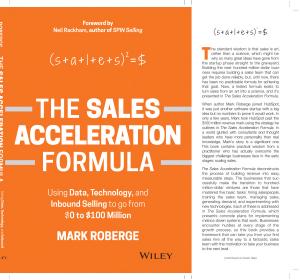
The Sales Acceleration Formula by Mark Roberge is a 2015 business book about sales, scaling, data-driven management. Hiring the right salespeople is the highest-leverage activity in sales leadership. A wrong hire costs not just salary but sales cycle time, management attention, and team morale.
Summary
Mark Roberge was HubSpot's first sales hire and eventually its Chief Revenue Officer, scaling the company from zero to over $100 million in recurring revenue. The Sales Acceleration Formula is his account of how he approached sales as an engineering problem — hiring, training, onboarding, managing, and compensating by metrics rather than intuition, and measuring everything to find what actually produced predictable revenue growth.
Roberge's starting point is that most early-stage sales hiring is guesswork. Founders or early sales leaders hire people who remind them of successful salespeople they've known, or who interview well, without knowing which traits actually predict success in their specific context. His approach was to define a hiring formula by identifying the attributes that correlated with performance at HubSpot — curiosity, intelligence, work ethic, coachability, and prior success — and then building an interview and scoring process to assess them consistently across candidates.
The same data-driven approach extends to training and onboarding (measuring exactly how long it takes a new rep to reach full productivity and optimizing that timeline), sales management (using leading indicators to coach reps earlier in the funnel rather than after the quarter closes), and demand generation (building a lead scoring model that quantifies which inbound activities predict purchase readiness). Each element is a formula that can be tested, measured, and improved.
The book is most useful for sales leaders at B2B SaaS or technology companies who have product-market fit and are ready to scale. The context is specific: inbound-heavy, software sales, and a company culture with the appetite to build measurement systems from scratch. The prescriptions don't translate directly to transactional, outbound-only, or non-software environments without adaptation. But the underlying principle — that sales should be managed by leading indicators and hypothesis testing, not intuition and hope — applies widely.
Talk to The Sales Acceleration Formula like its author wrote you back.
Get the ideas that fit your life — not generic summaries.
- Chat with the book
- Audiobook-style main ideas
- Adapts to your life and goals
- Helps you take action
Key takeaways
- 1.
Hiring the right salespeople is the highest-leverage activity in sales leadership. A wrong hire costs not just salary but sales cycle time, management attention, and team morale.
- 2.
The hiring formula should be empirically derived from your best performers, not borrowed from a general sales playbook. The traits that predict success at one company often don't transfer to another.
- 3.
Time to full productivity is a measurable, optimizable number. Every week a new rep spends below quota represents lost revenue that better onboarding and training could have recovered.
- 4.
Sales management by lagging indicators — deals closed, revenue booked — is too late. Managing by leading indicators (calls, demos, proposals) lets you coach reps when it still affects the outcome.
- 5.
Lead scoring converts marketing signals into a number that tells sales reps which leads to prioritize. Without it, reps optimize for easy calls rather than high-probability ones.
- 6.
Compensation structure shapes behavior more reliably than coaching. If you want reps to focus on a specific product or customer segment, the comp plan is the most direct lever.
- 7.
The sales playbook should document what actually works, not what leadership thinks works. Derive it from your top performers' behavior, not from conventional wisdom.
- 8.
Culture and process are not opposites. A data-driven, process-heavy sales organization can still be high-trust and high-morale if the processes are fair, transparent, and consistently applied.
Discussion questions
Use these on your own, with a book club, or as chat starters in Superbook. Book club version, ready to copy or print →
- 1.
Roberge treats sales hiring as an empirical problem. What attributes does your hiring process actually measure, and how do you know they predict performance?
- 2.
What is the current time-to-productivity for a new sales hire in your organization, and how systematically is it being tracked and improved?
- 3.
Which leading indicators in your sales funnel are you currently managing, and which ones do you only look at after the quarter closes?
- 4.
Roberge derived HubSpot's hiring formula from his best performers. If you did that analysis for your team, which current reps would define the baseline, and what attributes would emerge?
- 5.
How does your current compensation structure shape rep behavior, and where does it create incentives you didn't intend?
- 6.
What's in your sales playbook, and how confident are you that it reflects what your top performers actually do rather than what you believe they do?
- 7.
Roberge's approach requires significant measurement infrastructure. What's the minimum viable version of his data-driven approach that would work in your context?
- 8.
The book assumes inbound-heavy SaaS sales. Where does the formula need to be adapted for your specific market and motion?
- 9.
Lead scoring assumes marketing generates leads worth scoring. What does your lead quality look like, and how well does marketing and sales currently agree on what 'good' looks like?
- 10.
Roberge talks about coaching to early-stage funnel activity. What would change in how you run sales one-on-ones if you focused on leading rather than lagging indicators?
- 11.
The book frames sales as an engineering problem. What does that framing capture well, and what important aspects of sales does it miss or underemphasize?
- 12.
If you applied Roberge's approach to one specific part of your sales process — just hiring, or just onboarding, or just lead scoring — which would produce the biggest improvement, and why?
Themes
Frequently asked questions
-
What is The Sales Acceleration Formula about?
Mark Roberge's account of scaling HubSpot's sales team using data and measurement rather than intuition. The book covers hiring, training, onboarding, management, and lead generation as a set of formulas to be tested and optimized.
-
Is The Sales Acceleration Formula worth reading?
Yes, particularly for sales leaders at early-stage B2B technology companies who want to build a repeatable, scalable process. Some frameworks require significant measurement infrastructure to implement, but the principles transfer even in organizations that can only implement them partially.
-
Who should read The Sales Acceleration Formula?
Founders hiring their first sales reps, VPs of Sales at growth-stage companies building processes from scratch, and revenue leaders who want to reduce the role of intuition and gut feel in their hiring and management decisions.
-
How does the book define the hiring formula?
Roberge defines attributes that correlate with sales success in his specific context — curiosity, prior success, intelligence, work ethic, and coachability — then builds a structured interview process to assess each one consistently. The point is that the formula should be derived from your actual data, not borrowed from a general framework.
-
Does The Sales Acceleration Formula apply outside SaaS?
The principles apply broadly, but some specifics are tightly tied to inbound-heavy, software sales. The lead scoring model, the inbound marketing integration, and the time-to-quota metrics all assume a SaaS context. Sales leaders in outbound, transactional, or non-software environments will need to adapt the tools significantly.
Similar books
Traction: Get a Grip on Your Business
Gino Wickman
Zero to One: Notes on Startups, or How to Build the Future
Peter Thiel

Blitzscaling: The Lightning-Fast Path to Building Massively Valuable Companies
Reid Hoffman and Chris Yeh

Contagious: Why Things Catch On
Jonah Berger
