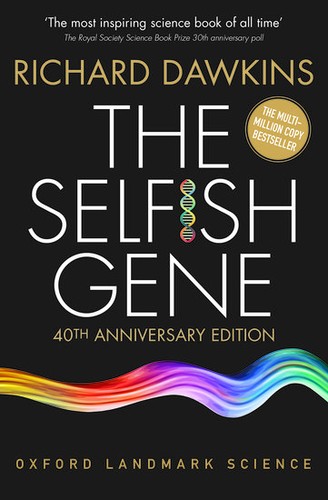
Talk to The Selfish Gene like its author wrote you back.
Get the ideas that fit your life — not generic summaries.
- Chat with the book
- Audiobook-style main ideas
- Adapts to your life and goals
- Helps you take action
What it argues
The Selfish Gene reframes evolution from the organism's point of view to the gene's. Dawkins argues that natural selection acts primarily on genes, not on individual animals or species. Organisms — including humans — are survival machines: vehicles built by genes to carry copies of themselves into the next generation. The idea isn't that genes are literally selfish. It's that the genes that survive are the ones that behaved as if they were, because any gene that failed to promote its own replication simply left fewer descendants.
The core concept is the "replicator." Early in Earth's history, molecules capable of copying themselves arose. Once copying began, variation and competition followed inevitably. The replicators that copied most efficiently crowded out the rest. Over billions of years this process produced bodies of extraordinary complexity as scaffolding for the replicators. Dawkins calls this perspective gene-centered evolution, and it unifies a wide range of puzzling biological phenomena: why parents sacrifice for children but not for cousins to the same degree, why worker bees die defending a queen they'll never reproduce with, why organisms cooperate at all.
What it gets right
- 1.
Natural selection operates at the level of the gene, not the organism. Bodies are vehicles; genes are the replicators that survive or perish across generations.
- 2.
The 'selfishness' of genes is metaphorical: genes that promoted their own copying accumulated; those that didn't vanished. No intention is implied, only differential survival.
- 3.
Kin selection explains altruism mathematically. An organism shares half its genes with a sibling and a quarter with a cousin, so the degree of self-sacrifice that evolution favors scales accordingly.
What it covers
Who wrote it
Richard Dawkins is a British evolutionary biologist and emeritus fellow of New College, Oxford, where he held the Charles Simonyi Chair for the Public Understanding of Science from 1995 to 2008. He is the author of more than a dozen books, including The Extended Phenotype, The Blind Watchmaker, Climbing Mount Improbable, The Ancestor's Tale, and The God Delusion. His work has shaped how evolutionary biology is communicated to non-specialists, and the gene-centered view he popularized in The Selfish Gene is now standard in the field. He received the Royal Society of Literature Award and the Michael Faraday Prize, among others.
