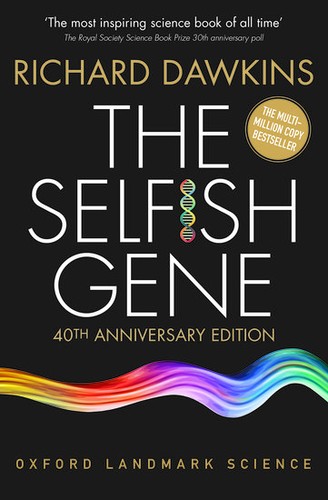
The Selfish Gene by Richard Dawkins is a 1976 science book about evolution, genetics, natural selection. Natural selection operates at the level of the gene, not the organism. Bodies are vehicles; genes are the replicators that survive or perish across generations.
Summary
The Selfish Gene reframes evolution from the organism's point of view to the gene's. Dawkins argues that natural selection acts primarily on genes, not on individual animals or species. Organisms — including humans — are survival machines: vehicles built by genes to carry copies of themselves into the next generation. The idea isn't that genes are literally selfish. It's that the genes that survive are the ones that behaved as if they were, because any gene that failed to promote its own replication simply left fewer descendants.
The core concept is the "replicator." Early in Earth's history, molecules capable of copying themselves arose. Once copying began, variation and competition followed inevitably. The replicators that copied most efficiently crowded out the rest. Over billions of years this process produced bodies of extraordinary complexity as scaffolding for the replicators. Dawkins calls this perspective gene-centered evolution, and it unifies a wide range of puzzling biological phenomena: why parents sacrifice for children but not for cousins to the same degree, why worker bees die defending a queen they'll never reproduce with, why organisms cooperate at all.
The most durable contribution of the book may not be the gene-centered view itself but the concept introduced in the final chapter: the meme. Dawkins proposed that cultural ideas, tunes, fashions, and catchphrases spread through minds the way genes spread through populations — via copying, variation, and selection. He didn't develop the idea fully, but the word and the framework it represents became a subject of serious academic study and, eventually, internet slang. The meme concept remains contested; critics argue the analogy is looser than Dawkins implies.
The book rewards careful reading, but it is not uniformly easy going. The logic is tight and cumulative, and readers who skim the early chapters on replication and gene pools will struggle with the later material on reciprocal altruism and the evolution of cooperation. Dawkins writes with unusual clarity for a scientist, and his gift for analogy carries the argument further than most popular science of its era. Fifty years on, the gene-centered view is standard in evolutionary biology, which is the clearest endorsement the book could receive.
Talk to The Selfish Gene like its author wrote you back.
Get the ideas that fit your life — not generic summaries.
- Chat with the book
- Audiobook-style main ideas
- Adapts to your life and goals
- Helps you take action
Key takeaways
- 1.
Natural selection operates at the level of the gene, not the organism. Bodies are vehicles; genes are the replicators that survive or perish across generations.
- 2.
The 'selfishness' of genes is metaphorical: genes that promoted their own copying accumulated; those that didn't vanished. No intention is implied, only differential survival.
- 3.
Kin selection explains altruism mathematically. An organism shares half its genes with a sibling and a quarter with a cousin, so the degree of self-sacrifice that evolution favors scales accordingly.
- 4.
The evolutionarily stable strategy (ESS) is a concept borrowed from game theory: a behavioral strategy that, when widespread in a population, cannot be invaded by a mutant alternative. It explains why animal conflicts rarely escalate to the death.
- 5.
Reciprocal altruism — cooperation between unrelated individuals — can evolve when interactions are repeated and cheaters can be identified and excluded. The tit-for-tat strategy from Axelrod's tournament illustrates the mechanism.
- 6.
The extended phenotype is the idea that a gene's effects on the world extend beyond the body it inhabits. A beaver dam and a cuckoo's cry are, in a meaningful sense, expressions of genes.
- 7.
Memes are cultural replicators — ideas, songs, habits, and phrases that spread from mind to mind by imitation. Dawkins proposed they obey the same logic of variation, copying fidelity, and selection that genes do.
- 8.
Organisms are not designed for happiness or survival per se; they are designed, by selection, to maximize the survival of their genes. This mismatch between evolutionary purpose and human experience has significant implications for how we understand our own desires and conflicts.
Discussion questions
Use these on your own, with a book club, or as chat starters in Superbook. Book club version, ready to copy or print →
- 1.
Dawkins distinguishes the gene's-eye view from the organism's-eye view. Before reading, which level did you instinctively think evolution acted on, and has that changed?
- 2.
The book argues that organisms are 'survival machines' for genes. Does that framing feel liberating, disturbing, or simply neutral to you, and why?
- 3.
Kin selection predicts that we'll sacrifice more for close relatives than distant ones. Does your own experience match that prediction, or are there cases in your life where it clearly doesn't?
- 4.
Dawkins says selfishness is built in at the genetic level but conscious cooperation is possible at the organism level. What does that mean for how we think about designing institutions, laws, or norms?
- 5.
The evolutionarily stable strategy shows how cooperation can be rational even among self-interested actors. Where do you see ESS-style equilibria in human social or economic life?
- 6.
The tit-for-tat strategy succeeds not because it's the cleverest, but because it's simple, forgiving, and retaliatory in proportion. Where have you seen that pattern succeed or fail in real relationships?
- 7.
Dawkins introduces memes in a single chapter and acknowledged the analogy was incomplete. Do you think cultural evolution actually works like genetic evolution, or does the analogy break down in important ways?
- 8.
The book was controversial partly because critics thought it lent scientific cover to selfishness as a natural norm. Dawkins explicitly rejects that reading. Who do you think is right, and where does the confusion come from?
- 9.
Consider an example of animal altruism that surprised you before reading this book. Does the gene-centered explanation actually satisfy you as an explanation, or does it feel like it leaves something out?
- 10.
The extended phenotype concept blurs the boundary between an organism and its environment. What human-made things — products, institutions, buildings — could be described as extended phenotypes of human genes or memes?
- 11.
Dawkins wrote this book as a scientist writing for a general audience in 1976. Which parts feel dated, and which still feel like live debates?
- 12.
If genes are fundamentally selfish, what grounds do we have for moral obligations to strangers, to other species, or to future generations?
Themes
Frequently asked questions
-
What is The Selfish Gene actually about?
It argues that evolution is best understood from the gene's point of view, not the organism's. Genes that promoted their own replication survived; organisms — including humans — are vehicles built by those genes. The book also introduces the concept of memes as cultural replicators.
-
Is The Selfish Gene still worth reading fifty years later?
Yes. The gene-centered view it popularized is now standard in evolutionary biology, so the science holds up. The writing is unusually clear for its subject, and the final chapter on memes and cultural evolution remains thought-provoking even though the idea has been extended and challenged substantially since 1976.
-
Does The Selfish Gene argue that humans are inherently selfish?
No, and Dawkins is emphatic about this. The selfishness he describes is at the gene level and is purely metaphorical — genes don't intend anything. He argues explicitly that understanding our evolutionary origins gives us the tools to consciously override them, which is something no other animal can do.
-
How long does it take to read The Selfish Gene?
Around six to six and a half hours at average reading pace. The book is dense in places — the chapters on gene pools and evolutionary stable strategies require close attention — so many readers find it takes longer than the page count suggests.
-
Who should read The Selfish Gene?
Anyone curious about why animals — and people — behave the way they do. It's essential reading for students of biology, psychology, or philosophy of mind. Readers without a science background can follow it, though the game theory sections in the middle chapters require patience.
Similar books
Sapiens: A Brief History of Humankind
Yuval Noah Harari
Behave: The Biology of Humans at Our Best and Worst
Robert M. Sapolsky
The Gene: An Intimate History
Siddhartha Mukherjee
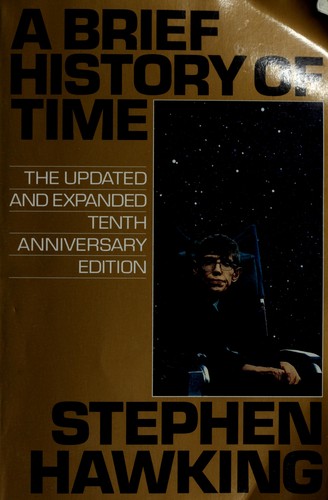
A Brief History of Time
Stephen Hawking
