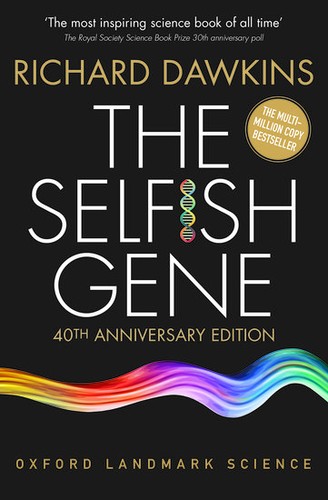
Talk to The Selfish Gene like its author wrote you back.
Get the ideas that fit your life — not generic summaries.
- Chat with the book
- Audiobook-style main ideas
- Adapts to your life and goals
- Helps you take action
The Selfish Gene, in detail
The Selfish Gene reframes evolution from the organism's point of view to the gene's. Dawkins argues that natural selection acts primarily on genes, not on individual animals or species. Organisms — including humans — are survival machines: vehicles built by genes to carry copies of themselves into the next generation. The idea isn't that genes are literally selfish. It's that the genes that survive are the ones that behaved as if they were, because any gene that failed to promote its own replication simply left fewer descendants.
The core concept is the "replicator." Early in Earth's history, molecules capable of copying themselves arose. Once copying began, variation and competition followed inevitably. The replicators that copied most efficiently crowded out the rest. Over billions of years this process produced bodies of extraordinary complexity as scaffolding for the replicators. Dawkins calls this perspective gene-centered evolution, and it unifies a wide range of puzzling biological phenomena: why parents sacrifice for children but not for cousins to the same degree, why worker bees die defending a queen they'll never reproduce with, why organisms cooperate at all.
The most durable contribution of the book may not be the gene-centered view itself but the concept introduced in the final chapter: the meme. Dawkins proposed that cultural ideas, tunes, fashions, and catchphrases spread through minds the way genes spread through populations — via copying, variation, and selection. He didn't develop the idea fully, but the word and the framework it represents became a subject of serious academic study and, eventually, internet slang. The meme concept remains contested; critics argue the analogy is looser than Dawkins implies.
The book rewards careful reading, but it is not uniformly easy going. The logic is tight and cumulative, and readers who skim the early chapters on replication and gene pools will struggle with the later material on reciprocal altruism and the evolution of cooperation. Dawkins writes with unusual clarity for a scientist, and his gift for analogy carries the argument further than most popular science of its era. Fifty years on, the gene-centered view is standard in evolutionary biology, which is the clearest endorsement the book could receive.
The big ideas
- 1.
Natural selection operates at the level of the gene, not the organism. Bodies are vehicles; genes are the replicators that survive or perish across generations.
- 2.
The 'selfishness' of genes is metaphorical: genes that promoted their own copying accumulated; those that didn't vanished. No intention is implied, only differential survival.
- 3.
Kin selection explains altruism mathematically. An organism shares half its genes with a sibling and a quarter with a cousin, so the degree of self-sacrifice that evolution favors scales accordingly.
