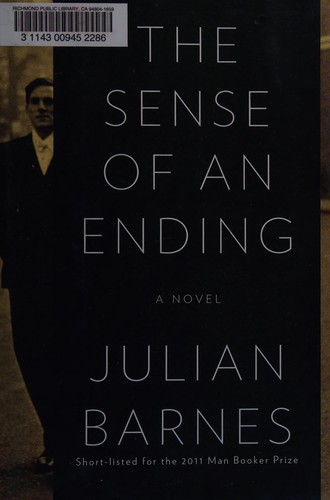
Talk to The Sense of an Ending like its author wrote you back.
Get the ideas that fit your life — not generic summaries.
- Chat with the book
- Audiobook-style main ideas
- Adapts to your life and goals
- Helps you take action
What it argues
The Sense of an Ending is a short novel in two parts. In the first, Tony Webster narrates his schooldays in 1960s England, his friendship with the brilliant and philosophical Adrian Finn, his relationship with a girl named Veronica, and Adrian's suicide. In the second, Tony — now retired, comfortably settled in his mild way of life — receives a bequest in a will: money and a diary, from Veronica's mother, a woman he barely knew. The bequest sets him to reconsider everything he believed he remembered.
Barnes is writing about memory as a mechanism of self-protection. Tony's narrator is unreliable not in the thriller sense — he is not lying to us — but in the more interesting sense: he has organized the story of his own life in a way that keeps him comfortable, that assigns guilt to others and credits himself with reasonable decency. The second part of the novel systematically dismantles that organization. What he discovers is not a dramatic secret but something worse: that his own actions, which he has long since bracketed and minimized, had consequences he did not allow himself to see.
What it gets right
- 1.
Memory is not a recording device. The novel demonstrates how self-interest shapes what we remember, what we emphasize, and what we quietly allow ourselves to forget.
- 2.
Tony's unreliability is not dishonesty but self-protection. He is exactly as self-serving as most people are, which is what makes his eventual confrontation with his own past land with genuine force.
- 3.
The letter Tony wrote to Adrian — which he barely remembers and minimizes — is the moral center of the novel. What we say in anger, and then forget, does not cease to exist.
What it covers
Who wrote it
Julian Barnes was born in Leicester in 1946 and studied at Oxford. He is one of Britain's most formally adventurous novelists, with a body of work that includes Flaubert's Parrot, A History of the World in 10½ Chapters, Arthur and George, and Nothing to Be Frightened Of. The Sense of an Ending won the Man Booker Prize in 2011. He has also been shortlisted for the Booker three times previously. Barnes writes criticism and essays as well as fiction and was awarded the David Cohen Prize for a lifetime's contribution to British literature in 2011.
