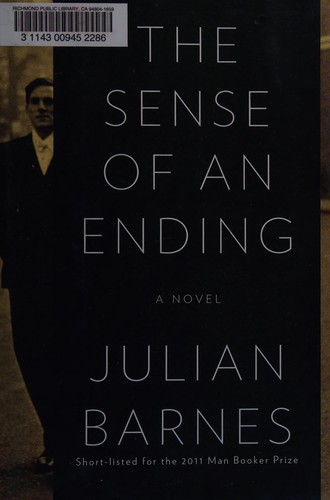
The Sense of an Ending by Julian Barnes is a 2011 literary fiction book about memory and self-deception, guilt, the unreliable past. Memory is not a recording device. The novel demonstrates how self-interest shapes what we remember, what we emphasize, and what we quietly allow ourselves to forget.
Summary
The Sense of an Ending is a short novel in two parts. In the first, Tony Webster narrates his schooldays in 1960s England, his friendship with the brilliant and philosophical Adrian Finn, his relationship with a girl named Veronica, and Adrian's suicide. In the second, Tony — now retired, comfortably settled in his mild way of life — receives a bequest in a will: money and a diary, from Veronica's mother, a woman he barely knew. The bequest sets him to reconsider everything he believed he remembered.
Barnes is writing about memory as a mechanism of self-protection. Tony's narrator is unreliable not in the thriller sense — he is not lying to us — but in the more interesting sense: he has organized the story of his own life in a way that keeps him comfortable, that assigns guilt to others and credits himself with reasonable decency. The second part of the novel systematically dismantles that organization. What he discovers is not a dramatic secret but something worse: that his own actions, which he has long since bracketed and minimized, had consequences he did not allow himself to see.
The novel's brevity is part of its argument. At around 170 pages, it is the length of a sustained meditation rather than a conventional narrative. Barnes does not describe so much as precisely notate — the prose is careful and slightly chilly, which suits a narrator whose defining characteristic is a preference for being undisturbed. The construction is extremely tight, with details in part one returning as detonators in part two. It is the kind of novel that rewards re-reading more than most.
It won the 2011 Man Booker Prize, to mixed reception: some readers found it a masterwork of compression; others found it slight and its ending somewhat contrived. The fairest reading is that the ending requires a small leap the novel has almost but not quite prepared — a device that critics of the book feel is unfair and admirers feel is exactly calibrated. This is not a comfortable read. Tony's final recognition — of what he did, what he refused to know — is designed to leave you examining your own memory's architecture.
Talk to The Sense of an Ending like its author wrote you back.
Get the ideas that fit your life — not generic summaries.
- Chat with the book
- Audiobook-style main ideas
- Adapts to your life and goals
- Helps you take action
Key takeaways
- 1.
Memory is not a recording device. The novel demonstrates how self-interest shapes what we remember, what we emphasize, and what we quietly allow ourselves to forget.
- 2.
Tony's unreliability is not dishonesty but self-protection. He is exactly as self-serving as most people are, which is what makes his eventual confrontation with his own past land with genuine force.
- 3.
The letter Tony wrote to Adrian — which he barely remembers and minimizes — is the moral center of the novel. What we say in anger, and then forget, does not cease to exist.
- 4.
The novel's title refers to both narrative form (the sense that endings are shaped, not just arrived at) and to the false sense of resolution we achieve by telling ourselves the story of our own lives.
- 5.
Part one and part two use the same events, but the second reading of them — after the bequest — is entirely different. Barnes's reread structure is a formal enactment of the novel's argument.
- 6.
The relationship between class, intellectual aspiration, and emotional intelligence is quietly present throughout. Tony's comfortable mediocrity is not accidental — it is the destination of a certain kind of English male education.
- 7.
Adrian's suicide, which Tony has long told himself was a philosophical act, turns out to have a mundane and devastating cause. The reinterpretation is one of the more precise deflations in recent literary fiction.
- 8.
What the novel ultimately argues: the past is not fixed, and the version you have been living with is probably one that flatters you.
Discussion questions
Use these on your own, with a book club, or as chat starters in Superbook. Book club version, ready to copy or print →
- 1.
Tony tells us from the start that his memory is imperfect. Does that admission make him more or less trustworthy as a narrator?
- 2.
The letter Tony wrote to Adrian and Veronica is described in part one as an act of adolescent spite that he later regrets. When its full contents are revealed in part two, does that change how you read the regret?
- 3.
Barnes argues, through Tony, that we revise the past to serve the present. Do you think that's universally true, or does Tony represent a specific psychological type?
- 4.
Veronica is a difficult character — Tony finds her infuriating, and the reader is filtered through his view. Did you find her sympathetic despite his framing? What did you think she knew and chose not to say?
- 5.
The ending requires the reader to reconstruct an event the novel never directly depicts. Did that feel earned or evasive?
- 6.
The novel is very short for a Booker winner. Do you think its brevity is a strength — compression as form — or does it leave too much unexplored?
- 7.
Adrian is described as philosophically exceptional, the most intelligent of Tony's group. His suicide is framed by Tony as a kind of intellectual decision. Does the novel ultimately accept that framing, or does it undercut it?
- 8.
Tony's complacent retirement — his mild contentment, his preference for not being disturbed — is presented as both ordinary and as something that enabled the harm he caused. Is that a moral argument, or just a personality sketch?
- 9.
Compared to Never Let Me Go, which also revisits a past that turns out to be other than it seemed, where does this novel's structure feel similar or different?
- 10.
The novel is very much about a specific English male type — educated, emotionally cautious, retrospectively self-satisfied. How universal does that character feel to you?
- 11.
Margaret, Tony's ex-wife, appears to see him more clearly than he sees himself. What does the novel do with her perspective?
- 12.
By the end, Tony cannot fully determine what he is guilty of — the novel stops just short of complete explanation. Was that the right place to stop?
Themes
Frequently asked questions
-
Is The Sense of an Ending worth reading?
Yes, if you want a precise, formally elegant short novel about memory and self-deception. At 170 pages it demands an afternoon rather than a week. The ending is somewhat controversial — some find it strained — but the first half is close to flawless.
-
How long is The Sense of an Ending?
Around 170 pages, which is very short for a Booker winner. Most readers finish it in two to three hours. Its brevity is part of its formal argument: the novel takes exactly as long as it needs to.
-
What is The Sense of an Ending about, without spoilers?
A retired Englishman receives a mysterious bequest that forces him to re-examine his memories of youth — specifically a friendship with a brilliant, philosophically minded school friend who later died, and a relationship with a woman whose family is now entangled in the bequest.
-
Is the ending of The Sense of an Ending satisfying?
It depends on the reader. The ending withholds final clarity and requires you to reconstruct a key event. Admirers find that appropriate to a novel about memory's limits. Critics find it a slight of hand. The debate about the ending is worth having.
-
Who shouldn't read this book?
Readers who want narrative richness and multiple characters — this is a narrow, interior novel. Readers who dislike unreliable narrators or ambiguous endings will find its central devices frustrating.