Talk to The Seven Sins of Memory like its author wrote you back.
Get the ideas that fit your life — not generic summaries.
- Chat with the book
- Audiobook-style main ideas
- Adapts to your life and goals
- Helps you take action
What it argues
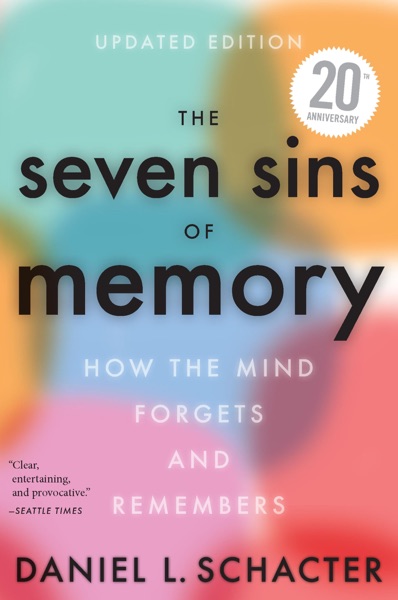
The Seven Sins of Memory is Daniel Schacter's account of the ways human memory routinely fails, organized around a taxonomy he developed to make the failures legible. Schacter, a Harvard cognitive neuroscientist, argues that memory's problems are not random glitches but systematic tendencies that reflect how memory is constructed and stored. The seven sins — transience, absent-mindedness, blocking, misattribution, suggestibility, bias, and persistence — each describe a different type of failure, and each has a neurological and evolutionary explanation.
The first three sins are omissions: transience is the fading of memories over time, absent-mindedness is the failure to encode information because attention wasn't engaged, and blocking is the inability to retrieve information that is stored but temporarily inaccessible — the tip-of-the-tongue experience being the clearest example. The final four are commissions: intrusions where memory actively produces something wrong. Misattribution means attributing a memory to the wrong source — remembering a face without being able to recall where you saw it. Suggestibility means being led by external cues or leading questions to remember things that didn't happen. Bias means letting current beliefs and moods distort memories of the past. Persistence is the involuntary return of unwanted memories, as in PTSD.
What it gets right
- 1.
Memory is reconstructive, not reproductive. Every act of remembering involves rebuilding the past from stored traces and current knowledge, making distortion normal rather than exceptional.
- 2.
Transience — the gradual fading of memory over time — is not a malfunction. Forgetting most of what we experience is adaptive; retaining everything would make it harder to update beliefs and focus on what matters.
- 3.
Absent-mindedness is largely a failure of encoding, not retrieval. You can't remember what you didn't attend to, which is why distraction at the moment of experience prevents memory formation.
What it covers
Who wrote it
Daniel Schacter is a William R. Kenan, Jr. Professor of Psychology at Harvard University and one of the world's leading researchers on human memory. His laboratory has produced influential work on false memories, memory and aging, and the neural bases of encoding and retrieval. He is the author of several books for general audiences, including Searching for Memory and Forgotten Ideas, Neglected Pioneers. The Seven Sins of Memory was awarded the William James Book Award by the American Psychological Association. Schacter has received honorary degrees and numerous other awards for his contributions to cognitive neuroscience.
