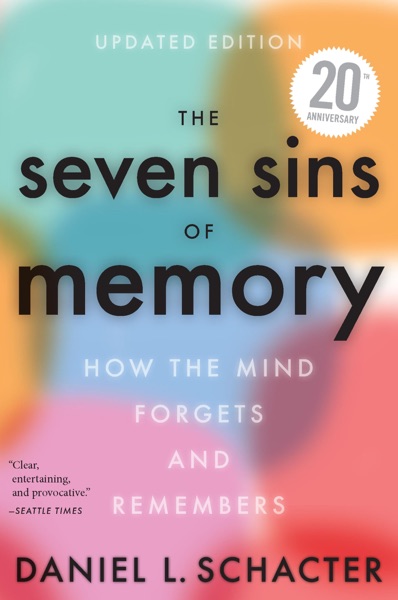
The Seven Sins of Memory by Daniel Schacter is a 2001 psychology book about memory, cognition, neuroscience. Memory is reconstructive, not reproductive. Every act of remembering involves rebuilding the past from stored traces and current knowledge, making distortion normal rather than exceptional.
Summary
The Seven Sins of Memory is Daniel Schacter's account of the ways human memory routinely fails, organized around a taxonomy he developed to make the failures legible. Schacter, a Harvard cognitive neuroscientist, argues that memory's problems are not random glitches but systematic tendencies that reflect how memory is constructed and stored. The seven sins — transience, absent-mindedness, blocking, misattribution, suggestibility, bias, and persistence — each describe a different type of failure, and each has a neurological and evolutionary explanation.
The first three sins are omissions: transience is the fading of memories over time, absent-mindedness is the failure to encode information because attention wasn't engaged, and blocking is the inability to retrieve information that is stored but temporarily inaccessible — the tip-of-the-tongue experience being the clearest example. The final four are commissions: intrusions where memory actively produces something wrong. Misattribution means attributing a memory to the wrong source — remembering a face without being able to recall where you saw it. Suggestibility means being led by external cues or leading questions to remember things that didn't happen. Bias means letting current beliefs and moods distort memories of the past. Persistence is the involuntary return of unwanted memories, as in PTSD.
Schacter uses case studies — wrongful convictions based on eyewitness error, false memory implantation in laboratory settings, flashbulb memories, and the neuroscience of forgetting — to illustrate each sin. The chapter on suggestibility is particularly important: it draws on the work of Elizabeth Loftus to show how easily memories can be altered by the questions asked afterward, with serious implications for eyewitness testimony and recovered memory therapy.
The book's central claim is that the seven sins are not design flaws but byproducts of features that make memory useful. The same plasticity that allows memory to update in light of new information makes it susceptible to distortion. The same retrieval processes that make connections between ideas creative also make them imprecise. Schacter argues this perspective — understanding memory as adaptive rather than defective — changes how we should think about memory's role in identity, law, and therapy.
Talk to The Seven Sins of Memory like its author wrote you back.
Get the ideas that fit your life — not generic summaries.
- Chat with the book
- Audiobook-style main ideas
- Adapts to your life and goals
- Helps you take action
Key takeaways
- 1.
Memory is reconstructive, not reproductive. Every act of remembering involves rebuilding the past from stored traces and current knowledge, making distortion normal rather than exceptional.
- 2.
Transience — the gradual fading of memory over time — is not a malfunction. Forgetting most of what we experience is adaptive; retaining everything would make it harder to update beliefs and focus on what matters.
- 3.
Absent-mindedness is largely a failure of encoding, not retrieval. You can't remember what you didn't attend to, which is why distraction at the moment of experience prevents memory formation.
- 4.
Misattribution is one of the most dangerous sins because it feels like memory. People confidently remember seeing a face without being able to identify where — and this mechanism underlies many wrongful convictions.
- 5.
Suggestibility research by Elizabeth Loftus demonstrated that leading questions after an event can implant memories that don't correspond to what actually happened. Eyewitness memory is far less reliable than courts have historically assumed.
- 6.
Bias means that current emotional states and beliefs reshape memories of the past. People consistently remember their past attitudes as more consistent with their present attitudes than they actually were.
- 7.
Persistence — the unwanted return of painful or traumatic memories — is the seventh sin, and the one most likely to be pathological. PTSD is its extreme form.
- 8.
The seven sins are byproducts of adaptive features. The memory system trades accuracy for flexibility and efficiency, which means it will always produce some errors of each type.
Discussion questions
Use these on your own, with a book club, or as chat starters in Superbook. Book club version, ready to copy or print →
- 1.
Schacter argues the seven sins are features, not bugs — byproducts of what makes memory useful. Does reframing failures as adaptive byproducts change how you think about your own memory errors?
- 2.
Absent-mindedness is caused by divided attention at the moment of encoding. What habits in your daily life are most likely to cause you to fail to encode important information?
- 3.
The suggestibility chapter suggests that the way questions are phrased after an event can alter memories of the event. How should this affect how we think about therapy, interrogation, and casual conversation about shared experiences?
- 4.
Misattribution underlies many wrongful convictions. Do you think the criminal justice system has adequately incorporated what cognitive science knows about eyewitness memory? What would need to change?
- 5.
Schacter describes bias as the tendency for memory to conform to current beliefs. Can you think of a belief you currently hold that might be shaping how you remember earlier experiences?
- 6.
Persistence — the involuntary return of unwanted memories — is treated as the seventh sin. What's the evolutionary logic of a mechanism that keeps bringing back painful experiences? Does Schacter's explanation satisfy you?
- 7.
The book was published in 2001. In the decades since, digital recording has made it possible to check memories against objective records. Has that changed how you relate to your own memory?
- 8.
Schacter uses the term 'sins' metaphorically — these aren't moral failures. But does moral language change how people feel about their own memory failures? Does it create shame where there should be just understanding?
- 9.
Blocking — the tip-of-the-tongue state — is described as a competition between similar memories. Have you noticed any patterns in when it happens to you that align with Schacter's explanation?
- 10.
False memory implantation in laboratory settings has been used to argue against recovered memory therapy. How do you evaluate that argument? Does it prove too much, or is the implication unavoidable?
- 11.
If you could reliably eliminate one of the seven sins from your memory, which would it be? What would you gain, and what might you lose?
Themes
Frequently asked questions
-
Is The Seven Sins of Memory accessible to non-scientists?
Yes. Schacter writes for a general audience and uses extensive case studies to illustrate abstract findings. A reader with no psychology background can follow the argument easily, though some sections involve technical explanations of brain regions and retrieval mechanisms.
-
What is the most practically useful sin to understand?
Absent-mindedness, for most people. It explains why you forget where you put your keys, missed what someone said, or can't remember something you definitely experienced. The fix — paying deliberate attention at the moment of encoding — is simple to understand if hard to practice.
-
Does the book address recovered memories and trauma therapy?
Yes. The suggestibility chapter discusses false memory research directly and its implications for recovered memory therapy are drawn out explicitly. Schacter is careful but does not equivocate: memory is malleable enough that therapeutic techniques that encourage recovering repressed memories can produce memories that don't correspond to real events.
-
How does this book compare to Thinking, Fast and Slow?
Kahneman's book is broader, covering the full architecture of cognition. Schacter's is narrower — focused entirely on memory — but deeper on that specific subject. Both are rigorous popular science; they complement each other well.
-
Is the book dated?
The 2001 research base is solid but the field has advanced significantly. The core taxonomy and the evidence for each sin hold up, but readers interested in the most current neuroscience of memory will want to supplement with more recent sources.
Similar books
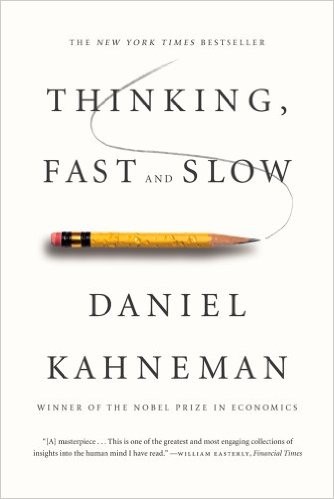
Thinking, Fast and Slow
Daniel Kahneman
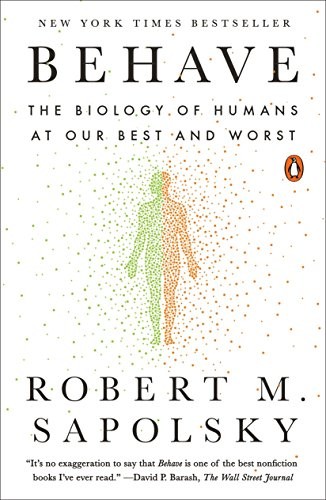
Behave: The Biology of Humans at Our Best and Worst
Robert M. Sapolsky
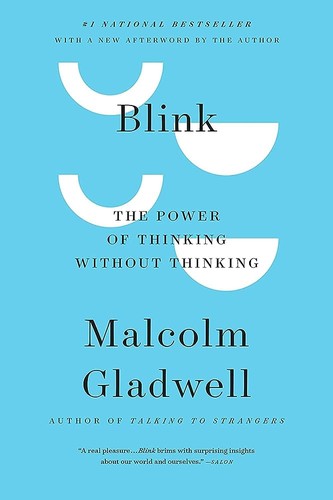
Blink: The Power of Thinking Without Thinking
Malcolm Gladwell

Predictably Irrational
Dan Ariely
