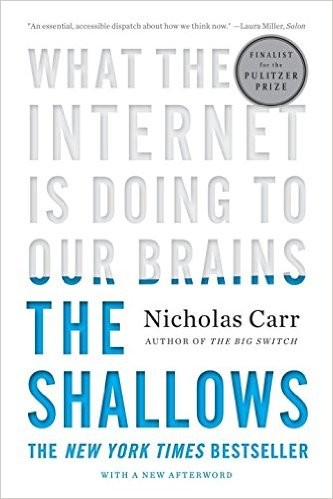
Talk to The Shallows: What the Internet Is Doing to Our Brains like its author wrote you back.
Get the ideas that fit your life — not generic summaries.
- Chat with the book
- Audiobook-style main ideas
- Adapts to your life and goals
- Helps you take action
What it argues
The Shallows is Nicholas Carr's argument that the internet — and the way we habitually use it, skimming hyperlinked text, watching short videos, checking feeds — is reshaping the neural circuits responsible for deep reading and sustained concentration. The book grew from a 2008 Atlantic essay, "Is Google Making Us Stupid?", which went viral for articulating a discomfort many readers had but couldn't quite name.
Carr's argument is rooted in neuroscience research on neuroplasticity — the finding that the brain's neural architecture is not fixed but changes in response to repeated experience and behavior. This was a genuine scientific revision of the earlier view that adult brains are structurally stable. Every habit we form, every technology we adopt, every type of attention we practice leaves physical traces in the brain's circuits. Carr argues that the habits of internet use — rapid context-switching, multitasking, scanning rather than reading — are rewiring neural circuits in ways that make sustained linear reading harder.
What it gets right
- 1.
Neuroplasticity means the brain's neural architecture changes in response to repeated behavior; the habits of internet use — scanning, skimming, multitasking — leave physical traces in neural circuits.
- 2.
Deep reading — sustained, linear engagement with a long text — is a specific cognitive practice that the printing press made common and that internet habits may be eroding.
- 3.
Every information technology, from the map to the mechanical clock to the typewriter, reshapes cognitive habits and the mental skills that are practiced and preserved.
What it covers
Who wrote it
Nicholas Carr is an American writer and cultural critic who focuses on technology, culture, and the economy. He was executive editor of the Harvard Business Review before becoming an independent writer. His other books include The Big Switch: Rewiring the World, from Edison to Google and Utopia Is Creepy: A Provocateur's Guide to a Dystopian Future. The Shallows was a finalist for the Pulitzer Prize in Nonfiction in 2011. He is known for his skeptical perspective on the cultural effects of technology, in contrast to the techno-optimism common in Silicon Valley.
