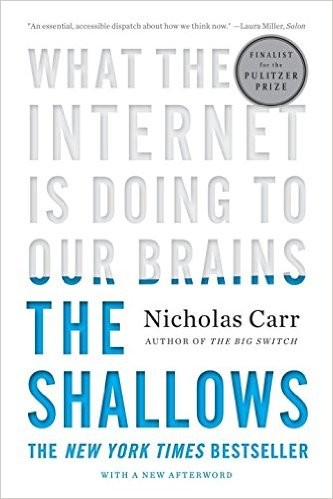
Talk to The Shallows: What the Internet Is Doing to Our Brains like its author wrote you back.
Get the ideas that fit your life — not generic summaries.
- Chat with the book
- Audiobook-style main ideas
- Adapts to your life and goals
- Helps you take action
The Shallows: What the Internet Is Doing to Our Brains, in detail
The Shallows is Nicholas Carr's argument that the internet — and the way we habitually use it, skimming hyperlinked text, watching short videos, checking feeds — is reshaping the neural circuits responsible for deep reading and sustained concentration. The book grew from a 2008 Atlantic essay, "Is Google Making Us Stupid?", which went viral for articulating a discomfort many readers had but couldn't quite name.
Carr's argument is rooted in neuroscience research on neuroplasticity — the finding that the brain's neural architecture is not fixed but changes in response to repeated experience and behavior. This was a genuine scientific revision of the earlier view that adult brains are structurally stable. Every habit we form, every technology we adopt, every type of attention we practice leaves physical traces in the brain's circuits. Carr argues that the habits of internet use — rapid context-switching, multitasking, scanning rather than reading — are rewiring neural circuits in ways that make sustained linear reading harder.
The historical sections contextualize the internet within a longer history of information technologies — the clock, the map, the printing press, the typewriter — each of which reshaped how people thought and how they organized information. The printing press expanded the practice of deep, sustained reading; Carr argues the internet may be reversing that expansion.
The book acknowledges that what the internet takes away in depth it partly compensates with breadth — faster access to information, pattern recognition across vast amounts of text, the ability to multitask. The question is whether these gains outweigh the loss of the ability to read deeply, think linearly, and concentrate for sustained periods. Carr's answer is that they probably do not, for the particular kind of thinking that produces original ideas rather than rearranges existing information.
Critics have argued that Carr's evidence for the specific cognitive effects is weaker than the book implies, and that technological anxiety about each new communication medium is a recurring historical pattern. But the neuroscience of habitual distraction has been substantially reinforced since the book's publication.
The big ideas
- 1.
Neuroplasticity means the brain's neural architecture changes in response to repeated behavior; the habits of internet use — scanning, skimming, multitasking — leave physical traces in neural circuits.
- 2.
Deep reading — sustained, linear engagement with a long text — is a specific cognitive practice that the printing press made common and that internet habits may be eroding.
- 3.
Every information technology, from the map to the mechanical clock to the typewriter, reshapes cognitive habits and the mental skills that are practiced and preserved.
