The Shallows: What the Internet Is Doing to Our Brains by Nicholas Carr is a 2010 science book about neuroscience, internet, cognition. Neuroplasticity means the brain's neural architecture changes in response to repeated behavior; the habits of internet use — scanning, skimming, multitasking — leave physical traces in neural circuits.
Summary
The Shallows is Nicholas Carr's argument that the internet — and the way we habitually use it, skimming hyperlinked text, watching short videos, checking feeds — is reshaping the neural circuits responsible for deep reading and sustained concentration. The book grew from a 2008 Atlantic essay, "Is Google Making Us Stupid?", which went viral for articulating a discomfort many readers had but couldn't quite name.
Carr's argument is rooted in neuroscience research on neuroplasticity — the finding that the brain's neural architecture is not fixed but changes in response to repeated experience and behavior. This was a genuine scientific revision of the earlier view that adult brains are structurally stable. Every habit we form, every technology we adopt, every type of attention we practice leaves physical traces in the brain's circuits. Carr argues that the habits of internet use — rapid context-switching, multitasking, scanning rather than reading — are rewiring neural circuits in ways that make sustained linear reading harder.
The historical sections contextualize the internet within a longer history of information technologies — the clock, the map, the printing press, the typewriter — each of which reshaped how people thought and how they organized information. The printing press expanded the practice of deep, sustained reading; Carr argues the internet may be reversing that expansion.
The book acknowledges that what the internet takes away in depth it partly compensates with breadth — faster access to information, pattern recognition across vast amounts of text, the ability to multitask. The question is whether these gains outweigh the loss of the ability to read deeply, think linearly, and concentrate for sustained periods. Carr's answer is that they probably do not, for the particular kind of thinking that produces original ideas rather than rearranges existing information.
Critics have argued that Carr's evidence for the specific cognitive effects is weaker than the book implies, and that technological anxiety about each new communication medium is a recurring historical pattern. But the neuroscience of habitual distraction has been substantially reinforced since the book's publication.
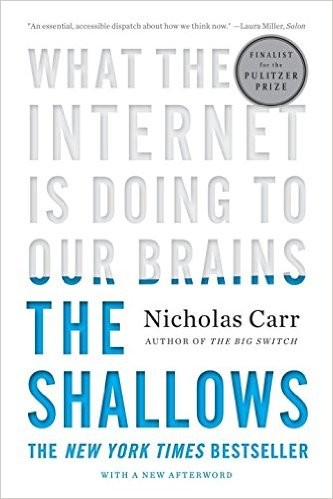
Talk to The Shallows: What the Internet Is Doing to Our Brains like its author wrote you back.
Get the ideas that fit your life — not generic summaries.
- Chat with the book
- Audiobook-style main ideas
- Adapts to your life and goals
- Helps you take action
Key takeaways
- 1.
Neuroplasticity means the brain's neural architecture changes in response to repeated behavior; the habits of internet use — scanning, skimming, multitasking — leave physical traces in neural circuits.
- 2.
Deep reading — sustained, linear engagement with a long text — is a specific cognitive practice that the printing press made common and that internet habits may be eroding.
- 3.
Every information technology, from the map to the mechanical clock to the typewriter, reshapes cognitive habits and the mental skills that are practiced and preserved.
- 4.
The internet rewards breadth and speed at the expense of depth and concentration: its architecture — hyperlinks, feeds, notifications — is optimized for attention capture rather than sustained engagement.
- 5.
Working memory is limited; each interruption or context switch clears working memory and requires cognitive reinvestment to rebuild the context for the task being resumed.
- 6.
The shift from oral to written culture changed how people thought and remembered; the shift from print to digital culture may produce changes of comparable magnitude in the opposite direction.
- 7.
Google's explicit goal of making answers to questions instantly accessible may undermine the cognitive processes of searching through memory that produce insight and original synthesis.
- 8.
Nietzsche's use of a typewriter changed his writing style, Carr argues; tools shape not just the medium but the thinking of those who use them.
Discussion questions
Use these on your own, with a book club, or as chat starters in Superbook. Book club version, ready to copy or print →
- 1.
Carr argues internet habits are physically rewiring your brain. Does that framing change how you think about your phone or computer use?
- 2.
Neuroplasticity applies to all habits, not just internet use. Does it make sense to worry specifically about internet-induced neural change?
- 3.
He argues that deep reading — sustained, linear engagement with long texts — is a specific and valuable cognitive practice. Do you agree? Is there something deep reading provides that other information practices don't?
- 4.
Every generation has worried that the new communication technology will damage cognition — Plato worried about writing, 18th-century critics worried about novels. Is Carr's worry different in kind?
- 5.
The internet gives fast access to vast information at the cost of depth. Is that trade-off obviously bad, or does it depend on what you need the information for?
- 6.
Carr says he noticed his own reading habits changing and this triggered the book's inquiry. Have you noticed similar changes in your own ability to focus?
- 7.
Working memory is limited and context-switching is costly. Does that neuroscience insight change how you think about multitasking?
- 8.
Google's business model depends on people returning frequently with new questions. Does that model create incentives that are systematically bad for deep thinking?
- 9.
The printing press expanded the practice of linear reading. Could the internet equally be creating new kinds of thinking that are valuable but different from what print cultivated?
- 10.
Which technology do you think has most changed your own cognitive habits, and would you give it up if you could?
- 11.
Is the concern about deep reading specifically a concern about class and cultural privilege — the ability to read long books — or a genuine cognitive issue that affects everyone?
- 12.
How does reading The Shallows itself — a long, linear argument — bear on the book's thesis?
Themes
Frequently asked questions
-
Is The Shallows backed by science?
The neuroplasticity research Carr draws on is solid. The specific claims about internet use producing measurable cognitive changes are extrapolated from that research rather than directly demonstrated; some cognitive scientists have found the claims stronger than the evidence at the time warranted. Subsequent research has been mixed.
-
Is the book anti-technology?
Not simply. Carr acknowledges the internet's benefits — breadth, speed, access — and is not arguing that people should stop using it. His argument is that the costs deserve more acknowledgment than the pro-technology consensus gives them, particularly the costs to deep cognition.
-
How long is it?
About 280 pages, roughly six hours at average pace. The writing is clear and the argument moves steadily; it is not a book that overstays its welcome.
-
Has the thesis been validated since 2010?
Partly. The neuroscience of distraction and working memory has been reinforced by subsequent research. The specific claims about internet use changing brain structure remain less well-established. The cultural observation — that sustained reading is declining and attention spans are shortening — is widely cited but hard to quantify.
-
Is this the same argument as Cal Newport makes in Deep Work?
Related but different. Newport's Deep Work is prescriptive — how to build habits of concentration despite the distracting environment. The Shallows is more diagnostic — what the internet is doing to the brain and why it matters. They complement each other.
Similar books

The Information: A History, a Theory, a Flood
James Gleick
Deep Work
Cal Newport
The Second Machine Age
Erik Brynjolfsson and Andrew McAfee
Algorithms to Live By: The Computer Science of Human Decisions
Brian Christian and Tom Griffiths
