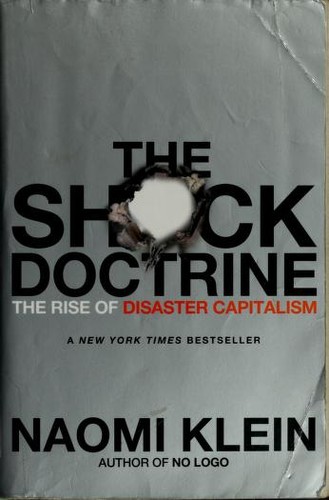
Talk to The Shock Doctrine: The Rise of Disaster Capitalism like its author wrote you back.
Get the ideas that fit your life — not generic summaries.
- Chat with the book
- Audiobook-style main ideas
- Adapts to your life and goals
- Helps you take action
What it argues
Naomi Klein's The Shock Doctrine, published in 2007, argues that free-market economic policies — privatization, deregulation, cuts to social spending — have historically been implemented not through democratic persuasion but by exploiting crises and disasters that leave populations too disoriented and traumatized to resist. Klein calls this process "disaster capitalism," and the central claim is that Chicago School economics and political shock are linked — that the doctrine requires the shock, because it cannot survive democratic deliberation.
The book opens with a parallel between CIA research into psychological disorientation through electroshock and sensory deprivation, and the use of economic crisis to push through radical reforms that would otherwise be politically impossible. Klein traces this pattern through a series of historical case studies: the Pinochet coup in Chile, Argentina's military dictatorship, the economic reforms imposed on post-Soviet Russia, the reconstruction of Iraq, Sri Lanka after the 2004 tsunami, and New Orleans after Hurricane Katrina. In each case, she argues, extreme disruption was used — or sometimes manufactured — to bypass democratic resistance to policies that concentrated wealth and reduced public services.
What it gets right
- 1.
The 'shock doctrine' is Klein's term for the deliberate or opportunistic use of disaster and crisis to impose economic policies — privatization, deregulation, austerity — that could not survive democratic deliberation.
- 2.
The parallel between psychological shock therapy (which disorients patients to make them receptive to new programming) and economic shock therapy (which disorients populations to make them accept radical restructuring) is the book's organizing metaphor.
- 3.
Milton Friedman's Chicago School economics, Klein argues, required political shock to be implemented — his program was consistently adopted in crisis conditions, not through peaceful democratic competition.
What it covers
Who wrote it
Naomi Klein is a Canadian author, journalist, and activist whose work focuses on corporate power, economic policy, and climate change. Her first book, No Logo (1999), documented the rise of global branding and anti-corporate activism. The Shock Doctrine (2007) became an international bestseller translated into more than thirty languages. Her subsequent books include This Changes Everything: Capitalism vs. The Climate and The Battle for Paradise. She has been a columnist for The Guardian and The Nation and holds academic positions at Rutgers University.
