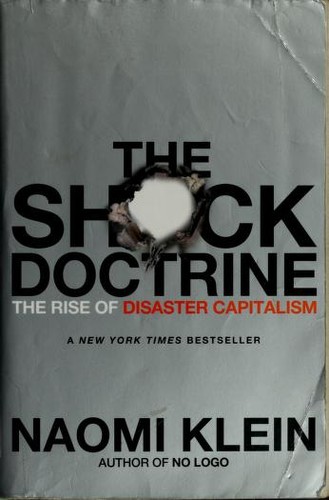
Talk to The Shock Doctrine: The Rise of Disaster Capitalism like its author wrote you back.
Get the ideas that fit your life — not generic summaries.
- Chat with the book
- Audiobook-style main ideas
- Adapts to your life and goals
- Helps you take action
The Shock Doctrine: The Rise of Disaster Capitalism, in detail
Naomi Klein's The Shock Doctrine, published in 2007, argues that free-market economic policies — privatization, deregulation, cuts to social spending — have historically been implemented not through democratic persuasion but by exploiting crises and disasters that leave populations too disoriented and traumatized to resist. Klein calls this process "disaster capitalism," and the central claim is that Chicago School economics and political shock are linked — that the doctrine requires the shock, because it cannot survive democratic deliberation.
The book opens with a parallel between CIA research into psychological disorientation through electroshock and sensory deprivation, and the use of economic crisis to push through radical reforms that would otherwise be politically impossible. Klein traces this pattern through a series of historical case studies: the Pinochet coup in Chile, Argentina's military dictatorship, the economic reforms imposed on post-Soviet Russia, the reconstruction of Iraq, Sri Lanka after the 2004 tsunami, and New Orleans after Hurricane Katrina. In each case, she argues, extreme disruption was used — or sometimes manufactured — to bypass democratic resistance to policies that concentrated wealth and reduced public services.
Klein's central villain is the Chicago School economist Milton Friedman and the network of advisers, institutions, and policy frameworks he developed. She does not accuse Friedman of endorsing atrocity, but argues that his economic program created structural incentives for those who did, because his policies could only be implemented in societies too shocked to say no.
The book is polemical and openly so. Klein does not claim neutrality, and critics — including serious economists across the political spectrum — have challenged specific historical claims, the causal logic linking shock to reform, and her treatment of cases that don't fit the pattern as well as her featured examples. Those criticisms are worth taking seriously. But the book's core question — whether radical economic restructuring requires coercion, and whether we should be suspicious of crises that conveniently enable policies previously blocked — is a genuine and important one that her critics have not fully answered.
The big ideas
- 1.
The 'shock doctrine' is Klein's term for the deliberate or opportunistic use of disaster and crisis to impose economic policies — privatization, deregulation, austerity — that could not survive democratic deliberation.
- 2.
The parallel between psychological shock therapy (which disorients patients to make them receptive to new programming) and economic shock therapy (which disorients populations to make them accept radical restructuring) is the book's organizing metaphor.
- 3.
Milton Friedman's Chicago School economics, Klein argues, required political shock to be implemented — his program was consistently adopted in crisis conditions, not through peaceful democratic competition.
