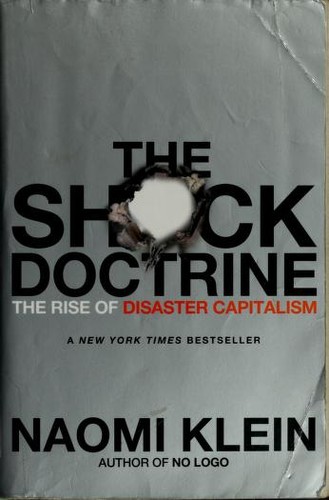
The Shock Doctrine: The Rise of Disaster Capitalism by Naomi Klein is a 2007 history book about capitalism, political economy, disaster exploitation. The 'shock doctrine' is Klein's term for the deliberate or opportunistic use of disaster and crisis to impose economic policies — privatization, deregulation, austerity — that could not survive democratic deliberation.
Summary
Naomi Klein's The Shock Doctrine, published in 2007, argues that free-market economic policies — privatization, deregulation, cuts to social spending — have historically been implemented not through democratic persuasion but by exploiting crises and disasters that leave populations too disoriented and traumatized to resist. Klein calls this process "disaster capitalism," and the central claim is that Chicago School economics and political shock are linked — that the doctrine requires the shock, because it cannot survive democratic deliberation.
The book opens with a parallel between CIA research into psychological disorientation through electroshock and sensory deprivation, and the use of economic crisis to push through radical reforms that would otherwise be politically impossible. Klein traces this pattern through a series of historical case studies: the Pinochet coup in Chile, Argentina's military dictatorship, the economic reforms imposed on post-Soviet Russia, the reconstruction of Iraq, Sri Lanka after the 2004 tsunami, and New Orleans after Hurricane Katrina. In each case, she argues, extreme disruption was used — or sometimes manufactured — to bypass democratic resistance to policies that concentrated wealth and reduced public services.
Klein's central villain is the Chicago School economist Milton Friedman and the network of advisers, institutions, and policy frameworks he developed. She does not accuse Friedman of endorsing atrocity, but argues that his economic program created structural incentives for those who did, because his policies could only be implemented in societies too shocked to say no.
The book is polemical and openly so. Klein does not claim neutrality, and critics — including serious economists across the political spectrum — have challenged specific historical claims, the causal logic linking shock to reform, and her treatment of cases that don't fit the pattern as well as her featured examples. Those criticisms are worth taking seriously. But the book's core question — whether radical economic restructuring requires coercion, and whether we should be suspicious of crises that conveniently enable policies previously blocked — is a genuine and important one that her critics have not fully answered.
Talk to The Shock Doctrine: The Rise of Disaster Capitalism like its author wrote you back.
Get the ideas that fit your life — not generic summaries.
- Chat with the book
- Audiobook-style main ideas
- Adapts to your life and goals
- Helps you take action
Key takeaways
- 1.
The 'shock doctrine' is Klein's term for the deliberate or opportunistic use of disaster and crisis to impose economic policies — privatization, deregulation, austerity — that could not survive democratic deliberation.
- 2.
The parallel between psychological shock therapy (which disorients patients to make them receptive to new programming) and economic shock therapy (which disorients populations to make them accept radical restructuring) is the book's organizing metaphor.
- 3.
Milton Friedman's Chicago School economics, Klein argues, required political shock to be implemented — his program was consistently adopted in crisis conditions, not through peaceful democratic competition.
- 4.
Chile under Pinochet was the first large-scale laboratory for Chicago School economics, implemented with direct American support and at the cost of thousands of deaths and disappearances.
- 5.
Post-Soviet Russia's 'shock therapy' transition produced a catastrophic collapse in living standards and the concentration of former state assets in the hands of a small oligarchic class — an outcome Klein argues was predictable from the model.
- 6.
Disaster reconstruction — in Iraq, Sri Lanka, and New Orleans — consistently prioritized market-based models that benefited outside contractors and foreign investors rather than rebuilding public infrastructure for existing residents.
- 7.
Klein argues that economic and political freedom are not naturally aligned — free markets have historically been implemented by authoritarian states willing to suppress the labor and social movements that would otherwise block them.
- 8.
The book challenges the post-Cold War consensus that free markets and democratic governance are mutually reinforcing. Klein's evidence suggests they are in structural tension when economic reforms are sufficiently radical.
Discussion questions
Use these on your own, with a book club, or as chat starters in Superbook. Book club version, ready to copy or print →
- 1.
Klein argues that radical free-market reforms require shock to be implemented. How much of the historical evidence she presents do you find convincing, and where does the argument feel overstretched?
- 2.
She uses the parallel between psychological shock therapy and economic shock therapy as an organizing metaphor. How far does that parallel illuminate her argument, and where does it break down?
- 3.
Milton Friedman was not personally complicit in the violence of Pinochet's Chile, but his economic framework was. How should we evaluate the relationship between an economic doctrine and the political conditions required to implement it?
- 4.
Which of Klein's case studies — Chile, Russia, Iraq, New Orleans — do you find most and least convincing as evidence for the shock doctrine pattern?
- 5.
Economists who have criticized the book argue that many of her examples involved reforms that reduced economic distortions regardless of how they were implemented. How do you weigh the process against the outcome?
- 6.
Klein claims free markets and democratic freedom are in structural tension. Defenders of free markets claim they are mutually reinforcing. What evidence would settle that debate?
- 7.
The book was published in 2007, before the 2008 financial crisis. How would the crisis and its aftermath fit into Klein's framework? Did the crash produce another round of shock doctrine policies?
- 8.
Klein is explicitly a political advocate, not a neutral analyst. Does her openness about her position make the book more or less reliable than if she claimed objectivity?
- 9.
What does the book imply about how economic policy should be made in normal times, before crises create conditions for shock doctrine application?
- 10.
How does the reconstruction of Iraq as described by Klein compare to what you knew or believed about it before reading?
- 11.
Klein describes the post-Katrina rebuilding of New Orleans as a disaster capitalism case study. Do you find that characterization fair, or does it miss important features of that situation?
- 12.
The book generated intense criticism from economists across the political spectrum. What do you think are the strongest objections to her argument, and how successfully does she answer them?
Themes
Frequently asked questions
-
Is The Shock Doctrine accurate?
Its general pattern — that radical economic restructuring has been repeatedly implemented in crisis conditions — is well-documented. Specific historical claims have been contested by economists and historians. The book is strongest as a framework for asking questions and weakest when it shoehorns cases into the pattern.
-
How long is The Shock Doctrine?
The main text runs about 560 pages and takes roughly 13 to 15 hours to read. Klein writes for a general audience and the chapters move quickly despite the density of historical material.
-
What is the main argument of The Shock Doctrine?
That free-market economic policies have historically been implemented by exploiting crises — coups, natural disasters, financial collapses — because those policies cannot survive democratic deliberation. Klein calls this pattern disaster capitalism.
-
Who should read The Shock Doctrine?
Readers interested in political economy, the history of neoliberalism, or the relationship between capitalism and democracy. It is a useful counterweight to triumphalist accounts of free-market globalization, though it should be read alongside mainstream economic accounts of the same events.
-
What is the strongest criticism of The Shock Doctrine?
That correlation is not causation — crisis conditions often produce economic reforms of many kinds, not only the market-liberalizing variety Klein focuses on, and that she selects cases that fit her argument while downplaying those that don't. The causal logic between shock and specific policy outcomes is less airtight than the historical narrative suggests.