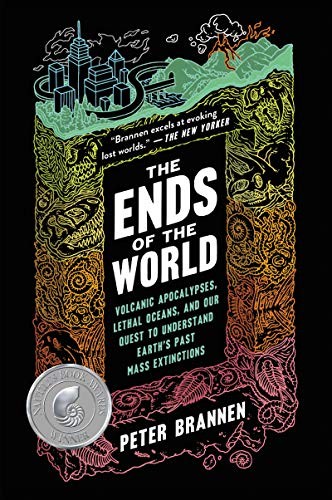
Talk to The Ends of the World: Volcanic Apocalypses, Lethal Oceans, and Our Quest to Understand Earth's Past Mass Extinctions like its author wrote you back.
Get the ideas that fit your life — not generic summaries.
- Chat with the book
- Audiobook-style main ideas
- Adapts to your life and goals
- Helps you take action
What it argues
Peter Brannen is a science journalist who spent years reporting on paleontology and geology, and The Ends of the World is the result of that work: a deep history of the five major mass extinctions in Earth's past, told through visits to the scientists who decode them and the rock formations that preserve their evidence. The book is both a scientific account and a sustained meditation on scale — the scale of geological time, the scale of planetary catastrophe, and the difficulty of fitting either into ordinary human comprehension.
Each of the five mass extinctions gets its own chapter or set of chapters, organized around the specific mechanism proposed for each event. The end-Ordovician extinction, roughly 445 million years ago, appears to have been driven by glaciation and a collapse of shallow marine ecosystems. The Late Devonian, 375 million years ago, may have been caused partly by the spread of the first forests, which altered the chemistry of shallow seas. The end-Permian, the largest extinction in Earth's history, killed more than 90 percent of marine species and appears to be closely tied to massive volcanic activity in what is now Siberia, warming the oceans and acidifying them simultaneously. The end-Triassic shares some of those same signatures. And the end-Cretaceous — the asteroid impact — is the most recent and the one most people know.
What it gets right
- 1.
Earth has experienced five major mass extinctions in the past 500 million years, each killing more than 75 percent of species and each associated with rapid changes in ocean chemistry and climate.
- 2.
The end-Permian extinction, roughly 252 million years ago, was the most severe in Earth's history. It killed more than 90 percent of marine species, likely driven by massive volcanic CO2 release warming and acidifying the oceans.
- 3.
Ocean acidification — the dissolution of carbonate shells as seawater absorbs CO2 — appears as a recurring mechanism in several extinction events, not just the current period.
What it covers
Who wrote it
Peter Brannen is an American science journalist whose work has appeared in The Atlantic, The New York Times, The Washington Post, Wired, and many other publications. The Ends of the World, his first book, was published in 2017 and was named a best book of the year by several publications. He has reported extensively on climate science, paleontology, and geology, often writing about deep time and its implications for understanding the present. He lives in the northeastern United States.
