The Ends of the World: Volcanic Apocalypses, Lethal Oceans, and Our Quest to Understand Earth's Past Mass Extinctions by Peter Brannen is a 2017 science book about mass extinctions, deep time, earth history. Earth has experienced five major mass extinctions in the past 500 million years, each killing more than 75 percent of species and each associated with rapid changes in ocean chemistry and climate.
Summary
Peter Brannen is a science journalist who spent years reporting on paleontology and geology, and The Ends of the World is the result of that work: a deep history of the five major mass extinctions in Earth's past, told through visits to the scientists who decode them and the rock formations that preserve their evidence. The book is both a scientific account and a sustained meditation on scale — the scale of geological time, the scale of planetary catastrophe, and the difficulty of fitting either into ordinary human comprehension.
Each of the five mass extinctions gets its own chapter or set of chapters, organized around the specific mechanism proposed for each event. The end-Ordovician extinction, roughly 445 million years ago, appears to have been driven by glaciation and a collapse of shallow marine ecosystems. The Late Devonian, 375 million years ago, may have been caused partly by the spread of the first forests, which altered the chemistry of shallow seas. The end-Permian, the largest extinction in Earth's history, killed more than 90 percent of marine species and appears to be closely tied to massive volcanic activity in what is now Siberia, warming the oceans and acidifying them simultaneously. The end-Triassic shares some of those same signatures. And the end-Cretaceous — the asteroid impact — is the most recent and the one most people know.
What connects the book's chapters is Brannen's attention to the chemistry of the oceans and atmosphere. In most of the extinction events, the villain is elevated CO2, either from volcanism or from the disruption of the carbon cycle, and the mechanism involves rapid ocean acidification, warming, and oxygen depletion. Brannen draws this comparison to current conditions carefully, never melodramatically, but the implication accumulates across the chapters: the signature of the past extinctions looks uncomfortably similar to what is now being measured.
The scientists Brannen profiles are a particular strength of the book. They are portrayed as people who work on timescales that require a different kind of imagination from most research, staring at slabs of rock to read the chemical diary of a dead ocean. The writing is vivid, the science is current through the mid-2010s, and the overall effect is to make deep time feel specific and strange rather than abstract and remote.
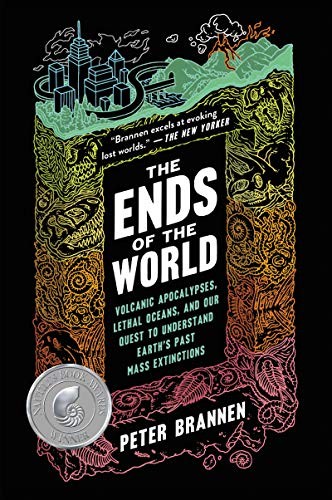
Talk to The Ends of the World: Volcanic Apocalypses, Lethal Oceans, and Our Quest to Understand Earth's Past Mass Extinctions like its author wrote you back.
Get the ideas that fit your life — not generic summaries.
- Chat with the book
- Audiobook-style main ideas
- Adapts to your life and goals
- Helps you take action
Key takeaways
- 1.
Earth has experienced five major mass extinctions in the past 500 million years, each killing more than 75 percent of species and each associated with rapid changes in ocean chemistry and climate.
- 2.
The end-Permian extinction, roughly 252 million years ago, was the most severe in Earth's history. It killed more than 90 percent of marine species, likely driven by massive volcanic CO2 release warming and acidifying the oceans.
- 3.
Ocean acidification — the dissolution of carbonate shells as seawater absorbs CO2 — appears as a recurring mechanism in several extinction events, not just the current period.
- 4.
The asteroid impact that ended the Cretaceous was catastrophic partly because of its specific timing and location; many impact scenarios of similar energy would have had smaller effects.
- 5.
Deep time requires a genuine imaginative effort. A million years is longer than modern Homo sapiens has existed; a billion years is longer than complex animal life has existed on Earth.
- 6.
Volcanism in the end-Permian Siberian Traps released enough CO2 to warm the planet by several degrees over roughly 100,000 years — still far slower than current anthropogenic emission rates.
- 7.
Recovery from mass extinctions takes millions of years. The rich Cretaceous ecosystems took roughly ten million years to re-establish after the asteroid impact.
- 8.
The carbon isotope signature in ancient rocks provides a chemical record of past extinction events, and the same signature is now measurable in modern ocean sediments.
Discussion questions
Use these on your own, with a book club, or as chat starters in Superbook.
- 1.
Brannen draws an implicit comparison between the chemistry of past extinction events and current ocean acidification measurements. How explicit do you think that comparison should be in a book like this?
- 2.
Each mass extinction in the book has its own character and mechanism. Which one struck you as most surprising, and why?
- 3.
The end-Permian extinction killed more than 90 percent of marine species. What do you think would have to be true about the surviving 10 percent to explain why they made it?
- 4.
Deep time is genuinely difficult to feel rather than just know. Did the book change your intuitive sense of how long Earth's history is? What helped or didn't help?
- 5.
Brannen visits the actual rock formations that record each extinction. How does that field reporting approach change the book compared to a purely desk-researched account?
- 6.
The end-Cretaceous extinction is the best known. Did reading the chapters on the earlier extinctions change how you think about the asteroid impact event?
- 7.
Recovery from the end-Cretaceous extinction took roughly ten million years. What does that timescale suggest about what 'recovery' from a biodiversity crisis actually means?
- 8.
The volcanic CO2 that drove the end-Permian extinction was released over about 100,000 years. Current anthropogenic emissions are releasing a comparable amount of carbon much faster. How does that rate comparison affect your reading of the extinction mechanism?
- 9.
Brannen is careful about how explicitly he draws comparisons to the present. Do you think that restraint is appropriate, or does it allow readers to avoid an obvious implication?
- 10.
Which of the scientists Brannen profiles struck you as most memorable, and what does their specific area of research illuminate about how we understand deep time?
- 11.
The book describes mass extinctions as events that reset the evolutionary slate, creating opportunities for surviving lineages. How do you think about that framing in relation to current biodiversity loss?
- 12.
What did reading this book change about how you think about the geological present — the period of time in which human civilization exists?
Themes
Frequently asked questions
-
Is The Ends of the World worth reading?
Yes. The field reporting is excellent, the science is carefully explained, and Brannen's ability to make deep time feel specific rather than abstract is a genuine achievement. It's one of the better popular science books about Earth history published in the last decade.
-
How long does it take to read this book?
About five to six hours. The chapters are organized around individual extinction events and can be read somewhat independently, though the cumulative argument builds across them.
-
Is this book about climate change?
Not primarily. It's about the five major mass extinctions in Earth's history. The chemistry of those events — particularly ocean acidification and elevated CO2 — bears comparison to current measurements, and Brannen makes that comparison carefully without making it the book's thesis.
-
How does this compare to The Sixth Extinction by Elizabeth Kolbert?
Kolbert's book is primarily about the current extinction crisis and uses field reporting from around the world to document species loss happening now. Brannen's book goes much deeper in time, examining past mass extinctions to understand the mechanisms. They complement each other well.
-
Who should read this book?
Anyone interested in Earth history, evolutionary biology, or paleontology, and anyone who wants a well-reported account of what mass extinctions actually involve. It's also useful for readers who want to understand what current ocean chemistry measurements mean in a geological context.
Similar books
The Sixth Extinction: An Unnatural History
Elizabeth Kolbert
A World Without Ice
Henry Pollack
A Short History of Nearly Everything
Bill Bryson
Guns, Germs, and Steel
Jared Diamond
