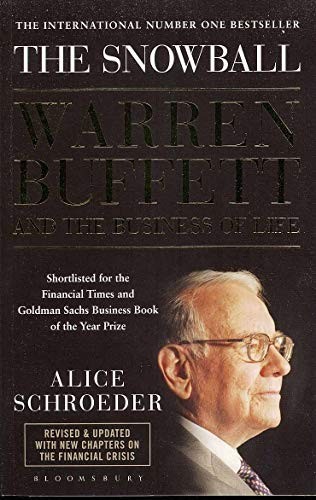
Talk to The Snowball: Warren Buffett and the Business of Life like its author wrote you back.
Get the ideas that fit your life — not generic summaries.
- Chat with the book
- Audiobook-style main ideas
- Adapts to your life and goals
- Helps you take action
The Snowball: Warren Buffett and the Business of Life, in detail
The Snowball is Alice Schroeder's authorized biography of Warren Buffett, written with his cooperation and based on hundreds of hours of interviews with him and the people who have known him across his life. At nearly 900 pages, it is the most comprehensive account of how Buffett developed his investment philosophy, built Berkshire Hathaway, and navigated the personal and professional dimensions of becoming one of the wealthiest people in history. Schroeder, a former Wall Street securities analyst who covered Berkshire, was uniquely positioned to evaluate both the financial and biographical material.
The title comes from Buffett's metaphor for compounding: "Life is like a snowball. The important thing is finding wet snow and a really long hill." The biography traces how Buffett found his wet snow in Benjamin Graham's value investing framework and his long hill in the decades of discipline that followed. The story begins in Omaha, where Buffett was born in 1930, proceeds through his obsessive early interest in numbers and business, his studies under Graham at Columbia, the formation of his investment partnerships in 1956, and the steady accumulation of businesses and capital that built Berkshire.
Schroeder does not shy away from the personal complications. Buffett's marriage to Susan Thompson was unconventional from relatively early on — she left Omaha to pursue a singing career in San Francisco while he remained behind with his companion Astrid Menks, a situation all three parties apparently navigated with unusual equanimity. The biography explores Buffett's emotional distance from his children, his difficulty with interpersonal directness outside of business, and the ways his single-minded focus on investing shaped every relationship in his life.
The investment history is embedded in biographical context rather than presented as a separate analysis. Readers see the ideas develop through specific decisions — the American Express salad oil scandal, the Washington Post Company investment, the Nebraska Furniture Mart acquisition, the near-disaster with USAir — and understand how Buffett's thinking evolved from Graham's strictly quantitative approach toward the quality-business orientation Fisher's work influenced. For investors, the biography provides context for the annual letters that Buffett later wrote. For general readers, it is a portrait of extraordinary single-mindedness and its costs.
The big ideas
- 1.
Compounding requires patience measured in decades, not years. Buffett's extraordinary wealth accumulated mostly in the second half of his life because compounding had had time to work.
- 2.
The transition from Graham's strictly cheap-asset focus to Fisher's quality-business approach was gradual, driven by specific investment experiences rather than theoretical revision.
- 3.
Buffett's partnership structure in the 1950s and 1960s gave him the institutional stability to invest with a very long time horizon — partners could not withdraw on short notice.
