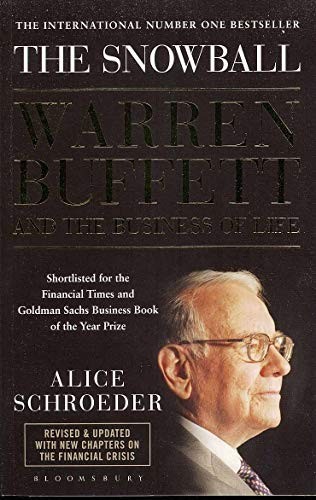
The Snowball: Warren Buffett and the Business of Life by Alice Schroeder is a 2008 biography book about long-term investing, compounding, business biography. Compounding requires patience measured in decades, not years. Buffett's extraordinary wealth accumulated mostly in the second half of his life because compounding had had time to work.
Summary
The Snowball is Alice Schroeder's authorized biography of Warren Buffett, written with his cooperation and based on hundreds of hours of interviews with him and the people who have known him across his life. At nearly 900 pages, it is the most comprehensive account of how Buffett developed his investment philosophy, built Berkshire Hathaway, and navigated the personal and professional dimensions of becoming one of the wealthiest people in history. Schroeder, a former Wall Street securities analyst who covered Berkshire, was uniquely positioned to evaluate both the financial and biographical material.
The title comes from Buffett's metaphor for compounding: "Life is like a snowball. The important thing is finding wet snow and a really long hill." The biography traces how Buffett found his wet snow in Benjamin Graham's value investing framework and his long hill in the decades of discipline that followed. The story begins in Omaha, where Buffett was born in 1930, proceeds through his obsessive early interest in numbers and business, his studies under Graham at Columbia, the formation of his investment partnerships in 1956, and the steady accumulation of businesses and capital that built Berkshire.
Schroeder does not shy away from the personal complications. Buffett's marriage to Susan Thompson was unconventional from relatively early on — she left Omaha to pursue a singing career in San Francisco while he remained behind with his companion Astrid Menks, a situation all three parties apparently navigated with unusual equanimity. The biography explores Buffett's emotional distance from his children, his difficulty with interpersonal directness outside of business, and the ways his single-minded focus on investing shaped every relationship in his life.
The investment history is embedded in biographical context rather than presented as a separate analysis. Readers see the ideas develop through specific decisions — the American Express salad oil scandal, the Washington Post Company investment, the Nebraska Furniture Mart acquisition, the near-disaster with USAir — and understand how Buffett's thinking evolved from Graham's strictly quantitative approach toward the quality-business orientation Fisher's work influenced. For investors, the biography provides context for the annual letters that Buffett later wrote. For general readers, it is a portrait of extraordinary single-mindedness and its costs.
Talk to The Snowball: Warren Buffett and the Business of Life like its author wrote you back.
Get the ideas that fit your life — not generic summaries.
- Chat with the book
- Audiobook-style main ideas
- Adapts to your life and goals
- Helps you take action
Key takeaways
- 1.
Compounding requires patience measured in decades, not years. Buffett's extraordinary wealth accumulated mostly in the second half of his life because compounding had had time to work.
- 2.
The transition from Graham's strictly cheap-asset focus to Fisher's quality-business approach was gradual, driven by specific investment experiences rather than theoretical revision.
- 3.
Buffett's partnership structure in the 1950s and 1960s gave him the institutional stability to invest with a very long time horizon — partners could not withdraw on short notice.
- 4.
Understanding the business behind the stock matters more than any financial ratio. Buffett's deepest insights came from studying specific industries and companies over years.
- 5.
Mistakes are part of the record. Buffett has made significant errors — Berkshire textile operations, USAir, the original purchase of Berkshire itself — and been direct about them.
- 6.
Temperament matters as much as intelligence in investing. Buffett's ability to be greedy when others are fearful and fearful when others are greedy is a temperamental trait, not just a cognitive strategy.
- 7.
The float concept — using insurance premiums collected before claims are paid as an investment pool — created the financial structure that allowed Berkshire to invest at scale and low cost.
- 8.
Personal frugality and business ambition coexist in Buffett's biography. He is famously frugal in personal spending while being aggressively acquisitive in business. These are not contradictions but expressions of the same priorities.
Discussion questions
Use these on your own, with a book club, or as chat starters in Superbook. Book club version, ready to copy or print →
- 1.
The book's title metaphor — wet snow and a really long hill — describes Buffett's approach to compounding. What is your equivalent of wet snow and how long is your hill?
- 2.
Schroeder reveals significant personal complications in Buffett's life: the unconventional marriage, the distance from his children, the consuming focus on investing. Does understanding the personal costs change how you think about his professional achievements?
- 3.
Buffett spent years investing in the strict Graham style before evolving toward quality businesses. What specific experience or observation most significantly shifted his thinking?
- 4.
The Berkshire textile business was a catastrophic capital trap that Buffett held too long out of loyalty to employees. Have you ever held onto an investment past the point where the rational case was gone?
- 5.
Buffett built early investor loyalty by being unusually transparent about his approach and results. How much of his subsequent success do you think was enabled by that early relationship with investors?
- 6.
The insurance float business is a structural innovation that most investors could not replicate. Does the uniqueness of Berkshire's structure limit the applicability of Buffett's approach for individuals?
- 7.
Schroeder had unusual access and still says Buffett was difficult to fully know. What do you think motivates him at the deepest level — is it the money, the game, the scorecard, or something else?
- 8.
At what point in the biography does Buffett's wealth become so large that the investment decisions he makes are no longer instructive for individual investors managing smaller amounts?
- 9.
The biography covers Buffett's public advocacy for estate taxes and higher taxation of the wealthy alongside his extensive use of tax avoidance structures within Berkshire. How do you read that tension?
- 10.
Buffett maintained his single investment focus through personal and market crises that would have derailed most people. What is the psychological structure that made that consistency possible?
- 11.
The book describes the early investment partnerships in detail. If you could have been a limited partner in one of Buffett's early partnerships, what would you need to know to commit capital?
- 12.
Schroeder said the biography changed her relationship with Buffett — she ended up less admiring of him as a person than she started. Does that honesty make the book more or less useful as an investment education?
Themes
Frequently asked questions
-
Is The Snowball too long to be worth reading?
The length is justified by the scope of what Schroeder is attempting. The investment analysis is embedded in biographical context across decades, and extracting just the investing content would miss the point. Readers who want only the investment philosophy can get most of it from Buffett's annual letters. The biography is worth the time for readers who want to understand the person behind the philosophy.
-
Does The Snowball reveal anything about Buffett's investment approach not in the annual letters?
Yes. The biography shows the early development of the approach — the specific investments that shaped his thinking, the evolution from strict Graham value to quality-business investing, and the partnership structures that gave him an unusual institutional position. The letters assume the approach is formed; the biography shows how it developed.
-
What is the most surprising thing about Buffett revealed in The Snowball?
Different readers highlight different things. Schroeder's portrayal of his personal relationships — particularly his distance from his children and the unconventional marriage — often surprises readers who expected a simpler narrative. His willingness to let Schroeder report those aspects honestly also surprises many.
-
Should I read The Snowball or The Essays of Warren Buffett first?
The Essays first. Buffett's own writing gives you the investment framework; Schroeder's biography gives you the biographical context for it. Reading the biography without familiarity with the philosophy produces a less rich experience.
-
Is The Snowball accurate?
Schroeder's reporting standards were serious, and she had access that no other biographer has had. Buffett reportedly had some concerns about the personal sections after reading the final manuscript. No significant factual challenges have emerged, though Buffett's own account of some episodes differs in tone from Schroeder's.
Similar books
The Essays of Warren Buffett
Warren Buffett
The Intelligent Investor
Benjamin Graham
Common Stocks and Uncommon Profits
Philip A. Fisher
A Random Walk Down Wall Street
Burton G. Malkiel
