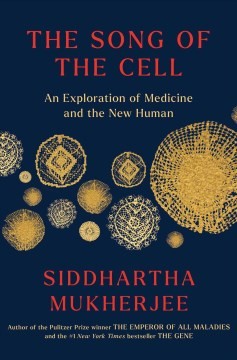
Talk to The Song of the Cell like its author wrote you back.
Get the ideas that fit your life — not generic summaries.
- Chat with the book
- Audiobook-style main ideas
- Adapts to your life and goals
- Helps you take action
The Song of the Cell, in detail
The Song of the Cell is Siddhartha Mukherjee's account of how the cell — the basic unit of life — was discovered, decoded, and eventually harnessed to rebuild and repair the human body. The book moves from the seventeenth-century microscopists who first glimpsed cells through glass to the twenty-first-century researchers engineering cellular therapies for cancer, diabetes, and immune disorders. Mukherjee's argument is that medicine is entering a cellular era: understanding what goes wrong inside cells, and learning to fix or replace them, is reshaping what it means to heal.
The structure alternates between history and clinical narrative. Mukherjee traces how the germ theory of disease gave way to a cellular theory, how organ systems were eventually understood as populations of specialized cells in constant communication, and how the discovery of stem cells opened the possibility of regeneration. Woven through the science are his patients — a woman with a collapsing immune system, a man whose cancer was attacked by engineered T-cells — whose cases ground the cellular biology in stakes that matter.
Mukherjee writes with a poet's ear. He reaches for metaphor and music throughout: cells send chemical signals that function like musical phrases, and the organism is a kind of composition. The conceit sometimes strains but more often illuminates. His core claim is that the reductionism of molecular biology — breaking life into genes and proteins — is giving way to a new synthesis that treats the cell as its own level of organization, irreducible to its parts.
The book is candid about limits. Cellular medicine is expensive, fraught with failure, and unevenly distributed. CAR-T therapy can cost hundreds of thousands of dollars per patient and still not work. Mukherjee doesn't obscure these facts. What he does show is how quickly the field is moving, and why the answers to most of medicine's hardest problems — aging, cancer, neurodegeneration — probably lie inside the cell.
The big ideas
- 1.
The cell is the fundamental unit of life and disease. Most of what goes wrong in the human body begins as something going wrong inside or between cells.
- 2.
Medicine is shifting from organ-based thinking to cell-based thinking. Understanding cellular behavior, rather than just anatomy, is driving the next generation of treatments.
- 3.
Stem cells retain the capacity to become specialized cell types, which makes them both central to development and potentially central to regenerative medicine.
