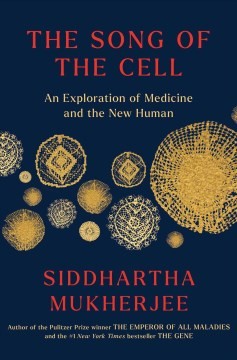
The Song of the Cell by Siddhartha Mukherjee is a 2022 science book about cell biology, medicine, evolution. The cell is the fundamental unit of life and disease. Most of what goes wrong in the human body begins as something going wrong inside or between cells.
Summary
The Song of the Cell is Siddhartha Mukherjee's account of how the cell — the basic unit of life — was discovered, decoded, and eventually harnessed to rebuild and repair the human body. The book moves from the seventeenth-century microscopists who first glimpsed cells through glass to the twenty-first-century researchers engineering cellular therapies for cancer, diabetes, and immune disorders. Mukherjee's argument is that medicine is entering a cellular era: understanding what goes wrong inside cells, and learning to fix or replace them, is reshaping what it means to heal.
The structure alternates between history and clinical narrative. Mukherjee traces how the germ theory of disease gave way to a cellular theory, how organ systems were eventually understood as populations of specialized cells in constant communication, and how the discovery of stem cells opened the possibility of regeneration. Woven through the science are his patients — a woman with a collapsing immune system, a man whose cancer was attacked by engineered T-cells — whose cases ground the cellular biology in stakes that matter.
Mukherjee writes with a poet's ear. He reaches for metaphor and music throughout: cells send chemical signals that function like musical phrases, and the organism is a kind of composition. The conceit sometimes strains but more often illuminates. His core claim is that the reductionism of molecular biology — breaking life into genes and proteins — is giving way to a new synthesis that treats the cell as its own level of organization, irreducible to its parts.
The book is candid about limits. Cellular medicine is expensive, fraught with failure, and unevenly distributed. CAR-T therapy can cost hundreds of thousands of dollars per patient and still not work. Mukherjee doesn't obscure these facts. What he does show is how quickly the field is moving, and why the answers to most of medicine's hardest problems — aging, cancer, neurodegeneration — probably lie inside the cell.
Talk to The Song of the Cell like its author wrote you back.
Get the ideas that fit your life — not generic summaries.
- Chat with the book
- Audiobook-style main ideas
- Adapts to your life and goals
- Helps you take action
Key takeaways
- 1.
The cell is the fundamental unit of life and disease. Most of what goes wrong in the human body begins as something going wrong inside or between cells.
- 2.
Medicine is shifting from organ-based thinking to cell-based thinking. Understanding cellular behavior, rather than just anatomy, is driving the next generation of treatments.
- 3.
Stem cells retain the capacity to become specialized cell types, which makes them both central to development and potentially central to regenerative medicine.
- 4.
CAR-T therapy reprograms a patient's own immune T-cells to recognize and attack cancer cells — one of the first genuinely cellular therapies to reach clinical use.
- 5.
Cells communicate constantly through chemical signals. Breakdown in that communication — not just mutation — explains many diseases.
- 6.
The discovery of the cell required new tools, new conceptual frameworks, and the willingness to accept that visible anatomy was built from invisible components.
- 7.
Aging can be partially understood as cellular dysfunction: accumulated DNA damage, mitochondrial decline, and the buildup of senescent cells that refuse to die.
- 8.
Mukherjee's cases show that cellular medicine is already here but distributed unequally — available to patients in research hospitals while remaining inaccessible to most of the world.
Discussion questions
Use these on your own, with a book club, or as chat starters in Superbook. Book club version, ready to copy or print →
- 1.
Mukherjee frames medicine as moving from an organ-based to a cell-based paradigm. Do you find that shift convincing, or does the distinction feel artificial?
- 2.
The CAR-T cases in the book involve extraordinary cost and uncertainty. How should medicine weigh individual benefit against systemic resource constraints?
- 3.
Mukherjee uses musical metaphor throughout — cells as instruments, the body as composition. Did that framing help you understand the biology, or did it get in the way?
- 4.
The book traces how the germ theory of disease shaped medicine for more than a century. What assumptions in today's medicine might the next century's doctors find similarly partial?
- 5.
Stem cell research has been entangled with ethics from the start. How do you think about the moral status of embryonic cells used in research?
- 6.
Mukherjee is both an oncologist and a writer. Does his dual identity make the book more trustworthy, or does it sometimes feel like advocacy dressed as explanation?
- 7.
Which patient story in the book stayed with you most? What does it reveal about the gap between scientific possibility and clinical reality?
- 8.
Mukherjee acknowledges that many cellular therapies remain inaccessible to most people. Does scientific progress feel differently when its benefits are distributed this unevenly?
- 9.
The book argues that reductionism — breaking biology into genes and proteins — has reached its limit. Do you find that argument persuasive?
- 10.
Cellular senescence — the accumulation of cells that no longer divide but refuse to die — is one mechanism of aging. Does thinking about aging cellularly change how you think about it personally?
- 11.
How does The Song of the Cell change, if at all, how you think about what the human body actually is?
- 12.
Mukherjee's earlier book, The Emperor of All Maladies, covered cancer as a disease of cells. Does reading this book retroactively change how you understood that one?
Themes
Frequently asked questions
-
What is The Song of the Cell about?
It traces the history of cell biology from the first microscopes to modern cellular medicine, arguing that understanding and manipulating cells is the central project of twenty-first-century medicine. Mukherjee alternates between historical narrative and clinical cases.
-
Do I need a biology background to read The Song of the Cell?
No. Mukherjee writes for a general audience and explains technical concepts through analogy and narrative. Some sections assume familiarity with basic biology, but nothing requires a science degree.
-
How does this compare to The Emperor of All Maladies?
The Emperor of All Maladies is specifically about cancer and reads as a narrative history. The Song of the Cell is broader — it covers the whole cell — and is more a hybrid of history, philosophy of science, and clinical memoir. Many readers find Emperor more emotionally gripping; this one is more intellectually expansive.
-
Is The Song of the Cell worth reading?
Yes, especially if you are curious about where medicine is heading. It is long and occasionally dense, but Mukherjee is among the best science writers working today and the subject is genuinely important.
-
Who should read The Song of the Cell?
Readers interested in biology, medicine, or the history of science. Also useful for anyone trying to understand CAR-T therapy, stem cells, or cellular approaches to aging. Less useful if you want a practical health book — this is science writing, not advice.
Similar books

The Emperor of All Maladies: A Biography of Cancer
Siddhartha Mukherjee
The Gene: An Intimate History
Siddhartha Mukherjee
The Selfish Gene
Richard Dawkins
A Short History of Nearly Everything
Bill Bryson
