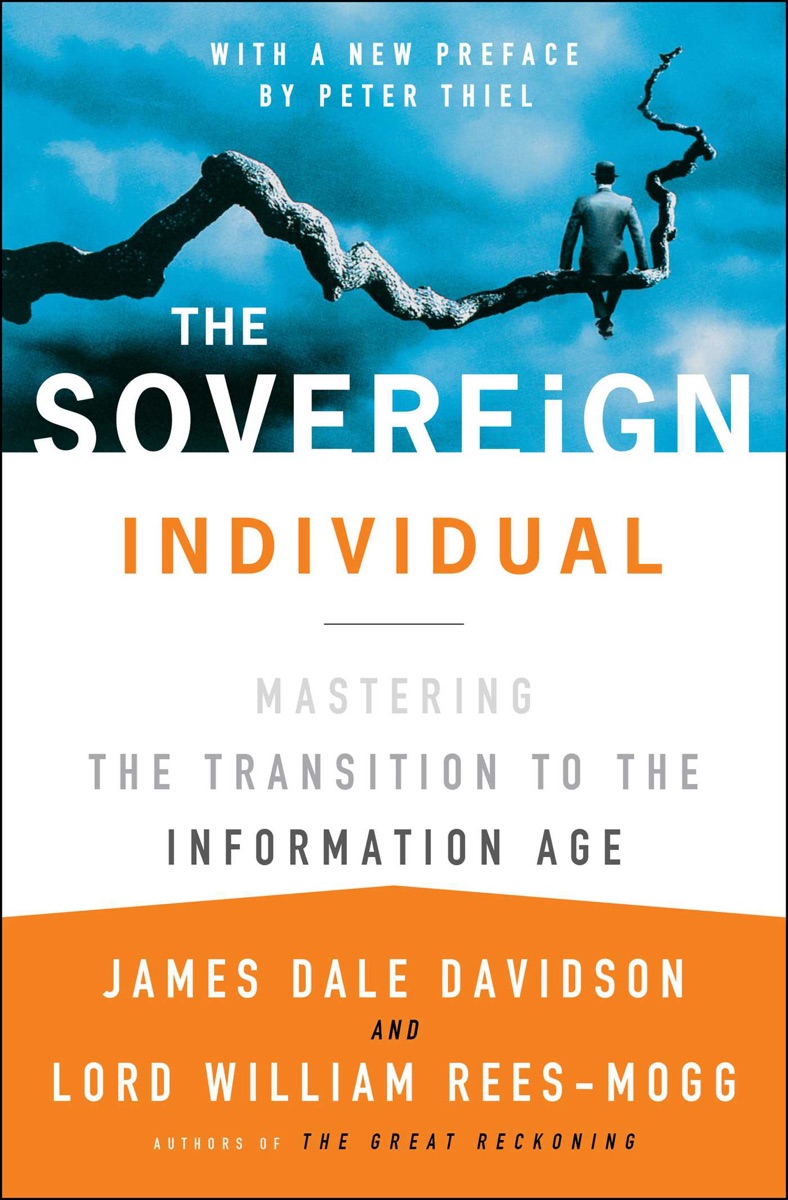
Talk to The Sovereign Individual like its author wrote you back.
Get the ideas that fit your life — not generic summaries.
- Chat with the book
- Audiobook-style main ideas
- Adapts to your life and goals
- Helps you take action
The Sovereign Individual, in detail
The Sovereign Individual, published in 1997, is a sweeping argument that the rise of digital technology and cryptographic money will break the monopoly nation-states have held over taxation, violence, and the terms of economic life. Davidson and Rees-Mogg frame history through the lens of what they call "megapolitics": the underlying balance of physical power that determines how societies organize themselves. Each shift in that balance — gunpowder, the printing press, the industrial revolution — dissolved one dominant institution and created another.
Their core thesis is that microprocessors are as profound a force as any of these earlier transitions. Information can now be encrypted, wealth can be held in forms that are physically untaxable, and skilled individuals can route their economic lives around any jurisdiction that becomes extractive. The sovereign individual, in their telling, is a person wealthy and technically capable enough to opt out of the coercive bargain the nation-state has offered for two centuries: protection in exchange for compliance and taxation.
Much of the book is an extended forecast. Davidson and Rees-Mogg predicted the rise of something very like Bitcoin — a cryptographic form of money that governments cannot easily seize or inflate. They predicted the decline of mass democracy as the economics of industrialism that sustained it erode. They predicted violent backlash from those whose livelihoods depend on nation-state structures: welfare recipients, public employees, politically connected industries. These predictions have aged unevenly, with some looking prescient and others dated.
The writing is dense and the argument is sweeping to the point of grandiosity. The book is better read as a provocation than a forecast. Its value lies less in its accuracy than in the framework it provides: that every form of political economy is contingent on physical and technological realities that eventually change. Readers who find the conclusions alarming or elitist — and many will — are still left with the core question: if technology does erode the nation-state's enforcement capacity, what replaces it?
The big ideas
- 1.
Megapolitics governs history: the physical balance of power determines what political institutions survive and which collapse, not ideology or moral progress.
- 2.
The printing press, gunpowder, and industrialism each destroyed one ruling class and created another. Microprocessors are doing the same thing now.
- 3.
Cryptography enables wealth that cannot be taxed by territorial governments. The authors predicted something essentially identical to Bitcoin in 1997.
