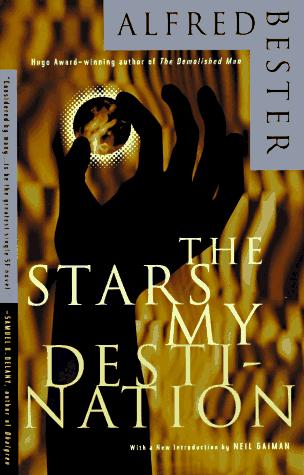
Talk to The Stars My Destination like its author wrote you back.
Get the ideas that fit your life — not generic summaries.
- Chat with the book
- Audiobook-style main ideas
- Adapts to your life and goals
- Helps you take action
What it argues
Gully Foyle is the worst kind of man: stupid, brutal, and totally without ambition — until the day a passing spaceship fails to rescue him from a wrecked hulk where he has survived alone for months. That abandonment transforms him. Gully Foyle becomes something else entirely: a man with a single, consuming purpose. He will find the ship that left him to die, and he will destroy everyone connected to it. The engine that powers the entire novel is pure vendetta.
The world of the twenty-fourth century has a central conceit: jaunting, the human ability to teleport short distances using only mental concentration. It has restructured civilization. The rich live in fortified compounds to prevent intrusion; the poor jaunte through walls and windows. Bester uses the technology not as hardware but as a social lens — every invention reorganizes class, and this one reorganized it radically. The world Gully moves through is baroque, violent, stratified, and inventive in the way that the best pulp science fiction is inventive: ideas thrown at the page until they land somewhere interesting.
What it gets right
- 1.
Gully Foyle is not a hero who happens to do bad things — he is a villain who is also, unavoidably, the protagonist. Bester doesn't reconcile that, and the refusal is the novel's most honest choice.
- 2.
Jaunting reorganizes society in ways Bester traces carefully: the rich build blind-walled fortresses, the poor move at will, and the technology is both liberation and threat depending on where you're standing.
- 3.
The Count of Monte Cristo parallel is explicit. What Bester adds is moral ambiguity about whether revenge transforms or merely amplifies what was already there.
What it covers
Who wrote it
Alfred Bester was an American science fiction author whose two major novels, The Demolished Man (1953) and The Stars My Destination (1956), are considered cornerstones of the genre. The Demolished Man won the first Hugo Award for Best Novel. Bester also worked extensively in radio, television, and comics — he wrote Green Lantern stories in the 1940s. His influence on later science fiction, particularly cyberpunk, is widely acknowledged; William Gibson and others have cited him as a direct predecessor. He died in 1987.
