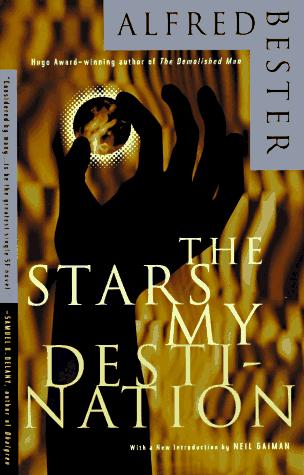
The Stars My Destination by Alfred Bester is a 1956 science fiction book about revenge and obsession, class and power, human potential. Gully Foyle is not a hero who happens to do bad things — he is a villain who is also, unavoidably, the protagonist. Bester doesn't reconcile that, and the refusal is the novel's most honest choice.
Summary
Gully Foyle is the worst kind of man: stupid, brutal, and totally without ambition — until the day a passing spaceship fails to rescue him from a wrecked hulk where he has survived alone for months. That abandonment transforms him. Gully Foyle becomes something else entirely: a man with a single, consuming purpose. He will find the ship that left him to die, and he will destroy everyone connected to it. The engine that powers the entire novel is pure vendetta.
The world of the twenty-fourth century has a central conceit: jaunting, the human ability to teleport short distances using only mental concentration. It has restructured civilization. The rich live in fortified compounds to prevent intrusion; the poor jaunte through walls and windows. Bester uses the technology not as hardware but as a social lens — every invention reorganizes class, and this one reorganized it radically. The world Gully moves through is baroque, violent, stratified, and inventive in the way that the best pulp science fiction is inventive: ideas thrown at the page until they land somewhere interesting.
Bester is writing a version of The Count of Monte Cristo — the wronged man who transforms himself through suffering and obsession into something his enemies cannot prepare for. But where Dumas's Edmond Dantès becomes noble through suffering, Gully Foyle becomes something stranger and more ambivalent. He is not redeemed; he is amplified. The novel doesn't resolve the question of whether what he becomes is better or worse than what he was, and that moral irresolution is what makes it more than pulp.
Published in 1956, The Stars My Destination is one of science fiction's proto-cyberpunk novels — it anticipates the corporate dystopia, the body modification, the protagonist-as-weapon aesthetics that Gibson and others would develop thirty years later. It is short, violent, funny in a black way, and propulsive in a manner that most contemporary science fiction doesn't risk. Dated in some of its assumptions about gender, but structurally it still holds.
Talk to The Stars My Destination like its author wrote you back.
Get the ideas that fit your life — not generic summaries.
- Chat with the book
- Audiobook-style main ideas
- Adapts to your life and goals
- Helps you take action
Key takeaways
- 1.
Gully Foyle is not a hero who happens to do bad things — he is a villain who is also, unavoidably, the protagonist. Bester doesn't reconcile that, and the refusal is the novel's most honest choice.
- 2.
Jaunting reorganizes society in ways Bester traces carefully: the rich build blind-walled fortresses, the poor move at will, and the technology is both liberation and threat depending on where you're standing.
- 3.
The Count of Monte Cristo parallel is explicit. What Bester adds is moral ambiguity about whether revenge transforms or merely amplifies what was already there.
- 4.
Bester's prose style is frenetic — punchy, fast, full of invented slang and visual typography. It anticipates cyberpunk by three decades and does it better than most cyberpunk prose.
- 5.
The novel is partly about human potential: what would the worst specimen of humanity do if given unlimited resources and a reason to become competent? The answer is uncomfortable.
- 6.
PyrE — the central MacGuffin — raises questions about democratizing destruction that were genuinely ahead of their time in 1956 and remain urgent.
- 7.
The corporation as power structure and the individual as corporate weapon both appear here, forty years before they became science fiction's dominant mode.
- 8.
Bester ends the novel with a choice that redistributes power rather than consolidating it — a structural decision that is more politically interesting than a simple revenge plot.
Discussion questions
Use these on your own, with a book club, or as chat starters in Superbook. Book club version, ready to copy or print →
- 1.
Is Gully Foyle sympathetic? Does the novel want him to be, or does it want you to be uncomfortable with how much you root for him?
- 2.
Jaunting eliminates distance as an obstacle. Bester argues this restructures class more than almost any other technology. Does that reasoning hold up?
- 3.
The novel is Monte Cristo in space. Where does it improve on Dumas, and where does it fall short?
- 4.
Gully's transformation from brute to genius happens through will and obsession. Is that a realistic account of what hatred can do to a person, or a fantasy?
- 5.
Bester's treatment of women is a product of 1956, and some of it is difficult. Does the novel's other ambitions earn enough credit to read past that, or not?
- 6.
PyrE can be detonated by thought. Gully's final choice with it is to give it to everyone. Is that nihilistic, utopian, or something else?
- 7.
The novel anticipates cyberpunk by decades. What specifically did Gibson and others take from it, and what did they add that Bester wasn't doing?
- 8.
Foyle's obsession with revenge eventually expands into something larger. Was that expansion earned, or does it feel like the plot needed a reason to keep going?
- 9.
The corporate structures in the novel feel contemporary even though they were written in 1956. What does that say about how much science fiction anticipated the present?
- 10.
By the end, Foyle has achieved his revenge but also changed what he was seeking revenge for. Did the novel convince you that growth is possible for someone who starts as he does?
- 11.
Is this ultimately an optimistic or a pessimistic novel about human nature?
Themes
Frequently asked questions
-
Is The Stars My Destination worth reading?
Yes, if you want to understand where science fiction came from and where it was going before cyberpunk named it. It's one of the five or ten most influential SF novels ever written, and it remains readable in a way that a lot of 1950s SF does not.
-
Is the book dated?
Some of it is. Bester's treatment of women reflects 1956 attitudes and includes one scene that contemporary readers will find genuinely disturbing. The politics and technology feel remarkably fresh; the gender dynamics do not. Worth knowing before you start.
-
What is The Stars My Destination about, without spoilers?
A man abandoned to die in space becomes obsessed with vengeance against those responsible. In pursuing that vendetta, he transforms himself — and through a series of escalating complications, ends up at the center of an interplanetary conflict he didn't plan for.
-
How long does it take to read?
Under five hours. Bester's prose is fast — he was a pulp writer who learned economy. The book is 235 pages and moves quickly. It rewards a re-read for the structural details that only become clear after you know where it's going.
-
Who shouldn't read The Stars My Destination?
Readers who need their protagonists to be basically decent, or who find ambivalent moral frameworks frustrating. Gully Foyle does terrible things for comprehensible reasons and never becomes conventionally sympathetic. That's the point — but it's not for everyone.