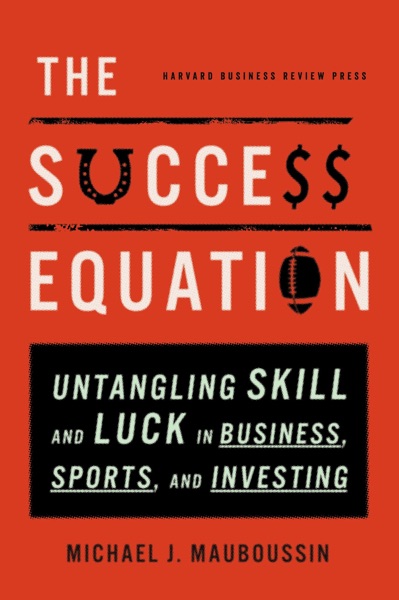
Talk to The Success Equation like its author wrote you back.
Get the ideas that fit your life — not generic summaries.
- Chat with the book
- Audiobook-style main ideas
- Adapts to your life and goals
- Helps you take action
What it argues
The Success Equation is Michael Mauboussin's attempt to solve a practical problem: how do you know whether a result came from skill or from luck? The question matters in investing, sports, business, and everyday life, but most people have no systematic way to answer it. Mauboussin, a seasoned investment strategist and adjunct professor at Columbia Business School, brings together statistics, psychology, and sports analytics to build a framework for separating the two.
The book's central device is a luck-skill continuum. At one extreme sit activities like roulette, where outcomes are entirely random. At the other sit chess or competitive debate, where skill dominates. Most real-world domains land somewhere in between, and where they land has large consequences for how you should make decisions, evaluate performance, and allocate resources. Investing, for instance, sits much closer to the luck end than most practitioners acknowledge. This is uncomfortable but important: it means that many investment track records that look like evidence of skill are more plausibly explained by chance.
What it gets right
- 1.
Most outcomes fall somewhere on a luck-skill continuum. Knowing where your domain sits determines how you should interpret results and allocate effort.
- 2.
Reversion to the mean is the tell: if past winners reliably regress toward average, luck is doing more work than skill in that domain.
- 3.
Mutual fund performance is much closer to the luck end than the industry's marketing implies. Most active managers underperform their benchmarks after fees over long horizons.
What it covers
Who wrote it
Michael Mauboussin is head of Consilient Research at Counterpoint Global and a longtime adjunct professor at Columbia Business School. He spent over two decades as chief investment strategist at Legg Mason Capital Management. His other books include Think Twice, More Than You Know, and Expectations Investing (co-authored with Alfred Rappaport). He is known for bringing behavioral science, statistical thinking, and ecology into investment analysis, and his research is widely read by professional investors and decision scientists.
