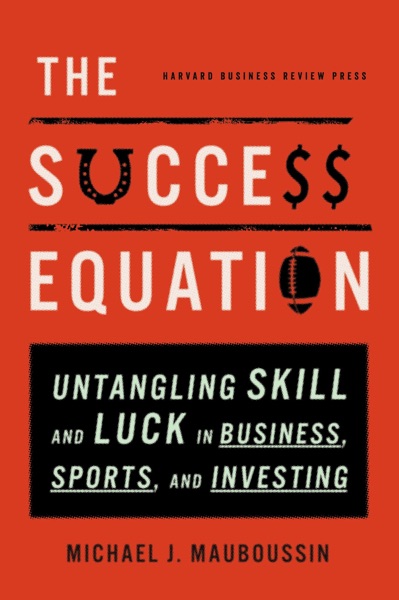
The Success Equation by Michael Mauboussin is a 2012 business book about luck vs. skill, decision-making, statistics. Most outcomes fall somewhere on a luck-skill continuum. Knowing where your domain sits determines how you should interpret results and allocate effort.
Summary
The Success Equation is Michael Mauboussin's attempt to solve a practical problem: how do you know whether a result came from skill or from luck? The question matters in investing, sports, business, and everyday life, but most people have no systematic way to answer it. Mauboussin, a seasoned investment strategist and adjunct professor at Columbia Business School, brings together statistics, psychology, and sports analytics to build a framework for separating the two.
The book's central device is a luck-skill continuum. At one extreme sit activities like roulette, where outcomes are entirely random. At the other sit chess or competitive debate, where skill dominates. Most real-world domains land somewhere in between, and where they land has large consequences for how you should make decisions, evaluate performance, and allocate resources. Investing, for instance, sits much closer to the luck end than most practitioners acknowledge. This is uncomfortable but important: it means that many investment track records that look like evidence of skill are more plausibly explained by chance.
Mauboussin walks through several diagnostics for placing an activity on the continuum. The reversion-to-mean test is among the cleanest: if top performers reliably drift back toward average over time, luck is dominating. He applies this across sports leagues, mutual funds, and corporate earnings — the results often surprise readers who assumed that sustained success reflects sustained skill.
The second half of the book turns practical. Mauboussin distinguishes process from outcome and argues that good processes can produce bad outcomes and vice versa. The implication is that judging decisions by results alone — what he calls resulting — is a mistake, especially in domains where luck is large. He also covers how to improve feedback quality, build better models of performance, and think probabilistically about prediction. The writing is clear and example-heavy. Readers looking for a short, data-grounded treatment of how chance distorts our understanding of success will find few better books.
Talk to The Success Equation like its author wrote you back.
Get the ideas that fit your life — not generic summaries.
- Chat with the book
- Audiobook-style main ideas
- Adapts to your life and goals
- Helps you take action
Key takeaways
- 1.
Most outcomes fall somewhere on a luck-skill continuum. Knowing where your domain sits determines how you should interpret results and allocate effort.
- 2.
Reversion to the mean is the tell: if past winners reliably regress toward average, luck is doing more work than skill in that domain.
- 3.
Mutual fund performance is much closer to the luck end than the industry's marketing implies. Most active managers underperform their benchmarks after fees over long horizons.
- 4.
Resulting is the error of judging the quality of a decision by its outcome. A good decision that ends badly is still a good decision; a bad decision that ends well is still bad.
- 5.
Feedback is distorted in luck-heavy domains because outcomes don't reliably signal whether your process was good. You need to evaluate process separately from results.
- 6.
Sample size matters acutely when luck is large. Short track records in investing or business prove almost nothing about underlying skill.
- 7.
Experts in luck-heavy domains are often worse at prediction than simple statistical base rates, because their narratives override the base-rate discipline.
- 8.
To improve skill, focus on process quality and deliberate practice. To account for luck, make many small bets, diversify, and avoid overconfidence in any single outcome.
Discussion questions
Use these on your own, with a book club, or as chat starters in Superbook. Book club version, ready to copy or print →
- 1.
Which domains in your own work or life are closer to the luck end of the continuum than you typically admit?
- 2.
Mauboussin uses reversion to the mean as a diagnostic for luck. Where have you seen it play out in business or sports in a way that surprised you at the time?
- 3.
Have you ever made a bad decision that turned out well, or a good decision that turned out badly? How did you interpret the outcome at the time?
- 4.
How does knowing that mutual fund performance is largely luck-driven change how you think about the managers who pitch you on their track records?
- 5.
What would better feedback systems look like in your profession for separating skill from luck?
- 6.
Mauboussin argues that experts in luck-heavy domains often underperform base-rate models. Where in your work are you relying on narrative judgment that might be worse than a simple statistical rule?
- 7.
The book distinguishes position (the accumulated advantage of past decisions) from process (the quality of current decisions). How does that framing apply to a career you've observed?
- 8.
If you ran a performance review system at your organization, how would you change it given this book's framework?
- 9.
Where in your life are you currently measuring results when you should be measuring process?
- 10.
Mauboussin notes that in sports, the team with the best record often doesn't win the championship because playoff samples are small. How does this reframe your view of a recent competitive outcome?
- 11.
Where have you been guilty of overfitting — finding a compelling narrative in what was probably noise?
- 12.
If you could redesign one decision-making process in your organization to better account for luck, what would you change first?
Themes
Frequently asked questions
-
What is The Success Equation about?
It's a framework for separating luck from skill in any outcome — investing, sports, business, or everyday decisions. Mauboussin shows where different domains sit on a luck-skill continuum and what that means for how you should make decisions and evaluate performance.
-
Who should read The Success Equation?
Investors, managers, analysts, and anyone who evaluates performance — of people, teams, or portfolios. It's especially useful for those who set compensation, make hiring decisions, or allocate capital, because those roles are most vulnerable to the resulting error.
-
Is The Success Equation worth reading?
Yes, particularly if you work in finance or sports analytics. The reversion-to-mean framework and the distinction between process and outcome are genuinely clarifying. It's shorter and more focused than most behavioral-finance books.
-
How does this book differ from Fooled by Randomness?
Taleb's book is more philosophical and personal; Mauboussin's is more analytical and prescriptive. The Success Equation gives you specific tests and tools for placing an activity on the luck-skill continuum and changing your process accordingly.
-
What is the most actionable idea in The Success Equation?
Evaluate process separately from outcomes. Write down your reasoning before making a decision so you can later assess whether the process was sound, independent of whether luck made the outcome good or bad.
Similar books
Thinking, Fast and Slow
Daniel Kahneman
Thinking in Bets: Making Smarter Decisions When You Don't Have All the Facts
Annie Duke
The Signal and the Noise
Nate Silver
Fooled by Randomness
Nassim Nicholas Taleb
