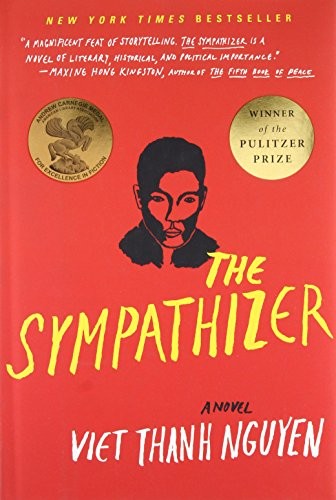
Talk to The Sympathizer like its author wrote you back.
Get the ideas that fit your life — not generic summaries.
- Chat with the book
- Audiobook-style main ideas
- Adapts to your life and goals
- Helps you take action
The Sympathizer, in detail
The Sympathizer is narrated by a nameless communist spy who is also the aide-de-camp to a South Vietnamese general. The novel opens in April 1975, the fall of Saigon, and follows the narrator as he evacuates to the United States along with the South Vietnamese refugees he is sent to infiltrate and monitor. He is a man of two minds — literally, he says — a child of a French priest and Vietnamese mother, educated in America, ideologically committed to the North, emotionally entangled in the South. The novel is structured as a forced confession, addressed to a Commandant, and the narrator's self-awareness about his own contradictions is what makes the voice extraordinary.
Nguyen uses the spy's dual consciousness to run a sustained critique of American imperialism, Vietnamese nationalism, and the self-serving narratives that every side of the Vietnam War constructed about itself. The narrator watches a Hollywood director (a barely-veiled Francis Ford Coppola figure) make a war film in the Philippines that erases the interiority of Vietnamese characters; he participates in a botched assassination attempt; he endures a re-education camp whose horrors are rendered with the same ironic clarity as everything else. The novel refuses any camp — American, North Vietnamese, South Vietnamese — a comfortable position.
The Pulitzer Prize citation called it a novel about a man who "sees from both sides." That undersells it. The narrator doesn't just see from both sides; he is both sides, and the novel argues that this condition — of being formed by colonialism, war, and competing loyalties — is not exceptional but characteristic of much of the world that American narratives have never known how to represent with interiority. The style is maximalist, sardonic, self-conscious, and occasionally very funny in a dark way.
This is not an easy read, but the difficulty is earned. The humor is black, the politics are explicit, and the narrator's reliability is never stable — he is writing under duress, confessing to a commandant who may want him dead, and the novel keeps the reader wondering how much of what is told is strategy and how much is truth. Readers who want a traditional Vietnam War narrative should look elsewhere. Readers interested in what that war looks like from inside Vietnamese subjectivity — and what that subjectivity looks like when shaped by French colonialism and American pop culture — will find nothing else quite like it.
The big ideas
- 1.
The novel argues that the most damaging thing about American imperialism is its refusal to imagine the interiority of those it acts upon — the Hollywood film subplot is the sharpest articulation of this.
- 2.
The narrator's dual consciousness is not a personal quirk but a colonial product — a mind split by competing cultures and their competing claims on loyalty.
- 3.
Nguyen refuses to sentimentalize either the South Vietnamese diaspora or the communist North. Both are capable of atrocity; both construct self-serving myths.
