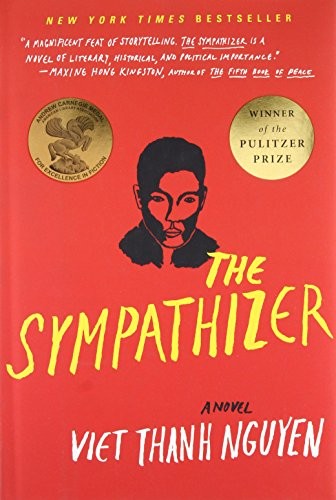
The Sympathizer by Viet Thanh Nguyen is a 2015 literary fiction book about dual identity and divided loyalty, the vietnam war and its aftermath, colonialism and its legacies. The novel argues that the most damaging thing about American imperialism is its refusal to imagine the interiority of those it acts upon — the Hollywood film subplot is the sharpest articulation of this.
Summary
The Sympathizer is narrated by a nameless communist spy who is also the aide-de-camp to a South Vietnamese general. The novel opens in April 1975, the fall of Saigon, and follows the narrator as he evacuates to the United States along with the South Vietnamese refugees he is sent to infiltrate and monitor. He is a man of two minds — literally, he says — a child of a French priest and Vietnamese mother, educated in America, ideologically committed to the North, emotionally entangled in the South. The novel is structured as a forced confession, addressed to a Commandant, and the narrator's self-awareness about his own contradictions is what makes the voice extraordinary.
Nguyen uses the spy's dual consciousness to run a sustained critique of American imperialism, Vietnamese nationalism, and the self-serving narratives that every side of the Vietnam War constructed about itself. The narrator watches a Hollywood director (a barely-veiled Francis Ford Coppola figure) make a war film in the Philippines that erases the interiority of Vietnamese characters; he participates in a botched assassination attempt; he endures a re-education camp whose horrors are rendered with the same ironic clarity as everything else. The novel refuses any camp — American, North Vietnamese, South Vietnamese — a comfortable position.
The Pulitzer Prize citation called it a novel about a man who "sees from both sides." That undersells it. The narrator doesn't just see from both sides; he is both sides, and the novel argues that this condition — of being formed by colonialism, war, and competing loyalties — is not exceptional but characteristic of much of the world that American narratives have never known how to represent with interiority. The style is maximalist, sardonic, self-conscious, and occasionally very funny in a dark way.
This is not an easy read, but the difficulty is earned. The humor is black, the politics are explicit, and the narrator's reliability is never stable — he is writing under duress, confessing to a commandant who may want him dead, and the novel keeps the reader wondering how much of what is told is strategy and how much is truth. Readers who want a traditional Vietnam War narrative should look elsewhere. Readers interested in what that war looks like from inside Vietnamese subjectivity — and what that subjectivity looks like when shaped by French colonialism and American pop culture — will find nothing else quite like it.
Talk to The Sympathizer like its author wrote you back.
Get the ideas that fit your life — not generic summaries.
- Chat with the book
- Audiobook-style main ideas
- Adapts to your life and goals
- Helps you take action
Key takeaways
- 1.
The novel argues that the most damaging thing about American imperialism is its refusal to imagine the interiority of those it acts upon — the Hollywood film subplot is the sharpest articulation of this.
- 2.
The narrator's dual consciousness is not a personal quirk but a colonial product — a mind split by competing cultures and their competing claims on loyalty.
- 3.
Nguyen refuses to sentimentalize either the South Vietnamese diaspora or the communist North. Both are capable of atrocity; both construct self-serving myths.
- 4.
The confession structure means the narrator is always performing for an audience — and the reader must decide how to read performance against sincerity.
- 5.
The re-education camp section is among the most harrowing in the novel, partly because the commandants use the language of liberation to enact cruelty.
- 6.
The novel's treatment of Vietnamese representation in American media is a direct political argument: erasure of subjectivity is its own form of violence.
- 7.
The ending opens into a sequel (The Committed) — Nguyen is building an explicitly political fictional project across books.
- 8.
Sympathy, as the novel uses the word, is not sentiment. It is the capacity to hold contradictions without resolving them.
Discussion questions
Use these on your own, with a book club, or as chat starters in Superbook. Book club version, ready to copy or print →
- 1.
The narrator says he is a man of two minds. Is that a source of power for him, a wound, or both? Does the novel settle the question?
- 2.
The Hollywood film subplot is one of the most satirical sections. Is it fair to American filmmakers of that era, or is Nguyen's critique too blunt?
- 3.
The narrator participates in an assassination. Is his complicity different from the other characters' complicity, or does the novel suggest all complicity is equivalent?
- 4.
The commandant at the end is revealed to be the narrator's old friend. What does that reveal change about how you read the earlier sections?
- 5.
Nguyen is writing partly against Apocalypse Now and The Deer Hunter — American films about Vietnam that center American psychic damage. Does The Sympathizer succeed as a corrective, or does it risk being polemical?
- 6.
The narrator's French-Vietnamese heritage is treated as both wound and resource. How does colonialism shape his consciousness beyond his explicit beliefs?
- 7.
The confession structure means we never fully trust the narrator. How much does that unreliability matter to how you read the political arguments?
- 8.
The novel won the Pulitzer Prize in 2016, making it the first novel by a Vietnamese American author to do so. Does that context change how you read it?
- 9.
The re-education camp scenes are written with the same dry ironic voice as everything else. What is the effect of that tonal consistency across very different kinds of content?
- 10.
The narrator's love for the two women in the novel is handled briefly and somewhat coldly. Is that a narrative limitation or a deliberate choice?
- 11.
How does The Sympathizer compare to other war novels you've read — in terms of whose perspective it centers and what it asks the reader to hold?
- 12.
The novel is explicitly political in a way that much literary fiction avoids. Does the explicitness strengthen it or does it sometimes crowd out the human story?
Themes
Frequently asked questions
-
Is The Sympathizer a spy novel?
It uses spy-novel structure — a double agent, competing loyalties, surveillance and betrayal — but the genre is a vehicle for a political and philosophical argument about colonialism, identity, and how the Vietnam War has been remembered and misrepresented. It's a literary novel that happens to use a spy's vantage point.
-
Do I need to know much about the Vietnam War to read it?
Basic knowledge helps — knowing that the North won, that South Vietnamese refugees came to America, that Saigon fell in 1975 — but Nguyen embeds the necessary context. The novel's real subject is less the historical specifics than the structures of power and representation that the war made visible.
-
Is The Sympathizer hard to read?
The prose is dense and ironic and the narrator's self-awareness can be exhausting in a purposeful way. It is not a quick read. The confession structure means the narrative voice never relaxes. But the payoff is substantial — Nguyen is doing something no other novel about Vietnam does.
-
Who shouldn't read The Sympathizer?
Readers who prefer straightforward narrative and sympathetic protagonists will struggle. The narrator is complicit in violence, morally compromised, and rarely invites easy identification. The novel also contains a brutal sexual violence scene that some readers find gratuitous, though it serves a specific narrative function.
-
Is there a sequel?
Yes — The Committed (2021) follows the narrator to Paris in the 1980s, where he becomes involved in the French criminal underworld. It continues the political project of the first novel, engaging now with French postcolonial politics.
Similar books
A Long Way Gone: Memoirs of a Boy Soldier
Ishmael Beah
The Things They Carried
Tim O'Brien
Dispatches
Michael Herr
The Woman Warrior: Memoirs of a Girlhood Among Ghosts
Maxine Hong Kingston
