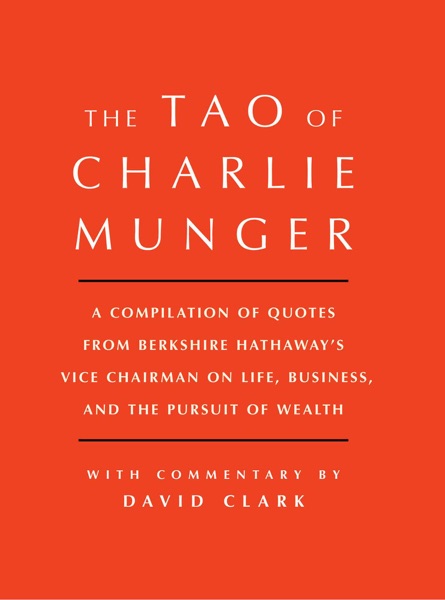
Talk to The Tao of Charlie Munger like its author wrote you back.
Get the ideas that fit your life — not generic summaries.
- Chat with the book
- Audiobook-style main ideas
- Adapts to your life and goals
- Helps you take action
The Tao of Charlie Munger, in detail
The Tao of Charlie Munger is David Clark's compilation and commentary on the wisdom of Charles T. Munger, the longtime vice-chairman of Berkshire Hathaway and Warren Buffett's partner. Clark collects quotations from Munger's speeches, letters, interviews, and the famous Poor Charlie's Almanack, and pairs each with explanatory context that makes Munger's thinking accessible to readers unfamiliar with investing or business history. The book is organized thematically rather than chronologically, covering Munger's views on mental models, rationality, investing, life philosophy, and human misjudgment.
Munger's core intellectual framework is the lattice of mental models — the idea that effective thinking requires drawing on insights from many disciplines rather than becoming a deep specialist in one. A person who knows only economics will misunderstand psychology; a person who knows only psychology will miss what incentives explain. Munger argues for building a toolkit from the "big ideas" of biology, psychology, economics, physics, mathematics, and history, and applying them in combination. Clark's commentary contextualizes each quote by explaining which mental model is in play and how Munger has applied it.
The investing philosophy Clark covers is best understood as applied rationality rather than a technical system. Munger and Buffett's approach — buy wonderful businesses at fair prices, hold forever, concentrate in the best ideas, never overpay for growth — is well-documented elsewhere. What the Munger quotations add is the psychological framing: why most investors systematically make the same errors, why the biases that served humans on the savanna work against them in markets, and why doing nothing is often the highest-return strategy available.
The book has limits. Clark is a popularizer rather than a scholar, and the commentary occasionally oversimplifies Munger's ideas. Readers who want the full Munger experience should go to Poor Charlie's Almanack. But as an introduction — or as a compilation that collects Munger's best lines in one place — The Tao of Charlie Munger is a useful starting point for anyone interested in how one of the twentieth century's sharpest minds thought about decisions, business, and life.
The big ideas
- 1.
The lattice of mental models is Munger's most important intellectual framework: effective thinkers draw on big ideas from many disciplines rather than over-relying on the tools of their own field.
- 2.
Inversion — thinking about how to fail rather than how to succeed — is one of Munger's most frequently cited problem-solving approaches. Many failures are more predictable than successes.
- 3.
Munger identifies roughly twenty-five cognitive biases that systematically distort human judgment, including incentive bias, social proof, availability bias, and commitment and consistency. Awareness of these biases does not automatically correct for them.
