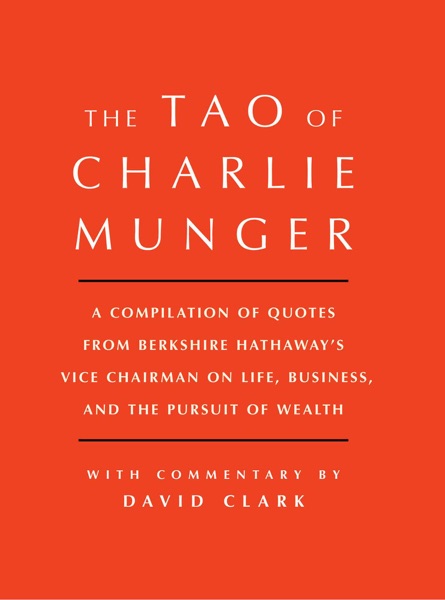
The Tao of Charlie Munger by David Clark is a 2017 business book about mental models, investing, decision-making. The lattice of mental models is Munger's most important intellectual framework: effective thinkers draw on big ideas from many disciplines rather than over-relying on the tools of their own field.
Summary
The Tao of Charlie Munger is David Clark's compilation and commentary on the wisdom of Charles T. Munger, the longtime vice-chairman of Berkshire Hathaway and Warren Buffett's partner. Clark collects quotations from Munger's speeches, letters, interviews, and the famous Poor Charlie's Almanack, and pairs each with explanatory context that makes Munger's thinking accessible to readers unfamiliar with investing or business history. The book is organized thematically rather than chronologically, covering Munger's views on mental models, rationality, investing, life philosophy, and human misjudgment.
Munger's core intellectual framework is the lattice of mental models — the idea that effective thinking requires drawing on insights from many disciplines rather than becoming a deep specialist in one. A person who knows only economics will misunderstand psychology; a person who knows only psychology will miss what incentives explain. Munger argues for building a toolkit from the "big ideas" of biology, psychology, economics, physics, mathematics, and history, and applying them in combination. Clark's commentary contextualizes each quote by explaining which mental model is in play and how Munger has applied it.
The investing philosophy Clark covers is best understood as applied rationality rather than a technical system. Munger and Buffett's approach — buy wonderful businesses at fair prices, hold forever, concentrate in the best ideas, never overpay for growth — is well-documented elsewhere. What the Munger quotations add is the psychological framing: why most investors systematically make the same errors, why the biases that served humans on the savanna work against them in markets, and why doing nothing is often the highest-return strategy available.
The book has limits. Clark is a popularizer rather than a scholar, and the commentary occasionally oversimplifies Munger's ideas. Readers who want the full Munger experience should go to Poor Charlie's Almanack. But as an introduction — or as a compilation that collects Munger's best lines in one place — The Tao of Charlie Munger is a useful starting point for anyone interested in how one of the twentieth century's sharpest minds thought about decisions, business, and life.
Talk to The Tao of Charlie Munger like its author wrote you back.
Get the ideas that fit your life — not generic summaries.
- Chat with the book
- Audiobook-style main ideas
- Adapts to your life and goals
- Helps you take action
Key takeaways
- 1.
The lattice of mental models is Munger's most important intellectual framework: effective thinkers draw on big ideas from many disciplines rather than over-relying on the tools of their own field.
- 2.
Inversion — thinking about how to fail rather than how to succeed — is one of Munger's most frequently cited problem-solving approaches. Many failures are more predictable than successes.
- 3.
Munger identifies roughly twenty-five cognitive biases that systematically distort human judgment, including incentive bias, social proof, availability bias, and commitment and consistency. Awareness of these biases does not automatically correct for them.
- 4.
The mathematics of compounding is not just a financial principle — it applies to learning, relationships, and reputation. A small advantage, maintained consistently over time, produces results that seem disproportionate to the effort.
- 5.
Opportunity cost is the most commonly ignored consideration in decisions. Every yes is a no to something else, and the implicit comparisons you're not making are often more important than the explicit ones you are.
- 6.
Concentrated portfolios outperform diversified ones over time, but only if the concentration is in genuinely high-quality businesses. Diversification is a hedge against ignorance, not a strategy for people with genuine insight.
- 7.
Munger's life philosophy emphasizes avoiding envy, developing patience, always telling the truth, and surrounding yourself with people you admire. The returns on these habits are delayed and hard to measure, which is why most people don't invest in them.
Discussion questions
Use these on your own, with a book club, or as chat starters in Superbook. Book club version, ready to copy or print →
- 1.
Munger argues that you need to master the big ideas of many disciplines to think effectively. Which disciplines outside your own area of expertise have most changed how you approach problems?
- 2.
Inversion — asking how to fail rather than how to succeed — is one of Munger's central tools. Take a project or goal you're currently working on and invert it. What would guarantee failure, and are any of those conditions present?
- 3.
He identifies incentive bias — the tendency to unconsciously distort perception to align with personal interests — as the most powerful cognitive force. Can you find an example in your own recent decision-making where incentive bias may have operated?
- 4.
Munger is contemptuous of envy, calling it the one deadly sin that offers no benefit to the person who has it. Is that fair? Does envy ever serve a useful function?
- 5.
The book emphasizes doing nothing — resisting the impulse to act — as often the most valuable decision available. In what areas of your life are you biased toward action when patience would serve you better?
- 6.
Munger says most people are unwilling to do the intellectual work necessary to have genuinely good ideas. Is that observation harsh, accurate, or both? What would the work actually look like in your domain?
- 7.
The lattice of mental models assumes that insights from biology, physics, and history can be translated into practical decision-making tools. Which translation from a distant field has been most useful to you in practice?
- 8.
Clark presents Munger as a kind of secular sage. Is there anything in the Munger worldview that strikes you as wrong, incomplete, or limited in its applicability?
- 9.
Munger's investing philosophy says to concentrate in the few best ideas. Most professional investors diversify. Who is right, and does the answer depend on what the investor actually knows?
- 10.
He is known for his willingness to say 'I don't know.' In professional contexts, how do people react to that answer? What would change if it became more acceptable?
- 11.
The book was published in 2017, when Munger was in his early nineties. Does his longevity — combined with continued sharp thinking — make his advice about life philosophy more credible?
Themes
Frequently asked questions
-
Do I need to know about investing to read this book?
No. The investing content appears throughout, but the book is organized around Munger's broader philosophy of rationality and decision-making. The core mental models apply to business decisions, personal choices, and intellectual habits generally. A reader with no investment background can extract the main value.
-
How does this compare to Poor Charlie's Almanack?
Poor Charlie's Almanack is the primary source — Munger's actual speeches and talks, compiled and annotated. The Tao of Charlie Munger is more accessible: shorter, organized thematically, with Clark's explanatory commentary. Start here if you're new to Munger; go to the Almanack if you want the full version.
-
Is Clark's commentary reliable?
It's useful as context but occasionally oversimplifies. Clark is a popularizer rather than a scholar, and some of the connections he draws between quotes and real-world applications are cleaner than the underlying ideas actually are. Read the commentary as a guide, not as authoritative interpretation.
-
What is Munger's most important mental model?
Probably the lattice itself — the idea that all the disciplines have important insights and that thinking well requires drawing on many of them rather than defaulting to the tools of one specialty. The second most important is probably inversion: ask how to fail as the first step in figuring out how to succeed.
-
Who should read this book?
Investors, managers, and anyone interested in decision-making who wants Munger's ideas in a concentrated form. Also useful for people who have heard Munger referenced frequently and want to understand what the actual framework is.
Similar books
Thinking, Fast and Slow
Daniel Kahneman

A Man for All Markets
Edward O. Thorp

Poor Charlie's Almanack
Charlie Munger
Thinking in Bets: Making Smarter Decisions When You Don't Have All the Facts
Annie Duke
