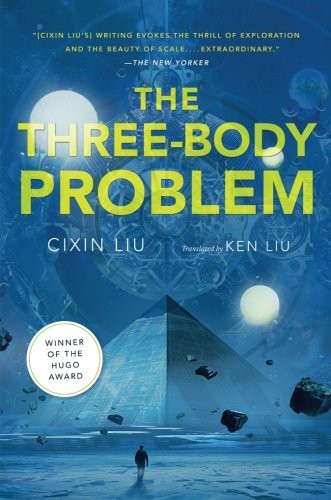
Talk to The Three-Body Problem like its author wrote you back.
Get the ideas that fit your life — not generic summaries.
- Chat with the book
- Audiobook-style main ideas
- Adapts to your life and goals
- Helps you take action
The Three-Body Problem, in detail
The Three-Body Problem begins during China's Cultural Revolution, where a young astrophysicist witnesses her father's murder at the hands of Red Guard cadres and subsequently makes a decision that will determine the fate of humanity. The novel then moves forward to a near-future present, following a physicist named Wang Miao who becomes entangled in a mysterious virtual reality game called Three Body and a string of suicides among the world's top scientists. The two storylines converge on a secret that has been hidden for decades: Earth has made contact with an alien civilization, and it's coming.
Liu Cixin is not primarily interested in alien invasion as adventure story. The book is a meditation on what contact between civilizations at radically different technological levels means — not culturally but physically, cosmically. The alien civilization, the Trisolarans, inhabit a solar system governed by three suns in chaotic orbital patterns, making their world almost uninhabitable, and their response to discovering a stable, resource-rich Earth involves a logic so cold and utilitarian that it reads as a kind of physics rather than villainy. Liu's worldview — sometimes called "dark forest theory," developed fully in the sequels — holds that the universe's silence is not emptiness but strategic concealment by civilizations that understand predation as the cosmos's base condition.
What makes the novel unusual is its Chinese perspective and its roots in actual hard physics. The three-body problem is a real unsolvable problem in orbital mechanics, and Liu uses it as both plot device and metaphor. The Cultural Revolution opening is not decoration; it establishes how a civilization can turn on its own scientists, and how that betrayal echoes outward. Ken Liu's translation (from the original Mandarin) is widely praised for preserving both the scientific rigor and the emotional register.
Western readers will find the pacing different from Anglo-American thriller conventions — the novel builds slowly, explains carefully, and rewards the patience. Readers who want to understand why this became the best-selling science fiction novel in Chinese history, and why Barack Obama and Mark Zuckerberg both cited it publicly, will find a book that takes its premise with uncommon seriousness. Readers who want action and dialogue will find the first third particularly challenging.
The big ideas
- 1.
The Cultural Revolution sections are not backstory — they are the moral center of the novel, explaining how betrayal at civilizational scale becomes transmissible across generations.
- 2.
Dark forest theory: in a cosmos of finite resources and impossible communication, the rational strategy for any civilization is to destroy any other civilization it discovers before being destroyed first.
- 3.
The three-body problem is genuinely unsolvable by analytical methods; Liu uses this real mathematical constraint as a metaphor for unpredictability and the limits of human reason.
