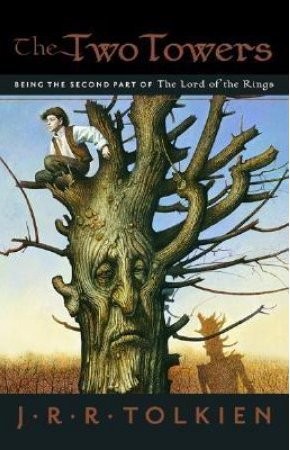
Talk to The Two Towers like its author wrote you back.
Get the ideas that fit your life — not generic summaries.
- Chat with the book
- Audiobook-style main ideas
- Adapts to your life and goals
- Helps you take action
What it argues
The Two Towers is the second volume of The Lord of the Rings, split into two halves that follow different threads of the broken Fellowship. The first half tracks Aragorn, Legolas, and Gimli pursuing the captured hobbits through Rohan; meets the resurrected Gandalf the White; and culminates in the massive Battle of Helm's Deep, where a vastly outnumbered force of men and elves holds a fortress against Saruman's army. The second half follows Frodo and Sam through the treacherous land of Ithilien, guided and endangered by Gollum, toward the Black Gate of Mordor and, ultimately, the pass of Cirith Ungol.
The novel's central moral study is Gollum, one of the most psychologically complex characters in English fantasy fiction. Gollum was once a hobbit-like creature called Sméagol, corrupted and extended by centuries of possession of the Ring. In The Two Towers, Tolkien shows Gollum's internal conflict — the remnant of Sméagol still capable of loyalty briefly reasserts itself under Frodo's compassionate treatment. The tragedy is watching that recovery collapse, and understanding exactly what destroys it. The character functions as both a warning about what the Ring does and a meditation on the possibility and limits of redemption.
What it gets right
- 1.
Gollum's divided self — the remnant of Sméagol versus the creature the Ring made — is Tolkien's most psychologically detailed character study, and his tragedy is the novel's emotional center.
- 2.
The Battle of Helm's Deep demonstrates that Tolkien could write kinetic action when he chose to; he usually chose not to, which makes the battle's sustained intensity more striking.
- 3.
Frodo's compassion toward Gollum, over Sam's objections, is presented as both morally right and practically wise — and the novel eventually justifies it in a way neither Frodo nor Sam could have predicted.
What it covers
Who wrote it
J.R.R. Tolkien (1892–1973) was an English author and academic who spent most of his career as a professor of Anglo-Saxon and then English language and literature at Oxford University. He is best known for The Hobbit (1937) and The Lord of the Rings (1954–55), which together established the template for modern secondary-world fantasy fiction. His posthumously published The Silmarillion (1977), edited by his son Christopher, reveals the vast mythological background he had constructed over decades. Tolkien's linguistic inventions — particularly the Elvish languages Quenya and Sindarin — remain remarkable achievements in constructed language.
