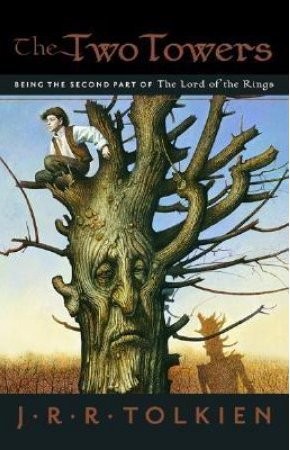
The Two Towers by J.R.R. Tolkien is a 1954 fantasy book about corruption and redemption, war and its cost, loyalty under pressure. Gollum's divided self — the remnant of Sméagol versus the creature the Ring made — is Tolkien's most psychologically detailed character study, and his tragedy is the novel's emotional center.
Summary
The Two Towers is the second volume of The Lord of the Rings, split into two halves that follow different threads of the broken Fellowship. The first half tracks Aragorn, Legolas, and Gimli pursuing the captured hobbits through Rohan; meets the resurrected Gandalf the White; and culminates in the massive Battle of Helm's Deep, where a vastly outnumbered force of men and elves holds a fortress against Saruman's army. The second half follows Frodo and Sam through the treacherous land of Ithilien, guided and endangered by Gollum, toward the Black Gate of Mordor and, ultimately, the pass of Cirith Ungol.
The novel's central moral study is Gollum, one of the most psychologically complex characters in English fantasy fiction. Gollum was once a hobbit-like creature called Sméagol, corrupted and extended by centuries of possession of the Ring. In The Two Towers, Tolkien shows Gollum's internal conflict — the remnant of Sméagol still capable of loyalty briefly reasserts itself under Frodo's compassionate treatment. The tragedy is watching that recovery collapse, and understanding exactly what destroys it. The character functions as both a warning about what the Ring does and a meditation on the possibility and limits of redemption.
Where The Fellowship of the Ring builds a world, The Two Towers populates it under pressure. The Battle of Helm's Deep is Tolkien's most sustained action writing; the Faramir chapters are his most nuanced character work; the Shelob sequence in the final pages is his most effective horror. The pacing is uneven by modern thriller standards — the Ents and their deliberate council in Fangorn Forest move at a pace Tolkien means as commentary — but the emotional register is richer than the first volume.
The Two Towers suffers slightly as a stand-alone volume because it ends with both narrative threads unresolved. It is structurally a middle chapter, and it reads like one. Readers who pick it up expecting the satisfaction of a complete story will be frustrated. Readers who commit to the full trilogy will find this volume contains some of Tolkien's best individual passages, and Gollum remains one of the great achievements of the genre.
Talk to The Two Towers like its author wrote you back.
Get the ideas that fit your life — not generic summaries.
- Chat with the book
- Audiobook-style main ideas
- Adapts to your life and goals
- Helps you take action
Key takeaways
- 1.
Gollum's divided self — the remnant of Sméagol versus the creature the Ring made — is Tolkien's most psychologically detailed character study, and his tragedy is the novel's emotional center.
- 2.
The Battle of Helm's Deep demonstrates that Tolkien could write kinetic action when he chose to; he usually chose not to, which makes the battle's sustained intensity more striking.
- 3.
Frodo's compassion toward Gollum, over Sam's objections, is presented as both morally right and practically wise — and the novel eventually justifies it in a way neither Frodo nor Sam could have predicted.
- 4.
The Ents' slow deliberation in Fangorn is Tolkien making a point about patience and consequences: ancient things move slowly because the long view is different from the urgent one.
- 5.
Faramir is constructed as a deliberate contrast to his brother Boromir: offered the Ring under similar circumstances, he passes the same test differently, and his reason for doing so illuminates both characters.
- 6.
The Nazgûl — now mounted on flying creatures — represent escalation of Sauron's power in a way that makes the threat feel like it's outpacing the Fellowship's capacity to respond.
- 7.
Sam Gamgee's heroism is of a specific kind — unglamorous, domestic, practical — and The Two Towers makes the clearest case that this kind of faithfulness is what the quest actually runs on.
- 8.
The Shelob sequence is Tolkien's most effective horror writing: a creature without personality or corruption, simply ancient hunger, and the response it provokes is different from anything the Ring produces.
Discussion questions
Use these on your own, with a book club, or as chat starters in Superbook. Book club version, ready to copy or print →
- 1.
Gollum almost recovers something of Sméagol under Frodo's influence. What destroys that recovery, and does the novel assign moral responsibility clearly?
- 2.
Sam distrusts Gollum throughout and is largely correct. Frodo trusts him and is also correct, in a longer sense. Are they both right? How does the novel hold those two responses simultaneously?
- 3.
Faramir refuses the Ring where Boromir failed. The difference seems to be Faramir's deeper understanding of what the Ring is. Is that a satisfying explanation, or does the novel need to do more work here?
- 4.
The Ents' deliberation before attacking Isengard is intentionally slow and anti-climactic in its preparation. What does Tolkien want you to feel during that sequence?
- 5.
The Battle of Helm's Deep is a defensive action where the heroes are vastly outnumbered and likely to lose. How does Tolkien generate tension and meaning in a battle the reader suspects will be won?
- 6.
Gandalf's return as Gandalf the White changes the power dynamic of the Fellowship significantly. Does that change diminish anything, or does it give the story something it needed?
- 7.
The Two Towers ends on a cliffhanger that leaves Frodo apparently dead and Sam alone with the Ring. What does the novel do with that situation emotionally? Is it effective?
- 8.
The Rohan sections of the book draw on Old English epic tradition — the language, the culture, the imagery. Does knowing that context change how you read those sections?
- 9.
Sam's loyalty to Frodo is the book's most consistent emotional note. Is that relationship between two characters of different class an idealization, or does Tolkien examine its complications?
- 10.
The book splits into two halves that follow different characters entirely. Is that structure a strength — letting each strand breathe — or does it create problems for investment and momentum?
- 11.
What does Shelob add to the book? She's not a character in the conventional sense, and the encounter doesn't advance the plot in the usual way. What is Tolkien doing with her?
Themes
Frequently asked questions
-
Can The Two Towers be read without reading The Fellowship of the Ring first?
Technically, but not recommended. The Two Towers begins in the middle of action from the previous volume and assumes familiarity with all major characters, the history of the Ring, and the world. It's the middle chapter of a single large novel published in three parts.
-
Is The Two Towers the best volume of The Lord of the Rings?
Many readers think so. It contains Gollum's fullest character development, the Battle of Helm's Deep, the Faramir chapters, and the Shelob sequence — a concentration of Tolkien's best work. It also benefits from the world-building already having been done.
-
Why does the book split into two separate halves?
Tolkien structured it around two threads of the broken Fellowship that travel separately after the events of The Fellowship of the Ring. Rather than alternating between them chapter by chapter, he follows each completely. It's a structural gamble that some readers find disorienting.
-
Why are Gollum's inner dialogues written in italics?
Tolkien uses the typographic convention to signal the division within Gollum's psyche: the Sméagol voice and the Gollum voice are distinct, and the italics mark when the Ring-corrupted voice speaks. It's one of the novel's more technically interesting effects.
-
Who shouldn't read The Two Towers?
Anyone who found The Fellowship of the Ring's pacing frustrating will not find The Two Towers faster. Fangorn Forest in particular moves at Entish pace. This volume is more tonally varied but no more willing to rush.