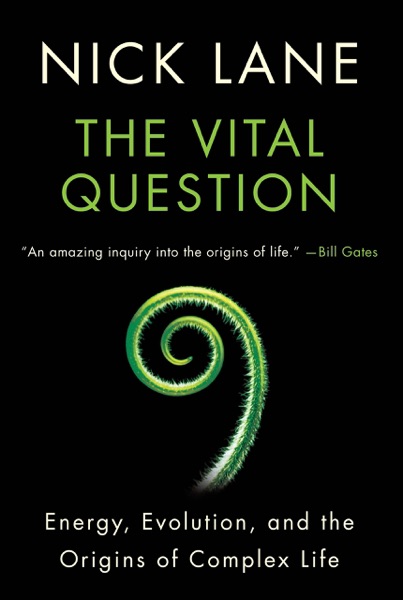
Talk to The Vital Question like its author wrote you back.
Get the ideas that fit your life — not generic summaries.
- Chat with the book
- Audiobook-style main ideas
- Adapts to your life and goals
- Helps you take action
What it argues
The Vital Question asks why life is the way it is — why all complex life is eukaryotic, why eukaryotes all have mitochondria, why sex exists, why organisms age and die, and why life may be exceedingly rare in the universe. Nick Lane's answer to all of these questions converges on a single deep mechanism: the chemiosmotic proton gradient across cell membranes, the way cells generate energy by pumping protons across a barrier and then harvesting the flow back through molecular machines called ATP synthases.
Lane's central claim is that this bioenergetic constraint explains the structure of all known life. Bacteria are energetically limited because their genomes must be small and tightly regulated to maintain the electrical potential across their membranes. The eukaryotic revolution — the merger between an archaeon host and a bacterial endosymbiont that became the mitochondrion — solved this problem by localizing energy production and freeing the rest of the genome to expand. That single event, Lane argues, may have happened only once in four billion years of life on Earth, which would explain why complex life is so rare and why all of it shares so many features.
What it gets right
- 1.
All known complex life (eukaryotes) traces back to a single merger between an archaeon and a bacterium — an event so improbable it may have occurred only once in four billion years.
- 2.
The proton gradient across mitochondrial membranes is the universal mechanism of cellular energy generation, and its constraints explain the structure of life at every scale.
- 3.
Bacteria are energetically limited by the need to maintain a genome-to-membrane-surface ratio; this prevents them from evolving the complexity of eukaryotic cells.
What it covers
Who wrote it
Nick Lane is a British biochemist and writer at University College London, where he heads the origins of life research group. He is the author of five books on evolution and bioenergetics, including Oxygen: A Four Billion Year History, Life Ascending, and The Energy of Life. His work focuses on the deep connection between energy and the evolution of complex life. Lane has received the Royal Society Michael Faraday Prize and the Biochemical Society Award. He is widely regarded as one of the most serious science writers working on origin-of-life questions.
