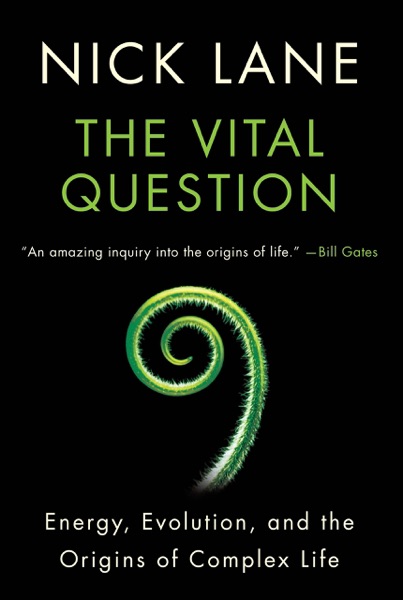
The Vital Question by Nick Lane is a 2015 science book about evolution, bioenergetics, origins of life. All known complex life (eukaryotes) traces back to a single merger between an archaeon and a bacterium — an event so improbable it may have occurred only once in four billion years.
Summary
The Vital Question asks why life is the way it is — why all complex life is eukaryotic, why eukaryotes all have mitochondria, why sex exists, why organisms age and die, and why life may be exceedingly rare in the universe. Nick Lane's answer to all of these questions converges on a single deep mechanism: the chemiosmotic proton gradient across cell membranes, the way cells generate energy by pumping protons across a barrier and then harvesting the flow back through molecular machines called ATP synthases.
Lane's central claim is that this bioenergetic constraint explains the structure of all known life. Bacteria are energetically limited because their genomes must be small and tightly regulated to maintain the electrical potential across their membranes. The eukaryotic revolution — the merger between an archaeon host and a bacterial endosymbiont that became the mitochondrion — solved this problem by localizing energy production and freeing the rest of the genome to expand. That single event, Lane argues, may have happened only once in four billion years of life on Earth, which would explain why complex life is so rare and why all of it shares so many features.
The middle sections of the book work through the implications for aging, sex, and the evolution of two sexes rather than more. Lane argues that mitochondria drive sexual reproduction because they need genetic quality control — the mixing of genes in sex allows defective mitochondria to be weeded out across generations. The existence of two sexes (rather than many) follows from the same logic.
Lane writes for a scientifically curious general reader, not a specialist. The argument is genuinely difficult — he covers thermodynamics, evolutionary theory, molecular biology, and geochemistry — but he is a careful explainer who returns often to the core logic rather than letting the reader get lost in detail. Some of his hypotheses are contested within biology, and he is upfront about what is established versus speculative. For readers willing to work, this is one of the most ambitious popular science books of the past decade.
Talk to The Vital Question like its author wrote you back.
Get the ideas that fit your life — not generic summaries.
- Chat with the book
- Audiobook-style main ideas
- Adapts to your life and goals
- Helps you take action
Key takeaways
- 1.
All known complex life (eukaryotes) traces back to a single merger between an archaeon and a bacterium — an event so improbable it may have occurred only once in four billion years.
- 2.
The proton gradient across mitochondrial membranes is the universal mechanism of cellular energy generation, and its constraints explain the structure of life at every scale.
- 3.
Bacteria are energetically limited by the need to maintain a genome-to-membrane-surface ratio; this prevents them from evolving the complexity of eukaryotic cells.
- 4.
Mitochondria are not just energy factories — they are the reason sex exists, the reason we age, and possibly the reason complex life is rare in the universe.
- 5.
Sexual reproduction exists primarily for genomic quality control: the mixing of genes across generations allows defective mitochondrial DNA to be eliminated from the population.
- 6.
The existence of exactly two sexes, rather than multiple mating types, follows from the requirement that mitochondrial genes come from only one parent, preventing conflict between incompatible mitochondrial genomes.
- 7.
Aging is driven largely by the accumulation of mitochondrial damage and the declining efficiency of cellular energy systems — not simply by 'wear and tear.'
- 8.
Life may be genuinely rare in the universe not because the chemistry of life is hard, but because the specific bioenergetic conditions for complex life — proton gradients at alkaline vents — are unusual.
Discussion questions
Use these on your own, with a book club, or as chat starters in Superbook. Book club version, ready to copy or print →
- 1.
Lane argues the eukaryotic merger may have happened only once in four billion years. If that's right, what does it imply about the likelihood of complex life elsewhere in the universe?
- 2.
The book claims that energy constraints, not random mutation alone, explain the shape of evolution. How does that change your intuitive picture of how life evolves?
- 3.
Lane is explicit about which parts of his argument are established and which are speculative. Did that transparency make the book more or less compelling to you?
- 4.
If mitochondria are the reason sex exists, does that change how you think about the relationship between biological function and the behaviors or structures it produces?
- 5.
The book argues that bacteria have been energetically constrained for four billion years and have not evolved complexity despite the time available. What does that say about the popular idea that evolution inevitably produces progress?
- 6.
Lane's account of aging is essentially mechanical — mitochondrial damage accumulating over time. Does a mechanistic explanation of aging change how you think about it?
- 7.
The alkaline hydrothermal vent hypothesis for life's origins is not consensus science. How do you evaluate a popular science book that builds on contested hypotheses?
- 8.
Lane uses the energy per gene metric to compare bacteria and eukaryotes. Did you find that framing convincing, or did it feel too reductive?
- 9.
The book covers thermodynamics, geochemistry, evolutionary biology, and cell biology in one argument. Which domain did you find most difficult, and did Lane successfully carry you through it?
- 10.
If mitochondria explain aging, sex, and the rarity of complex life, what other biological puzzles might have a similar deep energetic explanation?
- 11.
Lane writes primarily for curious non-specialists. Where did you feel the book asked too much of the reader, and where did you want more depth?
- 12.
Lane's thesis is optimistic about science's ability to explain life's fundamental features from physical principles. Do you share that optimism, or does life feel irreducibly contingent to you?
Themes
Frequently asked questions
-
What is The Vital Question about?
It's an argument that the chemiosmotic proton gradient — the way cells generate energy — explains why all complex life shares the same structure, why sex exists, why we age, and why complex life may be rare in the universe. The engine is the mitochondrion.
-
Is The Vital Question hard to read?
It's genuinely demanding. Lane covers thermodynamics, cell biology, evolutionary theory, and geochemistry. He is a careful explainer, but readers without some background in biology will need to move slowly. It rewards that effort more than most popular science books.
-
Is the science in The Vital Question consensus or speculative?
A mix. The bioenergetics of mitochondria is established. The alkaline vent hypothesis for life's origins, and some of the claims about sex and aging, are Lane's framework built on contested evidence. He flags these distinctions, which is part of what makes the book trustworthy.
-
Who should read The Vital Question?
Readers with a genuine interest in evolutionary biology and biochemistry who want a serious argument rather than a survey. It's not a casual read. People interested in the origins of life, the rarity of complex life, or the biology of aging will find it exceptionally rich.
-
How does The Vital Question compare to Lane's other books?
The Vital Question is his most ambitious and synthetic work. Life Ascending covers similar ground more accessibly. Oxygen is narrower and better for readers who want depth on a single theme. The Vital Question is the place to start if you want Lane's full argument about energy and life.
Similar books
A Short History of Nearly Everything
Bill Bryson
The Selfish Gene
Richard Dawkins
On the Origin of Species
Charles Darwin
Your Inner Fish: A Journey into the 3.5-Billion-Year History of the Human Body
Neil Shubin
