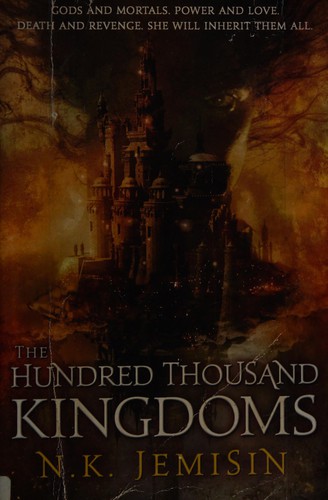
Talk to The Hundred Thousand Kingdoms like its author wrote you back.
Get the ideas that fit your life — not generic summaries.
- Chat with the book
- Audiobook-style main ideas
- Adapts to your life and goals
- Helps you take action
The Hundred Thousand Kingdoms, in detail
The Hundred Thousand Kingdoms is the first book in N.K. Jemisin's Inheritance trilogy. Yeine Darr is a barbarian chieftain's daughter from the conquered north who is unexpectedly summoned to Sky, the palace-city of the ruling Arameri family. Her grandfather, the head of the family and effectively ruler of the known world, names her as one of his heirs — a political maneuver more dangerous than it sounds. The Arameri have enslaved three gods, and those gods are woven into every power struggle Yeine now finds herself inside.
The book is about what it means to inherit a system you didn't build and didn't choose. Yeine is a colonized subject brought into the heart of the empire that colonized her people, asked to compete for power within that system, and slowly forced to understand how the system sustains itself — including through her. The enslaved gods, particularly Nahadoth the Nightlord, are the novel's emotional and thematic center: immortal beings reduced to servitude as punishment for a war they lost, forced to perform harm on behalf of the family that holds their chains.
Jemisin's prose is intimate and strange. The novel is narrated by Yeine in retrospect, and the narration itself is unstable — she frequently interrupts herself, questions her own memory, and addresses the reader directly. This structure asks you to consider from the first page whether the narrator knows the full story she's telling. It's a technique that pays off, but it requires patience and buy-in. This is not a novel that explains itself early.
The Hundred Thousand Kingdoms won the World Fantasy Award and launched Jemisin to prominence. Readers who respond to it tend to love its density of ideas and its refusal to let the political be decorative. Readers who bounce off it often find the non-linear narration frustrating and the relationship between Yeine and Nahadoth overwrought. Both reactions are fair. The sequels are thematically related but follow different characters, so each book in the trilogy stands somewhat on its own.
The big ideas
- 1.
The enslaved gods are the novel's most sustained argument: what does it mean to hold power over a being far greater than yourself, and what does that do to the one who holds the chains?
- 2.
Yeine's dual status — outsider and heir — forces the novel to examine complicity. Being brought inside a system of power does not mean escaping it.
- 3.
Jemisin's world treats colonialism not as backstory but as an ongoing present. The conquered north isn't just history; it's in every interaction Yeine has at Sky.
