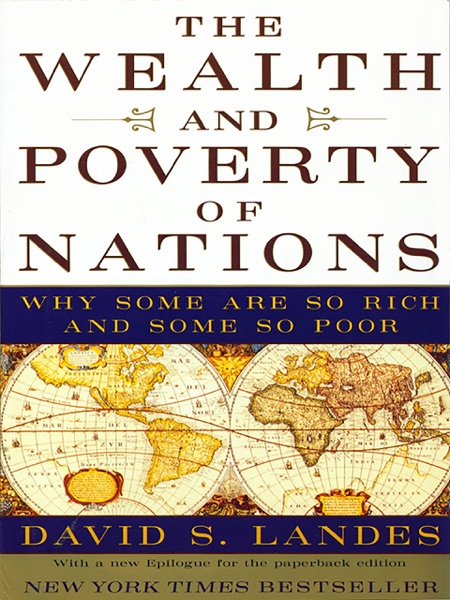
Talk to The Wealth and Poverty of Nations like its author wrote you back.
Get the ideas that fit your life — not generic summaries.
- Chat with the book
- Audiobook-style main ideas
- Adapts to your life and goals
- Helps you take action
What it argues
The Wealth and Poverty of Nations is David Landes's 1998 attempt to answer one of economic history's central questions: why are some nations rich and others poor? Landes, a Harvard economic historian, argues that geography, climate, and natural resources provide important context but that culture — particularly the work ethic, attitude toward knowledge, and institutional arrangements that foster or impede economic initiative — is the primary explanation for long-run differences in prosperity.
The book covers an enormous historical sweep, from the rise of European technology in the medieval period through the Industrial Revolution, the divergence of colonial and colonized worlds, and the economic trajectories of Latin America, East Asia, and Africa in the twentieth century. Landes is particularly interested in the question of why the Industrial Revolution happened first in Britain rather than China, India, or the Islamic world — regions that were technologically and economically competitive with Europe in the medieval period. His answer is cultural: Europe, particularly Protestant northwestern Europe, developed a set of attitudes toward work, time, knowledge, and women's participation in the economy that were unusually conducive to sustained technological development.
What it gets right
- 1.
Culture — particularly attitudes toward work, time, knowledge, and women's participation in the economy — explains long-run differences in national prosperity more than geography or natural resources alone.
- 2.
The Industrial Revolution happened in Britain rather than China or the Islamic world partly because European intellectual culture had developed a distinctive openness to empirical inquiry and technological experimentation.
- 3.
Protestant cultures in northwestern Europe developed a set of attitudes toward time, work discipline, and rational organization that proved unusually compatible with industrialization.
What it covers
Who wrote it
David S. Landes (1924–2013) was Coolidge Professor of History and Professor of Economics Emeritus at Harvard University, and one of the leading economic historians of the twentieth century. He was known for his work on European industrialization, the history of clocks (Revolution in Time), and banking history (The Unbound Prometheus). Landes spent his career at Berkeley and Harvard and wrote economic history for general audiences without sacrificing rigor. The Wealth and Poverty of Nations, published in 1998, was his most ambitious work, offering a cultural explanation for global economic divergence.
