Business · Book club
Leadership Without Easy Answers book club questions
Here are 12 book club questions for Leadership Without Easy Answers by Ronald A. Heifetz, ordered to open easily and end somewhere worth arguing about. Copy them, print them, or bring them up one at a time.
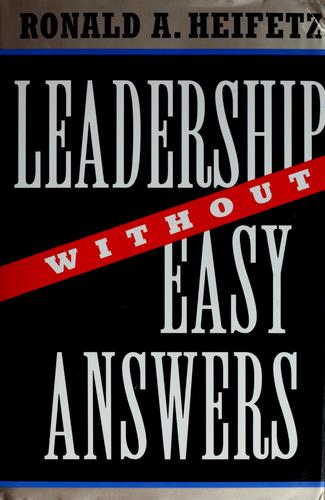
Leadership Without Easy Answers is Ronald Heifetz's foundational work on adaptive leadership, developed from his research and teaching at Harvard's Kennedy School.
Ronald A. Heifetz · 1994 · 6h 0m
Full summary and key takeaways →The 12 questions
- 1.
Think of a significant problem in an organization you know. Is it technical or adaptive? What does each answer imply about what leadership should do?
- 2.
Heifetz argues that people in authority are expected to have answers, which makes adaptive leadership structurally difficult for them. Have you experienced that tension? What did it feel like?
- 3.
Who in an organization you know is currently being marginalized because they are raising uncomfortable questions? What is the organization avoiding by silencing them?
- 4.
What values or loyalties are you protecting that might be making it harder for you to engage with an adaptive challenge you're facing?
- 5.
Heifetz says groups tend to look to authority for solutions they need to generate themselves. When have you done this — looked to a leader to solve something that required your own change?
- 6.
The book argues that adaptive work generates real losses. In a change effort you've been involved in, whose losses were named explicitly and whose were ignored?
- 7.
What is the productive range of distress for a group you currently lead or belong to? What happens when the pressure goes above or below it?
- 8.
Heifetz draws examples from politics, medicine, and social movements alongside business. Does the technical-adaptive distinction hold across all those contexts, or does it apply differently in different settings?
- 9.
The book was written in 1994. Which aspects of the adaptive leadership framework feel more relevant now than when it was published?
- 10.
How do you distinguish between a leader who is holding steady through genuine adaptive work and one who is simply being stubborn or avoiding accountability?
- 11.
Heifetz's model is explicitly non-heroic. What does that imply for how leadership should be taught, selected for, and evaluated in organizations?
- 12.
Where in your own life are you in the position of someone who has authority but is being asked to solve an adaptive challenge through technical means?
How to run the discussion
- Pick six to eight, not all of them. An hour of real discussion covers fewer questions than anyone expects, and racing the list is what makes a book club feel like homework.
- Open with what people noticed, not what they concluded. Asking for a verdict first hardens opinions before anyone has heard each other.
- Let the disagreement run. The questions below that split a room are the ones worth the time; the ones everyone answers the same way can be skipped.
- Ask the quiet person a specific question. A direct, narrow question is far easier to answer than an open invitation to contribute.
Themes worth steering toward
If the conversation stalls, these are the threads that usually restart it.
Common questions
What are good book club questions for Leadership Without Easy Answers?
Here are 12 book club questions for Leadership Without Easy Answers by Ronald A. Heifetz, ordered to open easily and end somewhere worth arguing about. The strongest openers ask what each reader noticed rather than what they concluded, and the discussion usually turns on adaptive leadership, authority, organizational change.
How long should a book club discussion of Leadership Without Easy Answers last?
Most groups run 60 to 90 minutes of actual discussion. That is roughly six to eight questions, not all of them, so pick the ones that suit your group rather than working down the list in order.
What are the main themes in Leadership Without Easy Answers?
Adaptive leadership, Authority, Organizational change, Politics, Social systems. Those are the threads most likely to divide a room, which makes them the useful places to steer a discussion that has gone quiet.
Picking the next one? See books like Leadership Without Easy Answers or questions for other book club picks.
