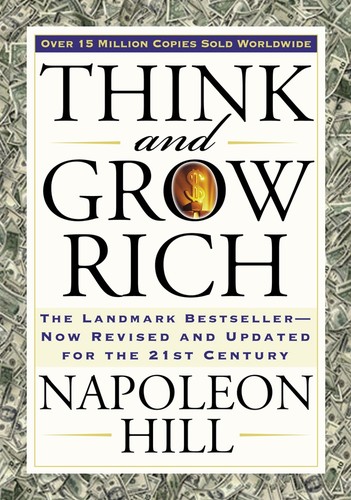
Talk to Think and Grow Rich like its author wrote you back.
Get the ideas that fit your life — not generic summaries.
- Chat with the book
- Audiobook-style main ideas
- Adapts to your life and goals
- Helps you take action
Think and Grow Rich, in detail
Think and Grow Rich, published in 1937, is Napoleon Hill's synthesis of interviews conducted over twenty years with hundreds of successful Americans, including Andrew Carnegie, Henry Ford, and Thomas Edison. The book presents thirteen principles Hill claims are common to people who accumulate wealth: desire, faith, autosuggestion, specialized knowledge, imagination, organized planning, decision, persistence, the master mind, the mystery of sex transmutation, the subconscious mind, the brain, and the sixth sense. Hill argues that wealth and success begin not with action but with a definite, intensely held thought.
The core claim is that a burning, specific desire — written down, reviewed twice daily, visualized as already achieved — sets in motion forces both psychological and, Hill implies, metaphysical that attract the resources and people needed to fulfill it. The auto-suggestion chapter instructs readers to read their goal statement aloud with emotion each morning and evening. The Master Mind chapter argues that a small group of people united around a common purpose develops collective intelligence beyond what any member possesses individually.
Reading Think and Grow Rich today requires calibration. It was written during the Depression, its examples are exclusively American men of the early 20th century, and some of its language is dated. The metaphysical claims — about vibrations, the ether, and invisible forces — have no empirical basis. But stripped of the cosmology, the behavioral observations are real: clear goals reduce cognitive noise, written commitments increase follow-through, persistent effort tends to outlast opposition, and social networks matter enormously for achieving difficult things.
The book's influence is disproportionate to its analytical rigor. It has sold over 100 million copies and shaped an entire genre of success literature. For historians of the genre or anyone wanting to understand where modern personal development came from, it remains essential. For practical guidance, it is best read as a historical document with a few durable ideas embedded in considerable mysticism.
The big ideas
- 1.
A definite, written goal with a specific deadline and a clear plan creates focus that diffuse wishing cannot. Hill calls this 'definiteness of purpose.'
- 2.
Persistence in the face of setbacks distinguishes people who eventually succeed from those who stop before reaching the breakthrough point.
- 3.
The Master Mind principle: a small group of aligned, committed people develops collective intelligence and social capital beyond what any individual could generate alone.
