Talk to Thinking with Type like its author wrote you back.
Get the ideas that fit your life — not generic summaries.
- Chat with the book
- Audiobook-style main ideas
- Adapts to your life and goals
- Helps you take action
What it argues
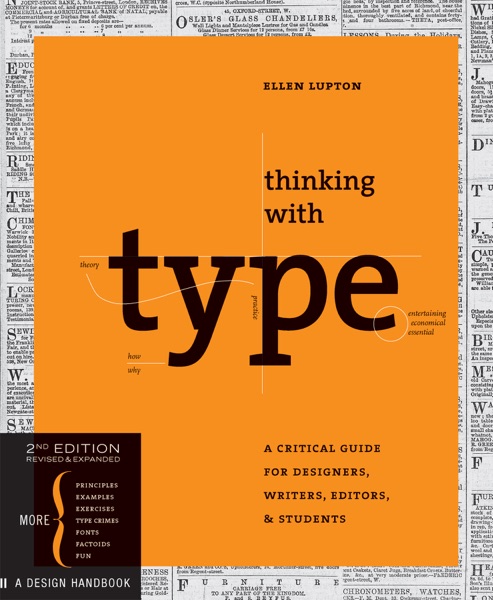
Thinking with Type is Ellen Lupton's critical guide to typography — not as a catalog of fonts, but as a discipline for thinking about how written language takes visual form. Lupton, a designer and curator at Cooper Hewitt, structures the book around three categories: letter, text, and grid. Each section covers a different scale of typographic decision-making, from the anatomy of an individual letterform to the large structural systems that organize a page or screen.
The letter section covers the history of type and the vocabulary for describing typefaces — serif, sans-serif, x-height, baseline, counter, aperture — not as trivia but as tools for noticing what makes different typefaces communicate differently. Lupton is interested in why certain typefaces feel authoritative or playful, intimate or institutional, and in how those associations were built up through specific historical uses. The text section moves to how type organizes into readable sequences: spacing, leading, column width, hierarchy. These are the decisions most readers never consciously notice, but they determine whether a body of text feels inviting or exhausting.
What it gets right
- 1.
Typography is not decoration added to content — it is a fundamental part of how written language communicates. Every typographic decision affects meaning.
- 2.
The vocabulary for describing typefaces (x-height, aperture, counter, weight, width) is not trivia. It gives you precise language for articulating why a choice works or doesn't.
- 3.
Hierarchy is the most important concept in text design. Readers scan before they read; hierarchy tells them what level of attention to give each element.
What it covers
Who wrote it
Ellen Lupton is an American graphic designer, author, and curator. She is senior curator of contemporary design at the Cooper Hewitt, Smithsonian Design Museum in New York and director of the Graphic Design MFA program at Maryland Institute College of Art. She has written or edited more than twenty books on design, including Graphic Design: The New Basics, Type on Screen, and Design Is Storytelling. Thinking with Type, first published in 2004 and expanded in 2010, has become one of the most widely used typography textbooks in design education.
