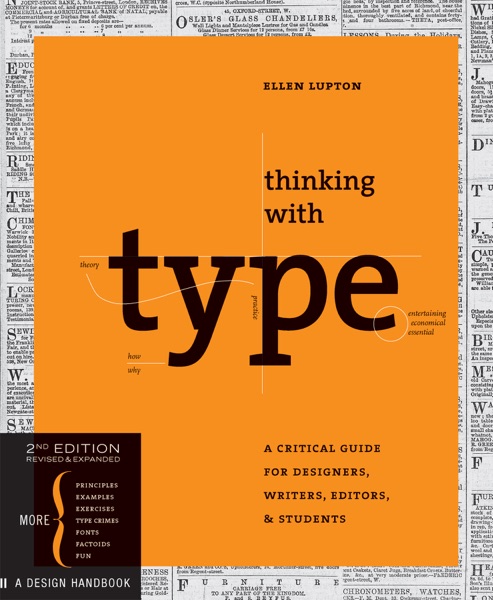
Thinking with Type by Ellen Lupton is a 2004 self-help book about typography, visual communication, graphic design. Typography is not decoration added to content — it is a fundamental part of how written language communicates. Every typographic decision affects meaning.
Summary
Thinking with Type is Ellen Lupton's critical guide to typography — not as a catalog of fonts, but as a discipline for thinking about how written language takes visual form. Lupton, a designer and curator at Cooper Hewitt, structures the book around three categories: letter, text, and grid. Each section covers a different scale of typographic decision-making, from the anatomy of an individual letterform to the large structural systems that organize a page or screen.
The letter section covers the history of type and the vocabulary for describing typefaces — serif, sans-serif, x-height, baseline, counter, aperture — not as trivia but as tools for noticing what makes different typefaces communicate differently. Lupton is interested in why certain typefaces feel authoritative or playful, intimate or institutional, and in how those associations were built up through specific historical uses. The text section moves to how type organizes into readable sequences: spacing, leading, column width, hierarchy. These are the decisions most readers never consciously notice, but they determine whether a body of text feels inviting or exhausting.
The grid section is the most structurally ambitious. Lupton argues that the grid is not a constraint but a generative device — it creates a framework of relationships that makes complex layouts coherent without making them rigid. The best typographic grids, she shows, are broken strategically. Understanding what the grid expects makes it possible to violate it with purpose.
Throughout, Lupton alternates between historical analysis and practical prescription, and the book's design is its own argument: the layout demonstrates the principles it describes. The second edition (2010) expanded the content for screen typography, which dates it less badly than earlier typography texts that assumed only print. Thinking with Type is an unusual combination — genuinely educational for novices and still useful for working designers who want a more rigorous vocabulary for decisions they already make by feel.
Talk to Thinking with Type like its author wrote you back.
Get the ideas that fit your life — not generic summaries.
- Chat with the book
- Audiobook-style main ideas
- Adapts to your life and goals
- Helps you take action
Key takeaways
- 1.
Typography is not decoration added to content — it is a fundamental part of how written language communicates. Every typographic decision affects meaning.
- 2.
The vocabulary for describing typefaces (x-height, aperture, counter, weight, width) is not trivia. It gives you precise language for articulating why a choice works or doesn't.
- 3.
Hierarchy is the most important concept in text design. Readers scan before they read; hierarchy tells them what level of attention to give each element.
- 4.
Line length (measure) has a direct effect on readability. Too wide and the eye loses its return path; too narrow and it creates excessive hyphenation and difficult rhythm.
- 5.
The grid is a generative system, not a prison. Understanding what a grid expects is what makes it possible to break it in ways that create tension rather than chaos.
- 6.
Spacing — letter-spacing, word-spacing, line-spacing — is as important as typeface selection. Poor spacing degrades an excellent typeface; good spacing improves a mediocre one.
- 7.
Type history is practical knowledge. Understanding why certain typefaces were designed for specific contexts explains what they still communicate today.
Discussion questions
Use these on your own, with a book club, or as chat starters in Superbook. Book club version, ready to copy or print →
- 1.
Lupton argues that typography is part of how language means, not just decoration applied to it. Can you identify a piece of writing where the typography changed how you understood the content?
- 2.
The book covers letter, text, and grid as three scales of typographic decision. Which of the three do you find you pay most attention to in your own work?
- 3.
She describes the grid as generative rather than restrictive. What other design constraints do you find work the same way — enabling rather than limiting?
- 4.
Lupton is both a practitioner and a historian. Does the historical context she provides change how you think about the typefaces in everyday use around you?
- 5.
Hierarchy is central to the text section. Think of a recent piece of design you found confusing. Was hierarchy the problem?
- 6.
The book is itself typographically designed to demonstrate its principles. Did you notice that as you read, and did it help or distract?
- 7.
Type spacing — leading, kerning, tracking — is mostly invisible when it's done well. Have you ever been in an environment where you noticed bad spacing? What made it visible?
- 8.
The grid section argues that knowing the rules makes breaking them legible. Is that principle specific to typography, or does it apply more broadly?
- 9.
Lupton writes about the associations that accumulate around typefaces through historical use. Which typeface has the strongest cultural associations for you, and what are they?
- 10.
The book was first published in 2004. Screen typography has changed dramatically since then. Which principles translate directly and which feel like print-era assumptions?
- 11.
If typography shapes how written language means, what responsibilities does that place on designers who work with public communication?
Themes
Frequently asked questions
-
What is Thinking with Type about?
Ellen Lupton's guide to typography as a design discipline — covering letterforms, text layout, and grid systems — written to give both students and working designers a more rigorous vocabulary for the decisions they make on every project.
-
Is Thinking with Type worth reading for non-designers?
Yes, particularly for writers, editors, or anyone who produces documents and presentations. Understanding basic typographic principles changes how you see and evaluate the visual presentation of text, not just how you create it.
-
How long is Thinking with Type?
It's a designed book with many images and short text blocks — around 224 pages. At average pace it reads in two to three hours, though most readers spend longer because the visual examples invite slow looking.
-
What edition of Thinking with Type should I read?
The second edition (2010) is the better choice. It expanded the original with new content on screen typography and digital tools. A third edition published in 2023 updated it further for contemporary practice.
-
What's the most useful idea in Thinking with Type?
The concept of hierarchy: that readers scan before they read, and typographic hierarchy is what guides that scanning. Understanding hierarchy explains most of why some layouts feel clear and others feel chaotic, regardless of how good the individual typefaces are.