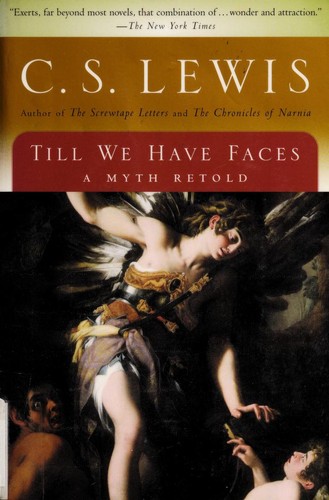
Till We Have Faces by C.S. Lewis is a 1956 literary fiction book about jealousy and love, self-knowledge and self-deception, the silence of the gods. The novel argues that love and possession can be psychologically identical from the inside — Orual's devotion to Psyche is real, and it is also a form of smothering ownership.
Summary
Till We Have Faces is C.S. Lewis's retelling of the myth of Cupid and Psyche, narrated by Orual — Psyche's older, plain-faced sister — who opens the novel with a formal complaint against the gods. Orual's account is her indictment: she loved Psyche faithfully and without limit, she did everything she could to protect her, and the gods repaid that love with cruelty and silence. It is a compelling and seemingly airtight case. Lewis spends the rest of the novel slowly, carefully dismantling it.
The book works in a register unusual for Lewis, who is better known for allegory and argument than for psychological realism. Here the central subject is self-deception — specifically, the way love can become a form of ownership, and how thoroughly the self can construct an honest-seeming account of its own motives that omits the ones it cannot bear to see. Orual is not a villain. She is worse: a woman who genuinely believes her own story, and whose suffering is real, but whose suffering has been inflicted on others as much as on herself.
The second part of the novel, brief and structurally jarring to some readers, abandons the first-person indictment and delivers the answer. Lewis is not being coy about whether the gods are real or whether Psyche's divine palace existed; the book believes in them. What changes in Part Two is Orual's capacity to see herself clearly, which is what the title announces: you cannot see the gods, or be seen by them, until you have a face — until you know what you actually are.
This is Lewis's own favorite among his books, and the critical consensus has moved substantially toward his position over the decades. It is harder than Narnia, more theologically demanding than Mere Christianity, and more honest about the ugliness of even sincere love than almost anything else he wrote. Readers who come expecting the accessible Lewis of the space trilogy or the children's books should prepare for something grittier. Readers who can handle a narrator who is unreliable in ways she doesn't know will find this one of the most searching accounts of self-knowledge in twentieth-century fiction.
Talk to Till We Have Faces like its author wrote you back.
Get the ideas that fit your life — not generic summaries.
- Chat with the book
- Audiobook-style main ideas
- Adapts to your life and goals
- Helps you take action
Key takeaways
- 1.
The novel argues that love and possession can be psychologically identical from the inside — Orual's devotion to Psyche is real, and it is also a form of smothering ownership.
- 2.
Self-deception in the book is not lying but a genuine inability to see; Orual constructs a coherent, sympathetic narrative that excludes the evidence that would indict her.
- 3.
Lewis uses the Cupid and Psyche myth to investigate the problem of divine silence — the gods don't explain themselves, which can be indifference or can be something more demanding.
- 4.
The title's central claim is that you cannot speak to or be known by anything beyond yourself until you have achieved a degree of self-knowledge — until you have a face rather than a mask.
- 5.
The plain-faced Orual and the beautiful Psyche are not simple contrasts; the plainness is partly internal, a projection of Orual's self-loathing onto her relationship with her sister.
- 6.
Part Two's structural break is intentional: the book cannot arrive at truth through the same narrative mode that has been building a beautiful lie, so the mode has to change.
- 7.
Lewis is more psychologically nuanced here than in any of his other work; the Fox's Stoic rationalism, Bardia's practical soldiering, and the priest's devotion are all treated as partial accounts of the same problem.
- 8.
The complaint against the gods is never fully answered in argument; it is answered by Orual's transformation, which is a kind of answer that argument cannot provide.
Discussion questions
Use these on your own, with a book club, or as chat starters in Superbook. Book club version, ready to copy or print →
- 1.
Orual's complaint against the gods is presented at length and in detail. Is it a good argument? Where does it fail, and when did you first notice the failure?
- 2.
Lewis was a Christian apologist writing a pagan myth. Does the novel work as a story independent of its theological argument, or does it require belief to fully function?
- 3.
Orual loved Psyche genuinely and also smothered her. Can those both be true? Does the novel resolve the tension, or leave it as a genuine moral complexity?
- 4.
The Fox is a Stoic philosopher whose rationalism Orual relies on throughout her life. How does the book judge him — fairly or harshly?
- 5.
Psyche is a somewhat opaque character compared to Orual — more symbolic than psychological. Is that appropriate for the story, or a weakness?
- 6.
Part Two is brief and tonally different from Part One. Did the shift work for you, or did it feel like Lewis interrupting his own novel to deliver the answer?
- 7.
The gods' silence is the book's central problem. Lewis doesn't argue that the silence is pedagogically useful — he shows it. Is that a more honest approach than direct argument?
- 8.
Orual builds a career, rules a kingdom, and earns the respect of enemies and allies — and is also a psychological mess throughout. Does worldly success and inner disorder feel true to life?
- 9.
The book ends with Orual accepting the judgment on herself. Is that acceptance tragic, liberating, or some combination that doesn't have a clean name?
- 10.
Lewis said this was the book he was most satisfied with. Why do you think he felt that way, given that his more popular books are more accessible?
- 11.
How does this version of the Cupid and Psyche myth compare to the original? What does Lewis change, and what do those changes reveal about his argument?
- 12.
The novel asks whether you can love something without consuming it. Do you think it answers the question, and what is the answer?
Themes
Frequently asked questions
-
Is Till We Have Faces hard to read?
Harder than Lewis's other fiction, yes. The first-person narration requires the reader to notice what Orual cannot or will not see, which demands active attention. The prose is clear, but the argument is dense and cumulative. It rewards rereading more than most of Lewis's other books.
-
Do I need to know the Cupid and Psyche myth beforehand?
A basic familiarity helps — Orual's narrative departs significantly from the Apuleius version and knowing the original makes the departures legible. But Lewis provides enough context that it functions without prior knowledge.
-
Is this a Christian novel?
The theology is pagan, not Christian, but the underlying questions — divine silence, love and possession, self-knowledge as a precondition for genuine encounter with the divine — are ones Lewis returns to throughout his Christian writing. It works as a standalone story; it also repays reading alongside Lewis's apologetics.
-
Who shouldn't read Till We Have Faces?
Readers who dislike unreliable narrators, who want action-driven plots, or who find Lewis's later Christian work off-putting may struggle. This is a patient, psychological novel about internal states, not external events.
-
Why is it less well known than Lewis's other work?
It was his last novel and lacks the accessibility of Narnia or the directness of his apologetics. Critics didn't appreciate it immediately. Its reputation has grown substantially since the 1980s and it is now widely regarded among scholars as his most accomplished fiction.