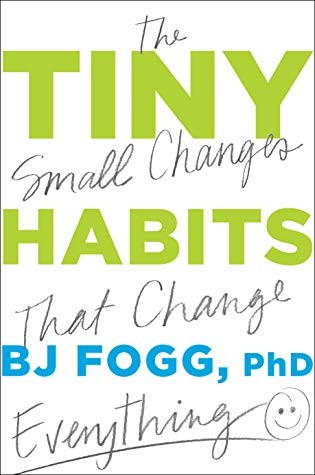
Talk to Tiny Habits: The Small Changes That Change Everything like its author wrote you back.
Get the ideas that fit your life — not generic summaries.
- Chat with the book
- Audiobook-style main ideas
- Adapts to your life and goals
- Helps you take action
Tiny Habits: The Small Changes That Change Everything, in detail
Tiny Habits is BJ Fogg's distillation of more than two decades of research at Stanford's Behavior Design Lab. The central argument is that motivation is an unreliable engine for lasting change. People fail at habits not because they lack willpower or drive but because they aim too big, too fast, and rely on fleeting motivation spikes to carry them through. Fogg's solution is to make behaviors so small they require almost no motivation at all, anchor them to existing routines, and then celebrate immediately when you do them.
The book is built around Fogg's Behavior Model: behavior happens when motivation, ability, and a prompt converge at the same moment. Most habit advice focuses on boosting motivation. Fogg argues this is the hardest lever to pull. Ability is far easier to manipulate — shrink the behavior until it is trivial to perform. A habit is not "meditate for twenty minutes every morning." It is "take one breath after I sit down at my desk." That single breath is a real habit in the model, and once it's reliable, it can grow. The anchor-tiny behavior-celebration sequence Fogg calls a "recipe," and the book is full of them.
Celebration is the element most readers find counterintuitive. Fogg argues that emotions, not repetition, wire habits into place. When you feel good immediately after a behavior — a small internal "yes," a fist pump, whatever registers as genuine for you — the brain tags that behavior as worth repeating. Waiting for the outcome to feel good (the weight loss, the promotion) keeps the reward too distant. Celebration closes the loop immediately. Fogg's research suggests this works whether the behavior takes two seconds or two minutes.
Where Fogg parts most clearly from other habit writers is on self-criticism. He is explicit that shame and guilt do not produce lasting behavior change. They produce avoidance. The book's tone is correspondingly forgiving — almost gentle for a productivity title. This has a practical edge: if you miss a habit, the prescription is to shrink it further, not to double down on willpower. Some readers will find this liberating; others may find the emotional framing soft. The framework has real gaps — it is most useful for adding behaviors, less developed for eliminating deeply entrenched ones, and the celebration mechanics can feel awkward to implement for people unused to self-affirmation. But as a practical system for building the first reliable version of a new behavior, it is one of the most carefully grounded approaches available.
The big ideas
- 1.
Motivation is unreliable. Fogg's Behavior Model holds that behavior happens when motivation, ability, and a prompt converge — and ability (making it easier) is the most controllable variable.
- 2.
Tiny is a feature, not a compromise. A habit that takes two seconds and requires no motivation is still a real habit, and real habits can grow.
- 3.
Anchor every new behavior to an existing one. The formula is: After I [existing anchor], I will [tiny new behavior]. The anchor provides the prompt automatically.
