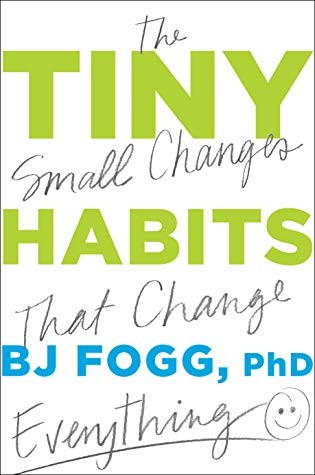
Tiny Habits: The Small Changes That Change Everything by BJ Fogg is a 2019 self-help book about habits, behavior change, motivation. Motivation is unreliable. Fogg's Behavior Model holds that behavior happens when motivation, ability, and a prompt converge — and ability (making it easier) is the most controllable variable.
Summary
Tiny Habits is BJ Fogg's distillation of more than two decades of research at Stanford's Behavior Design Lab. The central argument is that motivation is an unreliable engine for lasting change. People fail at habits not because they lack willpower or drive but because they aim too big, too fast, and rely on fleeting motivation spikes to carry them through. Fogg's solution is to make behaviors so small they require almost no motivation at all, anchor them to existing routines, and then celebrate immediately when you do them.
The book is built around Fogg's Behavior Model: behavior happens when motivation, ability, and a prompt converge at the same moment. Most habit advice focuses on boosting motivation. Fogg argues this is the hardest lever to pull. Ability is far easier to manipulate — shrink the behavior until it is trivial to perform. A habit is not "meditate for twenty minutes every morning." It is "take one breath after I sit down at my desk." That single breath is a real habit in the model, and once it's reliable, it can grow. The anchor-tiny behavior-celebration sequence Fogg calls a "recipe," and the book is full of them.
Celebration is the element most readers find counterintuitive. Fogg argues that emotions, not repetition, wire habits into place. When you feel good immediately after a behavior — a small internal "yes," a fist pump, whatever registers as genuine for you — the brain tags that behavior as worth repeating. Waiting for the outcome to feel good (the weight loss, the promotion) keeps the reward too distant. Celebration closes the loop immediately. Fogg's research suggests this works whether the behavior takes two seconds or two minutes.
Where Fogg parts most clearly from other habit writers is on self-criticism. He is explicit that shame and guilt do not produce lasting behavior change. They produce avoidance. The book's tone is correspondingly forgiving — almost gentle for a productivity title. This has a practical edge: if you miss a habit, the prescription is to shrink it further, not to double down on willpower. Some readers will find this liberating; others may find the emotional framing soft. The framework has real gaps — it is most useful for adding behaviors, less developed for eliminating deeply entrenched ones, and the celebration mechanics can feel awkward to implement for people unused to self-affirmation. But as a practical system for building the first reliable version of a new behavior, it is one of the most carefully grounded approaches available.
Talk to Tiny Habits: The Small Changes That Change Everything like its author wrote you back.
Get the ideas that fit your life — not generic summaries.
- Chat with the book
- Audiobook-style main ideas
- Adapts to your life and goals
- Helps you take action
Key takeaways
- 1.
Motivation is unreliable. Fogg's Behavior Model holds that behavior happens when motivation, ability, and a prompt converge — and ability (making it easier) is the most controllable variable.
- 2.
Tiny is a feature, not a compromise. A habit that takes two seconds and requires no motivation is still a real habit, and real habits can grow.
- 3.
Anchor every new behavior to an existing one. The formula is: After I [existing anchor], I will [tiny new behavior]. The anchor provides the prompt automatically.
- 4.
Emotions wire habits faster than repetition. Celebrating immediately after a behavior — even briefly — tells the brain the behavior is worth repeating.
- 5.
Shame and guilt do not produce lasting change. If a habit keeps failing, the prescription is to shrink it further, not to demand more of yourself.
- 6.
The Fogg Behavior Model (B = MAP) applies in both directions: to design behaviors you want and to understand why unwanted behaviors persist.
- 7.
Motivation waves are temporary. Designing habits to work at low motivation ensures they survive the days when nothing feels compelling.
- 8.
Starting small defeats the planning fallacy. People who begin with the smallest viable version of a habit report higher long-term consistency than those who begin with ambitious targets.
Discussion questions
Use these on your own, with a book club, or as chat starters in Superbook. Book club version, ready to copy or print →
- 1.
Fogg argues motivation is the wrong lever. Which habits have you tried to build by pumping up motivation rather than reducing the effort required?
- 2.
What existing routine in your day is reliable enough to serve as an anchor for a new behavior? What could you attach to it?
- 3.
Pick one habit that has failed repeatedly. How small would it need to be to require almost no motivation to execute?
- 4.
Fogg claims celebration immediately after a behavior is what makes it stick. Does that idea feel natural to you, or does it feel forced? Why?
- 5.
The book distinguishes between aspiration (I want to be fit) and behavior (I will do two push-ups after I brush my teeth). Where in your life are you stuck at the aspiration level?
- 6.
Fogg says shame and guilt about missed habits actively work against change. Which areas of your life have you approached primarily through self-criticism?
- 7.
How do your physical environments either enable or obstruct the behaviors you want? What is one concrete change you could make to your home or workspace?
- 8.
The book is most optimistic about adding new behaviors and less developed on removing entrenched ones. Which bad habits in your life are you most stuck on, and why?
- 9.
Fogg argues that small wins compound. Can you recall an example where a tiny starting behavior eventually grew into something significant?
- 10.
Who in your life models the kind of consistent, low-drama behavior change Fogg describes? What do you notice about how they approach new habits?
- 11.
Fogg draws a clear line between motivation spikes and system design. Where in your work or personal life are you counting on a motivation spike that may not arrive?
- 12.
If you had to design one tiny habit recipe for someone you care about — anchor, tiny behavior, celebration — what would it be and why?
Themes
Frequently asked questions
-
Is Tiny Habits worth reading if you've already read Atomic Habits?
Yes, though they cover adjacent territory. Fogg's model is more mechanistic and rooted in academic research; Clear's is more narrative and motivational. Fogg's emphasis on celebration as the wiring mechanism and his explicit rejection of shame-based approaches add something Atomic Habits doesn't develop at length. Reading both rewards the overlap.
-
How long does it take to read Tiny Habits?
Around five hours at average reading pace. The book is 304 pages and conversational in style. The middle chapters, which go deep on the celebration mechanic and walk through dozens of recipe examples, are the densest and reward slow reading.
-
What is the core idea of Tiny Habits?
Behavior change fails when it depends on motivation. Fogg's system anchors tiny new behaviors to existing routines and uses immediate celebration to wire them in. Make it small enough to require no motivation, attach it to something you already do, and celebrate the moment you complete it.
-
Who should read Tiny Habits?
People who have tried habit-building approaches that relied on discipline or motivation and found them inconsistent. Particularly useful for anyone who feels stuck in a pattern of ambitious starts and early dropoff, or who wants a research-grounded model rather than motivational advice.
-
What is Fogg's Behavior Model?
B = MAP: behavior happens when motivation, ability, and a prompt are all present at the same moment. Most habit advice targets motivation. Fogg argues that ability — making the behavior easier to do — is far more reliable to engineer, and that prompts (anchors) ensure the behavior gets triggered reliably.
Similar books
Tiny Habits vs.
Deciding between two books? Tiny Habits vs Atomic Habits .
