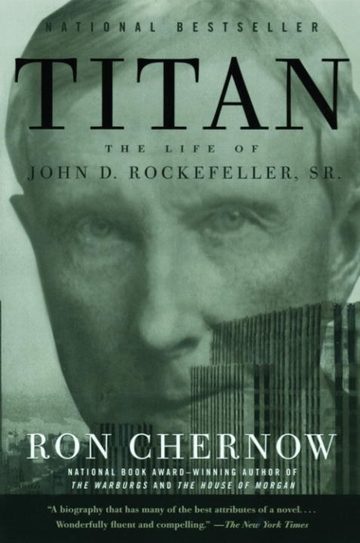
Talk to Titan: The Life of John D. Rockefeller Sr. like its author wrote you back.
Get the ideas that fit your life — not generic summaries.
- Chat with the book
- Audiobook-style main ideas
- Adapts to your life and goals
- Helps you take action
Titan: The Life of John D. Rockefeller Sr., in detail
Ron Chernow's Titan, published in 1998, is the definitive biography of John D. Rockefeller Sr. — the man who built Standard Oil, became the first billionaire in American history, gave away half his fortune, and lived to ninety-seven, outlasting almost every contemporary and rival. The book is both a life and a study of the Gilded Age: the period from the Civil War through the early twentieth century when American capitalism took the form we still recognize, and when the question of what a corporation could do went largely unanswered.
Chernow reconstructs Rockefeller's childhood in a destabilized family — his father William was a traveling confidence man who bigamously married another woman while Rockefeller's mother raised five children on intermittent support — and shows how that childhood produced a man of extraordinary self-discipline, secrecy, and religiosity. Rockefeller attended church three times on Sundays throughout his life and kept meticulous account books from the age of sixteen, treating money as a sacred trust. These weren't separate aspects of his character; Chernow shows they were fused.
The Standard Oil sections are the core of the book and among the most detailed accounts of nineteenth-century business practice available. Rockefeller's method — secret railroad rebates, the gradual absorption of competitors, the use of front companies to conceal Standard's reach — was not simply ruthless but systematically intelligent. He identified the oil industry's central problem (wildly unstable prices from overproduction and cutthroat competition) and solved it through control, at an enormous cost to competitors and ultimately to the public. The 1911 Supreme Court breakup of Standard Oil ended his active business career but crystallized his reputation.
The second half of the book covers the decades of philanthropy that followed — the founding of the University of Chicago, the Rockefeller Institute for Medical Research, and eventually the Rockefeller Foundation — alongside the public relations campaign to rehabilitate his image. Chernow treats the philanthropy as genuine, rooted in deep religious conviction, while refusing to let it excuse the methods of accumulation. It is a portrait of a man of genuine moral seriousness who used that seriousness to rationalize actions that caused widespread harm.
The big ideas
- 1.
Rockefeller identified the real problem in the early oil industry as instability — ruinous price competition — and solved it through control. His ruthlessness was systematic, not impulsive.
- 2.
Secret railroad rebates were Standard Oil's most powerful early tool: by negotiating lower shipping rates than competitors could get, Rockefeller could undercut prices and acquire rivals on his own terms.
- 3.
His religious conviction was genuine and constant, not performative: he attended church obsessively, tithed from his first paycheck, and believed wealth was a God-given stewardship requiring careful management.
