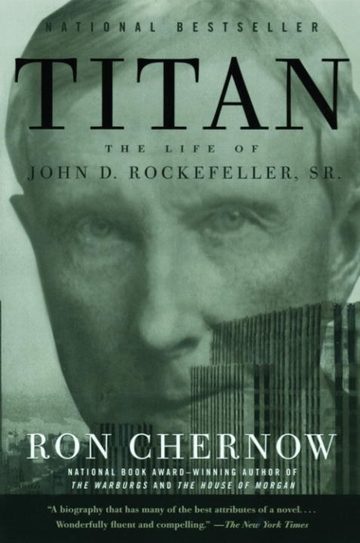
Titan: The Life of John D. Rockefeller Sr. by Ron Chernow is a 1998 biography book about business history, monopoly and capitalism, philanthropy. Rockefeller identified the real problem in the early oil industry as instability — ruinous price competition — and solved it through control. His ruthlessness was systematic, not impulsive.
Summary
Ron Chernow's Titan, published in 1998, is the definitive biography of John D. Rockefeller Sr. — the man who built Standard Oil, became the first billionaire in American history, gave away half his fortune, and lived to ninety-seven, outlasting almost every contemporary and rival. The book is both a life and a study of the Gilded Age: the period from the Civil War through the early twentieth century when American capitalism took the form we still recognize, and when the question of what a corporation could do went largely unanswered.
Chernow reconstructs Rockefeller's childhood in a destabilized family — his father William was a traveling confidence man who bigamously married another woman while Rockefeller's mother raised five children on intermittent support — and shows how that childhood produced a man of extraordinary self-discipline, secrecy, and religiosity. Rockefeller attended church three times on Sundays throughout his life and kept meticulous account books from the age of sixteen, treating money as a sacred trust. These weren't separate aspects of his character; Chernow shows they were fused.
The Standard Oil sections are the core of the book and among the most detailed accounts of nineteenth-century business practice available. Rockefeller's method — secret railroad rebates, the gradual absorption of competitors, the use of front companies to conceal Standard's reach — was not simply ruthless but systematically intelligent. He identified the oil industry's central problem (wildly unstable prices from overproduction and cutthroat competition) and solved it through control, at an enormous cost to competitors and ultimately to the public. The 1911 Supreme Court breakup of Standard Oil ended his active business career but crystallized his reputation.
The second half of the book covers the decades of philanthropy that followed — the founding of the University of Chicago, the Rockefeller Institute for Medical Research, and eventually the Rockefeller Foundation — alongside the public relations campaign to rehabilitate his image. Chernow treats the philanthropy as genuine, rooted in deep religious conviction, while refusing to let it excuse the methods of accumulation. It is a portrait of a man of genuine moral seriousness who used that seriousness to rationalize actions that caused widespread harm.
Talk to Titan: The Life of John D. Rockefeller Sr. like its author wrote you back.
Get the ideas that fit your life — not generic summaries.
- Chat with the book
- Audiobook-style main ideas
- Adapts to your life and goals
- Helps you take action
Key takeaways
- 1.
Rockefeller identified the real problem in the early oil industry as instability — ruinous price competition — and solved it through control. His ruthlessness was systematic, not impulsive.
- 2.
Secret railroad rebates were Standard Oil's most powerful early tool: by negotiating lower shipping rates than competitors could get, Rockefeller could undercut prices and acquire rivals on his own terms.
- 3.
His religious conviction was genuine and constant, not performative: he attended church obsessively, tithed from his first paycheck, and believed wealth was a God-given stewardship requiring careful management.
- 4.
The Standard Oil breakup in 1911 paradoxically made Rockefeller richer: the thirty-four successor companies were worth more separately than the consolidated trust, and he owned shares in all of them.
- 5.
His philanthropy was strategic and evidence-based, particularly in medicine: the Rockefeller Institute funded genuine scientific research at a time when American medicine was largely pre-scientific.
- 6.
Chernow argues that Rockefeller was a transitional figure: his methods were those of a mid-nineteenth-century entrepreneur operating in an environment with no antitrust law, and his philanthropic legacy helped define the twentieth-century American model of institutional giving.
- 7.
The family legacy was managed through successive generations with its own contradictions: John D. Rockefeller Jr. spent decades managing the public image and the philanthropic infrastructure his father created, while dealing with the psychological weight of the name.
- 8.
Ida Tarbell's exposé in McClure's Magazine (1902–1904) — the first major piece of American investigative journalism — is a presence throughout the book, and Chernow takes its evidence seriously without endorsing all of its framing.
Discussion questions
Use these on your own, with a book club, or as chat starters in Superbook. Book club version, ready to copy or print →
- 1.
Rockefeller believed he was solving a real problem — the destructive instability of the oil industry — through consolidation. Is that a credible defense of monopoly formation, or does the method invalidate the justification?
- 2.
His childhood with a bigamous, unreliable father seems to have produced both his legendary discipline and his capacity for secrecy and deception. How much explanatory weight should biography place on early experience?
- 3.
Rockefeller is both the archetypal robber baron and one of the great philanthropists in American history. Can those two things be reconciled, or are they essentially separate?
- 4.
Chernow writes with evident admiration for Rockefeller's organizational intelligence while being clear about the harm caused. Is that balance appropriate? Or does it risk rehabilitating someone who shouldn't be?
- 5.
Standard Oil's practices — secret rebates, front companies, absorption of competitors — were legal at the time. How should we evaluate business behavior that was legal but is now understood as damaging?
- 6.
The Rockefeller Foundation's early focus on public health and medical research had enormous positive effects — particularly the campaign against hookworm in the American South. Does institutional philanthropy of that kind carry legitimacy independent of its source?
- 7.
Ida Tarbell's journalism destroyed Standard Oil's public standing. What does that episode tell us about the role of the press in holding corporate power accountable?
- 8.
Rockefeller's descendants — particularly John D. Jr. and the generation that followed — spent their lives in the shadow of an enormous legacy. What does the book suggest about the effects of extreme wealth across generations?
- 9.
Standard Oil was broken up into thirty-four successor companies that eventually became Exxon, Mobil, Chevron, and others. Has the breakup achieved what the antitrust regulators intended?
- 10.
Chernow spent years on this research. The biography is nearly 800 pages. What does that investment of time and depth make possible in a biography? What are the limits of the form?
- 11.
The Gilded Age produced both the Standard Oil trust and the progressive movement that fought it. Are there contemporary analogues to both sides of that conflict?
- 12.
Rockefeller's religious practice seemed entirely genuine and entirely compartmentalized from his business practice. Is that compartmentalization common among people of intense ambition and genuine belief?
Themes
Frequently asked questions
-
How long is Titan by Ron Chernow?
The book is approximately 800 pages and takes most readers fifteen to twenty hours to finish. It is a thorough biography, not a fast read, but the prose is clear and the story is propulsive enough that most readers who start it continue.
-
Is Titan worth reading if I'm interested in business history?
Yes — it is probably the best available account of how a nineteenth-century American industrial monopoly was built and operated, written with access to sources that earlier biographies didn't have. The Standard Oil sections are detailed enough to serve as genuine business history, not just biography.
-
Does Titan rehabilitate Rockefeller?
No, though Chernow is clearly interested in him as a full human being rather than a caricature. The book documents the harm caused by Standard Oil's practices while also taking seriously Rockefeller's genuine religious conviction and the scale and quality of his philanthropy. It complicates the robber-baron narrative without dismissing it.
-
What is the most surprising thing in Titan?
For many readers, the depth of Rockefeller's religious practice. He tithed from his first paycheck at sixteen, attended church multiple times every Sunday for his entire life, and spoke about wealth in explicitly theological terms. Chernow argues this was not performative but entirely sincere.
-
Who should read Titan?
Anyone interested in American business history, the Gilded Age, or the origins of modern philanthropy. It is also a useful read for people thinking about the regulation of corporate power, since the Standard Oil story is the original case study in American antitrust history.