Business · Book club
Tools and Weapons book club questions
Here are 12 book club questions for Tools and Weapons by Brad Smith & Carol Ann Browne, ordered to open easily and end somewhere worth arguing about. Copy them, print them, or bring them up one at a time.
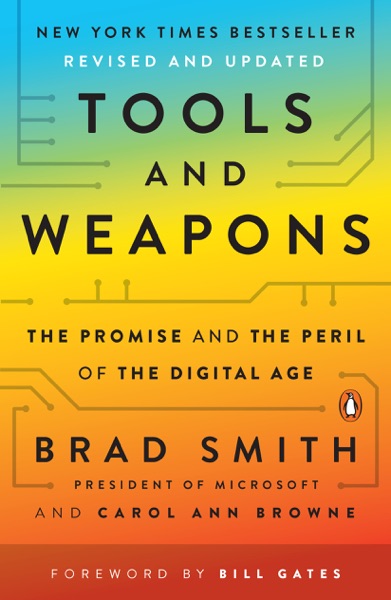
Tools and Weapons is Microsoft President Brad Smith's account of the technology policy and ethical dilemmas that major tech companies face in the contemporary world.
Brad Smith & Carol Ann Browne · 2019 · 6h 20m
Full summary and key takeaways →The 12 questions
- 1.
Smith argues that tech companies must engage with governments rather than resist all regulation. Is that a genuine ethical position or a strategic calculation to preserve industry influence over the regulatory process?
- 2.
The book documents Microsoft's response to government requests for user data. How should a company weigh its obligations to users against legal obligations to governments in authoritarian countries?
- 3.
Smith makes the case for a digital Geneva Convention to govern cyberwarfare. What would enforcement look like, and which actors would need to be at the table to make it effective?
- 4.
Facial recognition appears in the book as the technology Smith is most concerned about. Given what has happened since 2019, was that concern accurate?
- 5.
The book was written by a sitting executive about his own company. How much does that context limit what can be said, and where do you sense the limits of candor?
- 6.
Tools and Weapons argues that tech companies have become de facto governance actors. Is that a problem to be solved or an inevitability to be managed?
- 7.
Smith describes the 2017 NotPetya attack as a case where a state-sponsored weapon escaped its intended target and caused global collateral damage. What obligations does a government have when its offensive cyber tools cause harm beyond the intended target?
- 8.
The book suggests that the Silicon Valley libertarian tradition — technology as inherently democratizing and resistant to government control — is inadequate for the current moment. Do you agree?
- 9.
What would a genuine partnership between tech companies, governments, and civil society look like in practice? What would each party have to give up?
- 10.
Smith's prescription for AI governance is to slow deployment until regulatory frameworks are in place. Is that realistic given competitive pressures, or does it require the kind of international coordination that has historically been difficult to achieve?
- 11.
The digital divide discussion in the book is less developed than the security chapters. Why do you think that issue received less space, and what does that tell us about where industry attention is focused?
- 12.
If you were advising a government regulator responsible for AI governance today, which three issues from this book would you treat as most urgent?
How to run the discussion
- Pick six to eight, not all of them. An hour of real discussion covers fewer questions than anyone expects, and racing the list is what makes a book club feel like homework.
- Open with what people noticed, not what they concluded. Asking for a verdict first hardens opinions before anyone has heard each other.
- Let the disagreement run. The questions below that split a room are the ones worth the time; the ones everyone answers the same way can be skipped.
- Ask the quiet person a specific question. A direct, narrow question is far easier to answer than an open invitation to contribute.
Themes worth steering toward
If the conversation stalls, these are the threads that usually restart it.
Common questions
What are good book club questions for Tools and Weapons?
Here are 12 book club questions for Tools and Weapons by Brad Smith & Carol Ann Browne, ordered to open easily and end somewhere worth arguing about. The strongest openers ask what each reader noticed rather than what they concluded, and the discussion usually turns on technology policy, digital ethics, privacy.
How long should a book club discussion of Tools and Weapons last?
Most groups run 60 to 90 minutes of actual discussion. That is roughly six to eight questions, not all of them, so pick the ones that suit your group rather than working down the list in order.
What are the main themes in Tools and Weapons?
Technology policy, Digital ethics, Privacy, Artificial intelligence, Corporate responsibility. Those are the threads most likely to divide a room, which makes them the useful places to steer a discussion that has gone quiet.
Picking the next one? See books like Tools and Weapons or questions for other book club picks.
