Self-help · Book club
Ultralearning book club questions
Here are 12 book club questions for Ultralearning by Scott Young, ordered to open easily and end somewhere worth arguing about. Copy them, print them, or bring them up one at a time.
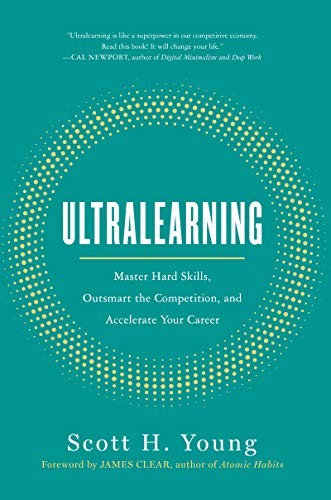
Ultralearning is Scott Young's synthesis of principles drawn from his own extreme learning projects — completing MIT's four-year computer science curriculum in one year, learning four languages in a year, and other aggressive self-directed learning experiments — and from the academic research on skill acquisition and deliberate practice.
Scott Young · 2019 · 5h 0m
Full summary and key takeaways →The 12 questions
- 1.
Young completed MIT's four-year CS curriculum in one year. What assumptions about how long learning takes does your own approach carry? Are those assumptions accurate?
- 2.
Think of a skill you've been trying to build for a long time without significant progress. Which of Young's nine principles is most absent from your current approach?
- 3.
Directness means practicing in the context of use, not in a proxy. Where in your current skill-building are you practicing a proxy instead of the real thing?
- 4.
When did you last deliberately test yourself on something you're learning, rather than reviewing or watching? What did you discover about what you actually retained?
- 5.
Young argues that the discomfort of retrieval practice is a signal of learning, not of failure. How do you typically respond to the feeling of struggling to recall something?
- 6.
What is a skill that, if you developed it to a high level in the next year, would most change your professional or personal situation?
- 7.
The metalearning principle says to research how to learn before you start. Have you ever done this systematically? What would a metalearning session for your current learning goal look like?
- 8.
Young's projects — MIT curriculum, four languages — are extreme. What would a less extreme but still intentional ultralearning project look like for you this year?
- 9.
The drill principle isolates weak components and attacks them specifically. What is the weakest component of the most important skill you're currently developing?
- 10.
He argues that passive learning — re-reading, re-watching — feels productive but produces shallow retention. Where in your learning life are you most prone to passive approaches?
- 11.
What environmental or scheduling change would most enable you to run a dedicated learning block each day?
- 12.
Young updated his thinking after feedback from research communities. How important is intellectual humility in a book about learning? Does it affect your trust in the framework?
How to run the discussion
- Pick six to eight, not all of them. An hour of real discussion covers fewer questions than anyone expects, and racing the list is what makes a book club feel like homework.
- Open with what people noticed, not what they concluded. Asking for a verdict first hardens opinions before anyone has heard each other.
- Let the disagreement run. The questions below that split a room are the ones worth the time; the ones everyone answers the same way can be skipped.
- Ask the quiet person a specific question. A direct, narrow question is far easier to answer than an open invitation to contribute.
Themes worth steering toward
If the conversation stalls, these are the threads that usually restart it.
Common questions
What are good book club questions for Ultralearning?
Here are 12 book club questions for Ultralearning by Scott Young, ordered to open easily and end somewhere worth arguing about. The strongest openers ask what each reader noticed rather than what they concluded, and the discussion usually turns on learning, skill acquisition, self-education.
How long should a book club discussion of Ultralearning last?
Most groups run 60 to 90 minutes of actual discussion. That is roughly six to eight questions, not all of them, so pick the ones that suit your group rather than working down the list in order.
What are the main themes in Ultralearning?
Learning, Skill acquisition, Self-education, Deliberate practice, Mastery. Those are the threads most likely to divide a room, which makes them the useful places to steer a discussion that has gone quiet.
Picking the next one? See books like Ultralearning or questions for other book club picks.
