Biography · Book club
Unbroken: A World War II Story of Survival, Resilience, and Redemption book club questions
Here are 12 book club questions for Unbroken: A World War II Story of Survival, Resilience, and Redemption by Laura Hillenbrand, ordered to open easily and end somewhere worth arguing about. Copy them, print them, or bring them up one at a time.
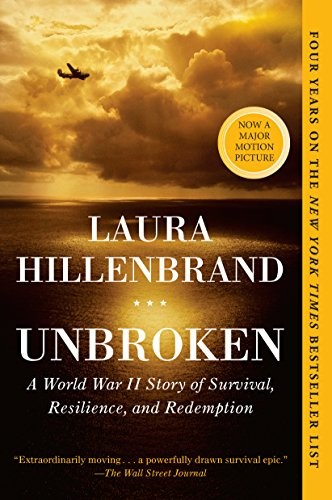
Unbroken follows Louis Zamperini from his juvenile delinquency in Depression-era California to the 1936 Berlin Olympics, where he ran the 5,000 meters at nineteen and briefly caught Hitler's attention.
Laura Hillenbrand · 2010 · 8h 45m
Full summary and key takeaways →The 12 questions
- 1.
Hillenbrand spends considerable time on Zamperini's pre-war life. How much does knowing who he was before the crash affect how you read the survival sections?
- 2.
What sustained Zamperini on the raft when the rational case for survival had largely collapsed? Was it will, habit, luck, or something else?
- 3.
Watanabe singled Zamperini out specifically because of his Olympic status. What does that suggest about why authoritarian systems often target high-profile individuals first?
- 4.
The book argues that Zamperini's identity as a runner helped keep him alive. Is there an identity you carry that you think would serve you in an extreme situation?
- 5.
Hillenbrand describes the post-war years as in some ways harder than captivity. Why do you think reentry into ordinary life is so difficult for people who have survived extreme trauma?
- 6.
Zamperini eventually converted to Christianity and credited that conversion with his recovery. How did Hillenbrand handle this part of the story, and did her approach feel honest to you?
- 7.
The Bird was never prosecuted after the war. How did you react to that, and what does Zamperini's decision to try to meet him anyway tell you about what Zamperini was after?
- 8.
Hillenbrand wrote most of this book while severely ill and largely housebound. Does knowing that change how you read the book, or is it irrelevant to the work itself?
- 9.
Survival stories often get read as instruction manuals: here is what toughness looks like. Does Unbroken support that reading, complicate it, or refuse it?
- 10.
Think of someone in your own life who has survived something serious. What, if anything, did they carry through it that helped them?
- 11.
The book ends with Zamperini at ninety-seven, having outlived most of his captors. Does the length of his life feel like a form of justice, or does that framing seem too neat?
- 12.
Hillenbrand uses meticulous research to reconstruct events no living witness fully remembered. What are the limits of that kind of narrative reconstruction, and did you trust it?
How to run the discussion
- Pick six to eight, not all of them. An hour of real discussion covers fewer questions than anyone expects, and racing the list is what makes a book club feel like homework.
- Open with what people noticed, not what they concluded. Asking for a verdict first hardens opinions before anyone has heard each other.
- Let the disagreement run. The questions below that split a room are the ones worth the time; the ones everyone answers the same way can be skipped.
- Ask the quiet person a specific question. A direct, narrow question is far easier to answer than an open invitation to contribute.
Themes worth steering toward
If the conversation stalls, these are the threads that usually restart it.
Common questions
What are good book club questions for Unbroken: A World War II Story of Survival, Resilience, and Redemption?
Here are 12 book club questions for Unbroken: A World War II Story of Survival, Resilience, and Redemption by Laura Hillenbrand, ordered to open easily and end somewhere worth arguing about. The strongest openers ask what each reader noticed rather than what they concluded, and the discussion usually turns on survival, resilience, war.
How long should a book club discussion of Unbroken: A World War II Story of Survival, Resilience, and Redemption last?
Most groups run 60 to 90 minutes of actual discussion. That is roughly six to eight questions, not all of them, so pick the ones that suit your group rather than working down the list in order.
What are the main themes in Unbroken: A World War II Story of Survival, Resilience, and Redemption?
Survival, Resilience, War, Redemption, Identity, Forgiveness. Those are the threads most likely to divide a room, which makes them the useful places to steer a discussion that has gone quiet.
Picking the next one? See books like Unbroken: A World War II Story of Survival, Resilience, and Redemption or questions for other book club picks.
