Talk to Universal Principles of Design like its author wrote you back.
Get the ideas that fit your life — not generic summaries.
- Chat with the book
- Audiobook-style main ideas
- Adapts to your life and goals
- Helps you take action
Universal Principles of Design, in detail
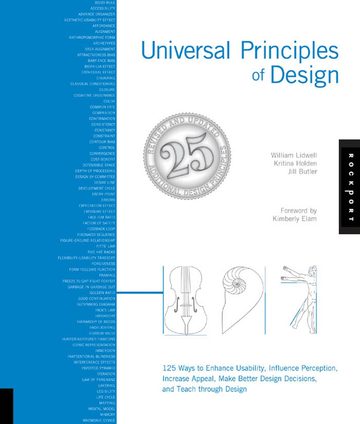
Universal Principles of Design is a reference book organized as an encyclopedia: 125 design principles, each given a two-page spread with a clear definition, a visual example, and a brief note on application. The range is deliberately wide, spanning cognitive psychology (mental models, cognitive load, signal-to-noise ratio), perceptual phenomena (figure-ground relationship, closure, Gestalt principles), behavioral design (affordances, feedback, nudges), aesthetic principles (golden ratio, symmetry, alignment), and usability heuristics. No single principle dominates — the book argues that good design draws on multiple disciplines simultaneously.
The organizing idea is that design is not primarily a matter of taste or inspiration but of applied knowledge. There are patterns of how human beings perceive, process, and respond to things that operate consistently across cultures and contexts, and designers who understand those patterns can apply them deliberately rather than rediscovering them by trial and error. The book's ambition is to make that knowledge portable across disciplines — graphic design, industrial design, architecture, software interfaces, environmental design — by abstracting it into transferable principles.
The format has real strengths. Because each principle is self-contained and cross-referenced, the book works as a browsing resource as much as a text to be read sequentially. A designer can open it to "Fitts's Law" or "The Aesthetic-Usability Effect" or "Chunking" and find a concise, illustrated account that is immediately applicable. The visual examples are well-chosen across editions — architectural, typographic, industrial, and digital examples sit alongside each other, reinforcing the book's claim to universality.
The limitation is the same as the strength: the encyclopedic format produces breadth at the cost of depth. Each entry is a starting point rather than a complete account, and some principles are given the same two-page treatment as others that are much more complex. Readers who want rigorous theoretical grounding will need to go to the source texts — the book's bibliography is a useful guide. But as a shared reference for design teams, a survey of what has been learned across disciplines, and a tool for giving names to intuitions that practitioners often already have, it is hard to beat.
The big ideas
- 1.
Good design is applied knowledge, not taste. The patterns of human perception, cognition, and behavior are consistent enough to be codified and applied deliberately.
- 2.
The aesthetic-usability effect describes a real tendency: people perceive more attractive designs as easier to use, even when they aren't. Aesthetics is not separate from function — it affects how function is experienced.
- 3.
Cognitive load is the primary constraint in interface and communication design. The amount of mental processing a design requires directly affects whether people can and will use it.
