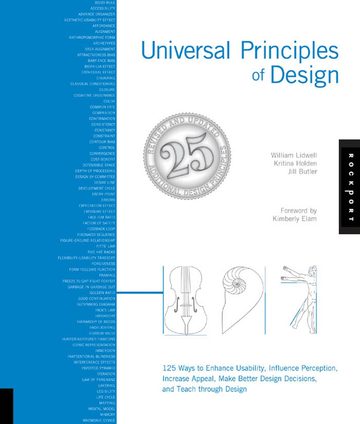
Universal Principles of Design by William Lidwell, Kritina Holden, and Jill Butler is a 2003 science book about design principles, human factors, visual communication. Good design is applied knowledge, not taste. The patterns of human perception, cognition, and behavior are consistent enough to be codified and applied deliberately.
Summary
Universal Principles of Design is a reference book organized as an encyclopedia: 125 design principles, each given a two-page spread with a clear definition, a visual example, and a brief note on application. The range is deliberately wide, spanning cognitive psychology (mental models, cognitive load, signal-to-noise ratio), perceptual phenomena (figure-ground relationship, closure, Gestalt principles), behavioral design (affordances, feedback, nudges), aesthetic principles (golden ratio, symmetry, alignment), and usability heuristics. No single principle dominates — the book argues that good design draws on multiple disciplines simultaneously.
The organizing idea is that design is not primarily a matter of taste or inspiration but of applied knowledge. There are patterns of how human beings perceive, process, and respond to things that operate consistently across cultures and contexts, and designers who understand those patterns can apply them deliberately rather than rediscovering them by trial and error. The book's ambition is to make that knowledge portable across disciplines — graphic design, industrial design, architecture, software interfaces, environmental design — by abstracting it into transferable principles.
The format has real strengths. Because each principle is self-contained and cross-referenced, the book works as a browsing resource as much as a text to be read sequentially. A designer can open it to "Fitts's Law" or "The Aesthetic-Usability Effect" or "Chunking" and find a concise, illustrated account that is immediately applicable. The visual examples are well-chosen across editions — architectural, typographic, industrial, and digital examples sit alongside each other, reinforcing the book's claim to universality.
The limitation is the same as the strength: the encyclopedic format produces breadth at the cost of depth. Each entry is a starting point rather than a complete account, and some principles are given the same two-page treatment as others that are much more complex. Readers who want rigorous theoretical grounding will need to go to the source texts — the book's bibliography is a useful guide. But as a shared reference for design teams, a survey of what has been learned across disciplines, and a tool for giving names to intuitions that practitioners often already have, it is hard to beat.
Talk to Universal Principles of Design like its author wrote you back.
Get the ideas that fit your life — not generic summaries.
- Chat with the book
- Audiobook-style main ideas
- Adapts to your life and goals
- Helps you take action
Key takeaways
- 1.
Good design is applied knowledge, not taste. The patterns of human perception, cognition, and behavior are consistent enough to be codified and applied deliberately.
- 2.
The aesthetic-usability effect describes a real tendency: people perceive more attractive designs as easier to use, even when they aren't. Aesthetics is not separate from function — it affects how function is experienced.
- 3.
Cognitive load is the primary constraint in interface and communication design. The amount of mental processing a design requires directly affects whether people can and will use it.
- 4.
Fitts's Law states that the time to reach a target is a function of the target's size and distance. This single principle has enormous implications for interface design: buttons should be large and close to where they are needed.
- 5.
The Gestalt principles — proximity, similarity, continuity, closure, figure-ground — describe how visual systems group elements. Designers who understand these can guide perception; those who don't will fight it.
- 6.
Affordances are the perceived properties of an object that suggest how it should be used. When affordances are wrong or absent, errors follow — not because users are careless but because the design failed.
- 7.
Design principles across disciplines share more than practitioners usually acknowledge. The principles governing a physical product, a graphic layout, and a software interface are often the same principle in different materials.
Discussion questions
Use these on your own, with a book club, or as chat starters in Superbook. Book club version, ready to copy or print →
- 1.
The book argues that design is applied knowledge rather than taste or inspiration. Does that framing feel accurate to your experience as a designer or as a user of designed things?
- 2.
Which of the 125 principles have you encountered most often in your work, and which have been most useful when you've applied them explicitly?
- 3.
The aesthetic-usability effect suggests that attractive design is perceived as more functional. Does that create a problem — are there situations where it leads users astray?
- 4.
Fitts's Law has been enormously influential in interface design. Can you think of interfaces you use regularly where it's been applied well, and others where it's been ignored?
- 5.
The book spans graphic design, industrial design, architecture, and software. Does the claim to universality hold up, or do some principles feel more discipline-specific than the format implies?
- 6.
Affordances — the perceived properties that suggest use — are central to good product design. What's an example of a badly designed affordance you encounter regularly?
- 7.
The encyclopedic format means each principle gets two pages. Which principles felt underexplained, and which felt well-served by the concision?
- 8.
The Gestalt principles describe how visual systems group things automatically. How consciously do you apply that knowledge when you design, or does it operate mostly as intuition?
- 9.
The book has been revised several times. What principles do you think have been added correctly in newer editions, and what gaps remain?
- 10.
Cognitive load reduction is one of the book's recurring themes. Where do you see cognitive load problems in things you use or make, and what would it take to fix them?
- 11.
The book is used in design education as well as professional practice. What's the difference between learning these principles in school and applying them under real project constraints?
Themes
Frequently asked questions
-
Is Universal Principles of Design a textbook or a reference?
Both, depending on how you use it. In design education it is often used as a supplementary textbook. In professional practice it works as a reference — you look up a principle when you need it, rather than reading sequentially. The format supports both uses.
-
Which edition should I get?
The revised and updated editions add principles and improve examples. The most recent edition available is generally the best choice. If you're primarily interested in interaction design, some practitioners find the Revised and Expanded version with digital examples more immediately applicable.
-
How much prior design knowledge do I need to get something from this book?
Very little. Each principle is explained from first principles with illustrated examples. That said, practitioners with field experience will find the principles connect more immediately to real decisions they have to make. It is useful at any level.
-
What is the most useful principle in the book?
Readers answer this differently depending on their discipline. Interface designers often cite Fitts's Law or Cognitive Load. Graphic designers often cite Gestalt principles or the Golden Ratio. Product designers often cite Affordances or Feedback. The breadth is the point — the most useful principle is usually the one you weren't applying.
-
Is this book only for professional designers?
No. Engineers, product managers, architects, writers, and anyone who makes things that other people use will find it useful. The principles are stated abstractly enough to apply across contexts, and the examples are drawn from many fields.
Similar books
The Design of Everyday Things
Donald Norman

Interaction of Color
Josef Albers
Designing Your Life
Bill Burnett and Dave Evans

Intuition Pumps and Other Tools for Thinking
Daniel Dennett
